
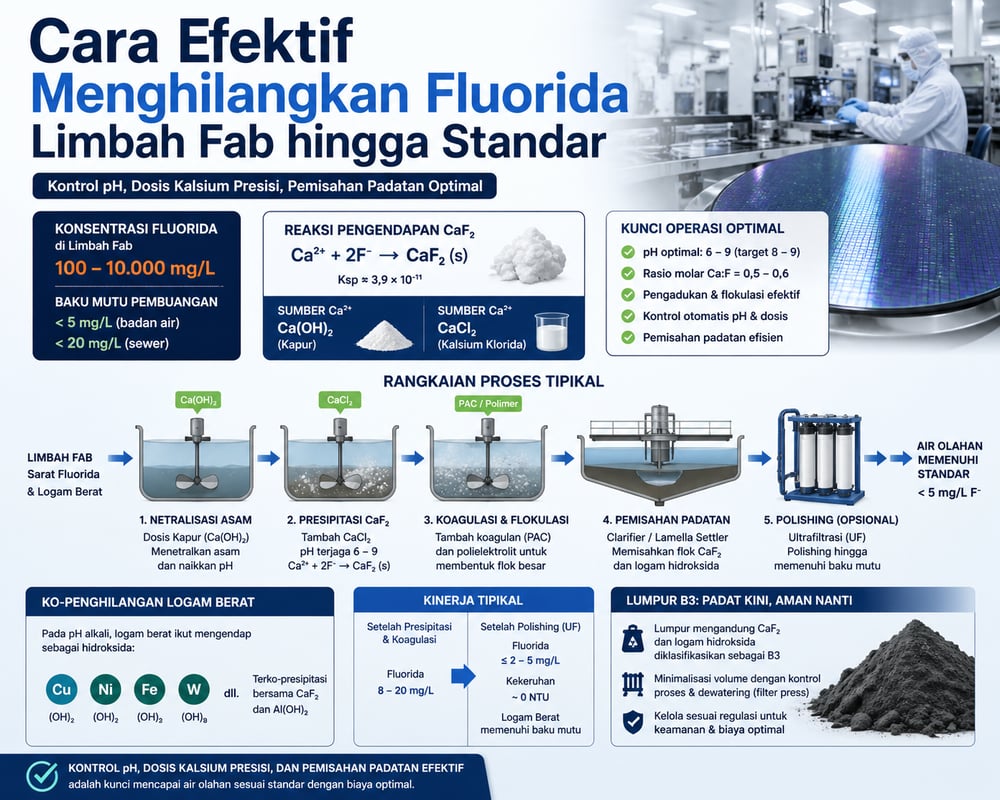
Semiconductor wastewater can carry 100–10,000 mg/L fluoride; sewer and aquatic limits are orders of magnitude lower. Plants are turning to calcium precipitation — and wrestling with the calcium fluoride sludge it leaves behind.
In the microelectronics industry, fluoride-laden rinse water from hydrofluoric acid (HF) etches routinely measures in the hundreds to thousands of mg/L (milligrams per liter), with typical ranges around 100–10,000 mg/L according to industry guidance (www.saltworkstech.com).
Regulators demand far less: sewer limits often below 20 mg/L and aquatic discharge limits below 5 mg/L — in some jurisdictions, even below 2 mg/L (www.saltworkstech.com) (www.sciencedirect.com). Heavy metals including tungsten (W), copper (Cu), nickel (Ni), and silver (Ag) are frequent co-contaminants; treated semiconductor effluents have been observed with dissolved tungsten up to ~0.4 mg/L — far above natural background — alongside elevated Cu, Ga, Ag, etc. (www.sciencedirect.com). Indonesia’s Permen/PP standards similarly restrict heavy metals to µg-levels (micrograms per liter) and fluoride to low mg/L, necessitating robust treatment.
The standard response on the fab floor: precipitate fluoride as calcium fluoride (CaF₂) with lime or calcium chloride, dial in pH, then separate the fine solids — and prepare for a lot of sludge.
Calcium fluoride precipitation chemistry
The primary industrial approach is CaF₂ precipitation using calcium salts. Calcium ions (Ca²⁺) react with fluoride (F⁻) to form poorly soluble CaF₂ according to Ca²⁺ + 2 F⁻ → CaF₂(↓), with solubility product Ksp≈3.9×10⁻¹¹ (Ksp is the equilibrium solubility product constant) (pubs.acs.org).
Lime (Ca(OH)₂) both neutralizes acid and supplies Ca²⁺; CaCl₂ supplies Ca²⁺ without strongly shifting pH. High-fluoride loads often use both: lime to neutralize pH, plus CaCl₂ to ensure soluble Ca²⁺ availability. In practice, a molar Ca:F ratio around 0.5 (stoichiometric for CaF₂) to ~0.6 performs best. One industrial case treating 1,800 mg/L F⁻ with CaCl₂ at Ca:F = 0.5 and pH ≈8.5 achieved 99.5% removal and ~10 mg/L F⁻ effluent (pubs.acs.org). Lab work likewise shows an optimal Ca/F around 0.6: Sinharoy et al. (2024) reported ~85% removal at Ca/F ≈0.6, with little improvement beyond that (www.mdpi.com).
pH control is critical. If pH is too low (<~3–4), much fluoride exists as undissociated HF (pKa≈3.2, where pKa is the acid dissociation constant) and precipitation is suppressed. At very high pH, hydroxide competes and Ca²⁺ tends to form Ca(OH)₂ or CaCO₃ instead of CaF₂ (www.mdpi.com). Moderately alkaline pH (typically pH 6–9) is optimal. One study showed removal rose with pH up to ∼6 and then declined (81.8% at pH 6; lower at pH >8 due to Ca(OH)₂ formation) (www.mdpi.com). Industrial systems often target pH~8–9 to maximize F⁻/Ca²⁺ precipitation and floc growth (pubs.acs.org) (www.mdpi.com).
Mixing, coagulation, and solids separation
CaF₂ crystals are very fine and slow-settling (www.saltworkstech.com). Settling alone often leaves tens of mg/L F⁻. Chang & Liu (2007) found Ca:F=0.5 at pH 6.5–8.5 could reduce F to ~15 mg/L, but additional flocculants — poly‑aluminum chloride (PAC) or organic polyelectrolytes — were needed to fully settle CaF₂ (www.researchgate.net).
Industry guidance points to a two-step approach: first lime/CaCl₂ dosing to precipitate most fluoride (effluent ~8–20 mg/L), then an aluminum-based coagulant to polish below 5 mg/L (www.saltworkstech.com). Plants often dose an aluminum coagulant such as PAC using a controlled dosing pump and follow with polymers from flocculants to improve capture.
Because the fine CaF₂ and Al(OH)₃ flocs settle slowly, sedimentation can demand long detention times and large tanks (www.saltworkstech.com). High-rate clarification with a clarifier or a compact lamella settler can shrink footprint. Modern designs also apply membrane filtration; in one report, combined precipitation–UF (ultrafiltration) achieved final F ~2 mg/L with turbidity ~0 NTU (www.sciencedirect.com), aligning with cross-flow options like ultrafiltration. Over‑dosing lime or coagulant, however, inflates wet sludge volumes (www.saltworkstech.com).
Control strategy: pH and calcium dose
Small deviations in calcium dose can swing removal yields: raising Ca/F from 0.5 to 0.6 increased removal from ~82% to ~85% in one trial (www.mdpi.com). For one industrial case, Ca:F=0.5 and pH 8.5 delivered 99.49% F removal (pubs.acs.org).
Automated pH control and titration-dosing of calcium sources are recommended to hit this narrow optimum and avoid excess reagent use (www.saltworkstech.com) (www.mdpi.com). Plants deploy instruments and metering through dosing pumps, and vendors note that integrated controls can avoid overdosing and large footprints (www.saltworkstech.com) (www.saltworkstech.com).
Chemically, rough dosing ranges are 2–5 g of lime or 3–7 g CaCl₂ per liter of high‑fluoride water (scaling with [F⁻]). For example, reducing 1,800 mg/L F⁻ to ~10 mg/L at Ca/F=0.5 might use ≈5–6 g/L CaCl₂ (pubs.acs.org). With proper controls, >90–99% fluoride removal is routinely reported (pubs.acs.org) (www.mdpi.com).
Heavy‑metal co‑removal and pH profile
Alkaline pH also precipitates many metals as hydroxides (e.g., Cu(OH)₂, Ni(OH)₂, Fe(OH)₃), so the CaF₂ scheme “removes other contaminants such as … cadmium, copper, chromium, lead, mercury, and zinc” (www.saltworkstech.com). Wastewaters from CMP and plating in fabs can carry metals at µg–mg/L levels; dissolved tungsten around 300–400 µg/L has been reported (www.sciencedirect.com).
In practice, an initial pH 7–8 step (Ca dose) traps fluoride, then a rise to pH 9–10 (excess lime) may co‑precipitate residual metals. Over‑liming increases sludge and costs with diminishing returns (www.saltworkstech.com).
System train and performance outcomes
A typical train runs acid neutralization (lime dosing) → CaCl₂ addition (with pH maintained) → mixing/flocculation → solids separation → optional polishing. In large plants, automated feedback dosing (e.g., online F sensors) helps avoid “overdosing and large footprint” drawbacks of open‑loop systems (www.saltworkstech.com) (www.saltworkstech.com). Semiconductor operations need fluorides and therefore face these treatment steps — precipitation, coagulation, and solids separation — as documented in a BNRC 2022 review (bnrc.springeropen.com) (bnrc.springeropen.com).
Conventional Ca precipitation often drives fluoride only to ~5–20 mg/L (www.saltworkstech.com), so polishing is common: aluminum coagulants like PAC can push below 5 mg/L, or plants add membrane polishing with RO systems where needed. Vendors also offer integrated RO, NF, and UF systems for industrial reuse and discharge quality.
Sludge management and disposal
The precipitated CaF₂ sludge is voluminous and water-rich. Treating wastewater with 500–1000 mg/L F⁻ stoichiometrically yields roughly 1–3 g of CaF₂ solid per liter removed. This fine sludge often holds >90% moisture and contains residual hydroxides and adsorbed metals.
Where heavy metals are present, CaF₂ sludge is classified as hazardous (B3) under Indonesian rules (similar worldwide) and shows heavy‑metal leaching risk, requiring stabilization (www.researchgate.net). Without treatment, disposal risks groundwater contamination (e.g., Zn, Ni) and incurs high costs. Dewatering via filter press is needed but difficult; the sludge is gelatinous and poorly dewaters, and conventional thickening is inefficient (www.saltworkstech.com).
Advanced options — cross-flow UF and ballasted sedimentation — can reduce volume (www.saltworkstech.com), aligned with membrane choices like ultrafiltration and dewatering aids under sludge treatment programs. Possible reuse has been explored: incorporating CaF₂‑bearing sludge into ceramics or cements can “fix” fluoride and heavy metals at high temperature, including cement solidification with <10% sludge to immobilize metals and yield structural products (www.researchgate.net) (www.researchgate.net). In practice, most plants send sludge to licensed hazardous landfills. Key challenges remain: ensure final stack solids meet leachability standards, minimize sludge volume, and manage desfluoridation byproduct costs.
Process summary and limits
Calcium precipitation via lime and/or CaCl₂ is the primary method to remove fluoride from semiconductor wastewaters. With optimized pH (~6–9) and Ca:F ratios around 0.5–0.6, >90–99% fluoride removal is routinely reported (pubs.acs.org) (www.mdpi.com). Conventional calcium precipitation commonly reduces fluoride to ~5–20 mg/L (www.saltworkstech.com); careful control or secondary polishing is used to meet low limits (e.g., <5 mg/L), with aluminum coagulants and, where needed, RO polishing. Heavy metals co‑precipitate with CaF₂ flocs — beneficial for compliance but rendering sludge hazardous. Handling fine, metal‑laden CaF₂ slurries — through dewatering and stabilization routes (thermal, cement, or engineered landfill) — dominates lifecycle costs. These steps are consistent with precipitation/coagulation/solids separation flowsheets reviewed for semiconductor wastewater (bnrc.springeropen.com) (bnrc.springeropen.com).
Modern systems emphasize tight chemical control and enhanced solids separation — high‑rate clarifiers, lamella separators, or membrane filtration — to minimize sludge volume (www.saltworkstech.com) (www.saltworkstech.com). With those controls, treatment trains can reliably meet stringent limits, including <5 mg/L fluoride (pubs.acs.org) (www.saltworkstech.com).
References
Semiconductor wastewater often contains 100–10,000 mg/L F (www.saltworkstech.com); precipitation at Ca:F≈0.5 stoichiometry (pH≈8–9) yields ≈99% removal (pubs.acs.org) (www.mdpi.com); standard process yields ~8–20 mg/L F before polishing (www.saltworkstech.com). The calcium fluoride precipitation and coagulation steps produce large sludge volumes and require enhanced separation (www.saltworkstech.com) (bnrc.springeropen.com). Fluoride sludge is hazardous with heavy‑metal leaching risk and must be stabilized (www.researchgate.net). Additional citations: Zhou et al. 2023 (ACS EST Water) (pubs.acs.org); Sinharoy et al. 2024 (IJMS) (www.mdpi.com); Saltworks white paper (2019) (www.saltworkstech.com) (www.saltworkstech.com); Chang & Liu 2007 (J. Environ. Eng.) (www.researchgate.net); BNRC 2022 review (bnrc.springeropen.com) (bnrc.springeropen.com); Wei et al. 2011 (J. Hazard. Mater.) (www.sciencedirect.com).
