

Industry: Cement | Process: Clinker_Cooling_&_Grinding
Modern dry‑process cement plants use on the order of 110–120 kWh of electricity per tonne of cement produced (www.sciencedirect.com). Roughly 60–70% of that electricity is consumed just to grind raw materials and clinker (scielo.org.za) — with about one‑third of total energy going to finish grinding clinker (scielo.org.za). In practical terms, 50 kWh/t or more may be spent in the finish mill and separator alone (www.sciencedirect.com; www.nbmcw.com). One industry source notes ~110 kWh/t overall, with 70% in comminution (~77 kWh/t) (www.nbmcw.com).
Because grinding can account for a large share of plant energy (and cost), reducing mill kWh/t is a high‑leverage efficiency measure. As a point of reference, Indonesian energy standards require modern cement mills to hold electrical use below roughly 100 kWh/t (www.iea.org), versus 110–120 kWh/t in older plants.
Chemistry and mill mechanisms
“Grinding aids” are specialty admixtures added at low dosage (≪1% by weight of clinker) to the mill feed. They are typically polar glycols, alcohols, or amines; common examples include alkanolamines such as mono‑, di‑, or triethanolamine (TEA) and glycols like ethylene or propylene glycol ether derivatives (scielo.org.za). Functionally, the additives act like a dispersant that prevents particle agglomeration — the same phenomenon targeted by industrial dispersants (dispersant chemicals prevent particle agglomeration) — so fines stay free‑flowing, not clumped.
Mechanistically, these molecules adsorb onto fresh cement or clinker surfaces, neutralizing surface charges and reducing van der Waals attraction between particles (www.nbmcw.com; scielo.org.za). As Levine and Das (2016) describe, grinding aids “partially neutralise the charges” and create repulsion or steric hindrance between particles, preventing buildup on balls or liners (www.nbmcw.com). In effect, a thin “lubricant” layer forms on fractured grains that sterically hinders re‑agglomeration; better mill flowability and fewer coatings mean each kWh grinds more material.
Studies also report that grinding aids lower the resistance of clinker to fragmentation and inhibit the electrostatic “sticking” that develops as particle surface energy increases◆ (scielo.org.za). This improves the internal circulation of fine particles, stabilizes the material bed in a vertical roller mill (VRM), and speeds breakage (zaf.sika.com; zaf.sika.com). The additives also diffuse into microcracks during idle periods, hindering crack healing and further preventing particle agglomeration (scielo.org.za).
In practice the main functions are: (a) reduce mill coating and “pearl” formation, (b) broaden the particle size distribution (PSD) for a coarser grind‑track layer, and (c) permit higher circulating load.
Bench tests and VRM case data
Numerous lab and plant studies confirm that adding grinding aids boosts mill productivity and lowers kWh/t. Bench‑scale tests show very significant trends: Hashim & Hussin (2018) found that using optimal additives produced “significant improvement in size distribution” and throughput by “decreasing agglomeration” and reducing ball coating (www.researchgate.net). Literature cites mill efficiency gains on the order of 15–25% from small additions of grinding aid (scielo.org.za). Even a 0.01–0.10% dose can improve performance that much by mitigating agglomeration. In contrast, without aids the grinding efficiency falls rapidly as Blaine fineness (a surface‑area measure) is increased (www.nbmcw.com; scielo.org.za).
Industrial case data are consistent. In a Loesche VRM test, one novel additive (SikaGrind VRM‑40) raised cement throughput by +11% while cutting specific energy by 10% (zaf.sika.com). In that trial, production rose from 143 t/h to 159 t/h and kWh/t fell from 38.0 to 34.2 (–10%) (zaf.sika.com). Even a “standard” triethanolamine blend (SikaGrind‑455) gave +9% output and –8% energy use. Another pilot trial (36 cm Loesche table) found the top grinding aid improved productivity +14%, fineness +12%, and mill vibration –72% compared to no aid (zaf.sika.com).
Quantitatively, typical energy savings or throughput boosts are often in the single‑digit to low‑double‑digit percentages. A survey of grinding aid performance reported throughput gains around 10–20% and energy reductions on the order of 5–10% (scielo.org.za; zaf.sika.com). In cement‑industry terms, cutting 5–10 kWh per tonne is realistic. Even a 5% drop in power (∼5–6 kWh/t) is valuable: at 3 Mt/yr capacity that saves ~15–18 GWh/yr. At $0.10/kWh that’s $1.5M–$1.8M savings.
As one technical summary notes, by facilitating finer grinding with less energy, grinding aids “significantly improve clinker production and fineness while decreasing energy consumption”, cutting both costs and CO₂ emissions (scielo.org.za).
Quality, pack set, and flow
Plants must verify that product quality is maintained (e.g., cement strength, setting time, Blaine fineness). Collateral benefits are often seen: reductions in pack‑set volume and free water demand typically accompany grinding aid use (zaf.sika.com). In one trial, pack‑set (a measure of cement flowability) dropped drastically as fresh fines were more dispersed (zaf.sika.com). Suitable grinding aids raise iron ore/rock industry terms “grinding efficiency” — delivering the same product with less energy or more product with the same energy.
Plant trial protocol and dosing
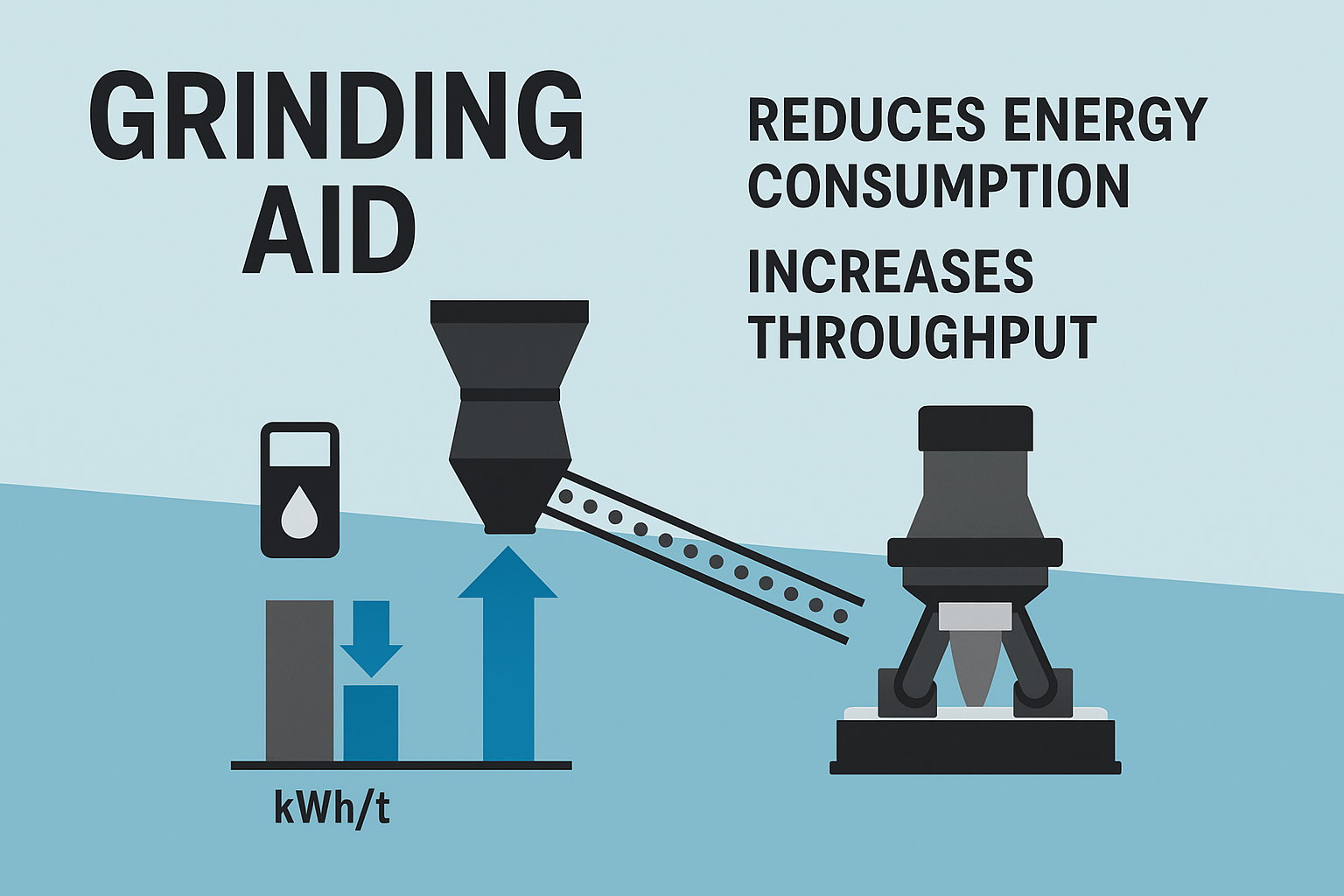
To quantify ROI, a structured plant trial is essential. Baseline data collection comes first: run the mill under steady conditions (constant feed, no new additives) to log power draw (kWh) and throughput (t/h or t/day) at fixed fineness. Record at least 1–2 weeks of data to establish stable averages for specific energy (kWh/t). Also document operating parameters (mill speed/pressure, separator settings, classifier return rate, mill temperature, etc.) and cement quality (Blaine, strength).
A safe‑start “blank” test helps verify reproducibility before dosing, as shown in Sika’s testing (zaf.sika.com). Then introduce the grinding aid — e.g., a glycol–amine blend — at a controlled, low dosage (often 0.02–0.10 wt% of clinker) via spray injection into the mill feed or on the conveyors feeding the mill (www.nbmcw.com). Increase the dose incrementally until a plateau effect is observed, and let the mill run 10–30 minutes after dosing to reach equilibrium. Controlled, low dosage makes accurate chemical dosing important; dedicated equipment such as a dosing pump supports consistency.
Measure performance changes continuously: power, vibration/dynamics, and production. For a fair comparison, either keep production rate constant and watch energy fall, or maintain the same energy input and measure increased tonnage. Alternatively, alternate days or shifts on vs. off. Monitor product fineness/Blaine to ensure cement quality remains within spec. Note reductions in pack set or ventilation draft as additional signals of aid effect.
For data analysis, calculate specific energy (kWh/t) and throughput (t/h) with and without the aid, and normalize for any feed variations. In ball mills, measure circulating load and partition curves if possible; in VRMs, track separator efficiency and pressure drop. Typical desirable results are a measurable drop in kWh/t (for constant output) or higher output (for constant kWh) by the GA day.
ROI math and payback windows
Example ROI calculation: assume a plant running 1 Mt cement/year (≈3,000 t/day) at a baseline 110 kWh/t. A successful trial that shows a 5% energy reduction (≈5.5 kWh/t saved) at unchanged throughput saves ≈5.5 GWh/year. At an industrial power cost of $0.08/kWh, this is ~$440,000/year. The cost of GA chemical, at ~0.05 wt% dose, is on the order of ~$1.00–$2.00 per tonne of cement (dependent on chemistry). For 1 Mt, GA cost is ~$1.5M (assuming $1.50/t). The simple payback implication: for each % of energy saved, the plant saves ~$88,000/year, so a 5% kWh drop returns ~$440k. Net gain then depends on whether that covers the $1.5M GA spend. In practice, GAs often pay for themselves via higher throughput, reduced energy, or cement volume gains — e.g., a +5% throughput at equal energy is a straight 5% volume uplift.
Trial guidelines for managers include: maintain everything else constant (do not change clinker chemistry, grind media, fresh feed moisture, or separator settings during the test; only the GA is varied); run for sufficient duration at each dose (short <1 h spikes are unreliable); include “flush” periods (run without GA to wash out) to ensure changes aren’t due to drift — Sika’s example required ~90 min blank to return to baseline (zaf.sika.com); and record detailed data: motor amps, sieve/blain fineness, mill autumn charge levels, airflow, etc. Even if not used directly in ROI calculations, these diagnostics help confirm improved milling kinetics. Consider multiple dosages — the efficiency vs. dose curve is not linear; beyond an optimum additional GA has diminishing returns, so identify the “knee” in performance. Evaluate cement and concrete performance to confirm that setting times and early strengths are acceptable (some GAs slightly retard hydration or improve strength; this must be accounted for in product specs). In ROI calculation, include both energy and productivity gains (e.g., if GA injection allows a 3% higher mill throughput at the same kWh due to lower circulating load, that incremental cement is additional revenue). Likewise, any reduction in grinding‑bed pack or abortive coating events saves downtime/maintenance.
By systematically comparing baseline vs. GA‑assisted operation, managers can compute net savings. Use conservative assumptions (e.g., exclude possible strength gains) to ensure a robust ROI. In practice, well‑run trials often show payback periods of a few months. If GA lowers kWh/t by 8–10% and/or boosts output by 10% — typical in the field (zaf.sika.com; scielo.org.za) — even a relatively expensive additive can pay for itself quickly.
Decision metrics and documentation
The bottom line: chemical grinding aids often yield quantifiable energy and output improvements. Industry trials demonstrate 8–10% specific‑energy reductions and double‑digit throughput gains (zaf.sika.com; scielo.org.za). Even modest savings (e.g., 2–5 kWh/t) have large aggregate impact in a multi‑million‑ton/year plant. Production managers should pair meter readings with lab quality tests to verify true benefit. By following a structured trial protocol and collecting clear before/after data (kWh/t, throughput, fineness), they can substantiate the ROI. In summary, with careful testing and analysis, installing a grinding aid program has repeatedly proven to cut kWh/ton by single‑digit to low‑double‑digit percentages (zaf.sika.com; scielo.org.za) — a win both economically and environmentally.
Sources and reference context
Peer‑reviewed and industry data (e.g., Genç 2016; Hashim et al. 2018; Zan/Ishak 2023) show grinding aids’ mechanisms and benefits (www.nbmcw.com; scielo.org.za). Manufacturer and case studies (e.g., Sika) document actual energy/throughput effects (zaf.sika.com). International energy reviews and standards provide context on typical cement plant consumption (www.sciencedirect.com; scielo.org.za). All cited data above.