

Industry: Cement | Process: Clinker_Production
Europe’s cement kilns routinely get 40–60% of their heat from alternative fuels (AF) such as biomass, refuse-derived fuel (RDF, processed municipal waste), and tire-derived fuel (TDF) instead of coal or petcoke, according to Global Cement. Indonesia is moving fast too: PT Semen Indonesia used about 0.56 Mt of AF in 2023 (up 27% year over year) and roughly 0.50 Mt in 2024, lifting its thermal substitution rate (TSR, the share of kiln heat from AF) from 7.27% to 7.56% (Kompas; Antara; Republika ESG).
That’s a sharp climb from an estimated national TSR of ~3.4% in 2015–16 (MDPI) and still far from Europe’s ~61% AF usage by 2010 (Global Cement). Recent projects elsewhere report 30–45% TSR and targets of 60% via blends of biomass, RDF and tire chips (Global Cement), and some Asian plants are pressing toward 50–80% substitution through extensive co-processing.
National targets and industry momentum
Indonesia’s environmental regulator has targeted the cement industry to process its own wastes into RDF for AF, explicitly linking kilns to municipal solid-waste absorption (Kompas). Corporate roadmaps echo the push — SIG’s Sustainability Roadmap 2030 calls for higher fossil-fuel substitution (Kompas) — while news from Semen Indonesia highlights a plan to ramp AF and raw-waste inputs (2 Mt in 2024) to cut carbon (Antara). Globally, the direction is similar: GCCA-aligned paths to net-zero cement by 2050 count on fuel substitution, with some Australian sites already at 30–45% TSR and targeting 60% (Global Cement).
Burner and fuel-feeding modifications
Co-processing AF changes combustion physics. Solid wastes and biomass differ in particle size, calorific value (CV, energy per unit mass) and volatility. Industry guidance recommends that solid AF be pneumatically injected very close to the burner tip, with straight, short feed piping to avoid blockages (MDPI). Burner suppliers advise center-injection (or via a concentric sub‑tube), slurry feed-line velocities around 25–40 m/s, and load under 4 kg fuel/kg air; mechanical conveying up to the burner platform is also recommended (MDPI).
Modern AF‑dedicated burners — such as FCT’s Turbu‑jet and ThyssenKrupp’s POLFLAME — use multiple primary-air nozzles and adjustable air channels to accommodate 70–85% AF substitution (MDPI; MDPI). In one commercial plant, a Turbu‑jet upgrade enabled ~70% AF substitution (MDPI). Achieving stable flames requires careful tuning of primary/secondary air splits and swirl intensity: too much excess air or turbulence can quench the flame, while too little drives CO and instability; operators often trim primary air and add swirl ports as AF levels rise (MDPI).
Calciner and preheater adaptations
High-volatility fuels such as RDF and biomass are typically injected into the calciner (a separate combustion chamber for preheating and decarbonation), which offers longer residence time. Tire chips may be co‑fired at the main burner or kiln inlet after shredding. Plants are adding or upgrading calciners to lift substitution; at Cimpor’s Alhandra site, a PyroRotors combustion chamber with a Pyroclon calciner enabled co‑processing and up to 80% TSR (Global Cement; Global Cement).
Multi-stage cyclone preheaters improve heat recovery when CV is lower or moisture is higher. Upgrading from a 4‑stage to a 5‑stage cyclone preheater can lift thermal efficiency from about 60% to roughly 90–95%, with capacity and fan/cooler implications (MDPI; MDPI). In practice, an added 5th stage, more powerful induced‑draft (ID) fans, and a larger cooler help manage higher flue‑gas volumes and temperatures.
Bypass for chlorine and alkalis
Many wastes contain chlorine or alkalis that volatilize at 1,400–1,500°C. Without control, these recirculate, causing coating build‑ups and higher acid gases. Plants firing high‑Cl AF install kiln or calciner bypasses to bleed off gas laden with alkali chlorides, stabilizing clinker chemistry and helping meet HCl limits (Google Patents; Global Cement).
Clinker mineralogy and heavy metals
Clinker chemistry and mineralogy can shift if fuels change ash or halogen inputs, yet studies consistently show that properly managed AF do not degrade cement properties. Heavy metals in AF largely volatilize or end up in kiln dust rather than in the clinker phases, and statistical analyses report no significant difference in Pb, Zn, Cd and other metals between AF and non‑AF clinkers (ResearchGate).
Process engineers still track free lime, LSF (lime saturation factor), silica modulus, and crystal structure to keep within specification (MDPI). High sulfur or alkalis in AF can create voids or liquid‑phase anomalies; to prevent “sulfur flashing,” kilns are kept slightly oxidizing and sulfur‑rich wastes are limited unless counterbalanced by alkalis (MDPI). Practical guidance often caps substitution (especially heavy‑metal‑bearing fuels) at ~30% unless proven safe, with alkali/Cl‑rich wastes managed by the bypass so clinker alkalis stay within standards (MDPI). Where firing conditions and bypasses are well‑tuned, clinkers from 100% new fuels can still meet free‑lime and compressive‑strength specs (MDPI; ResearchGate).
Greenhouse gases and criteria pollutants
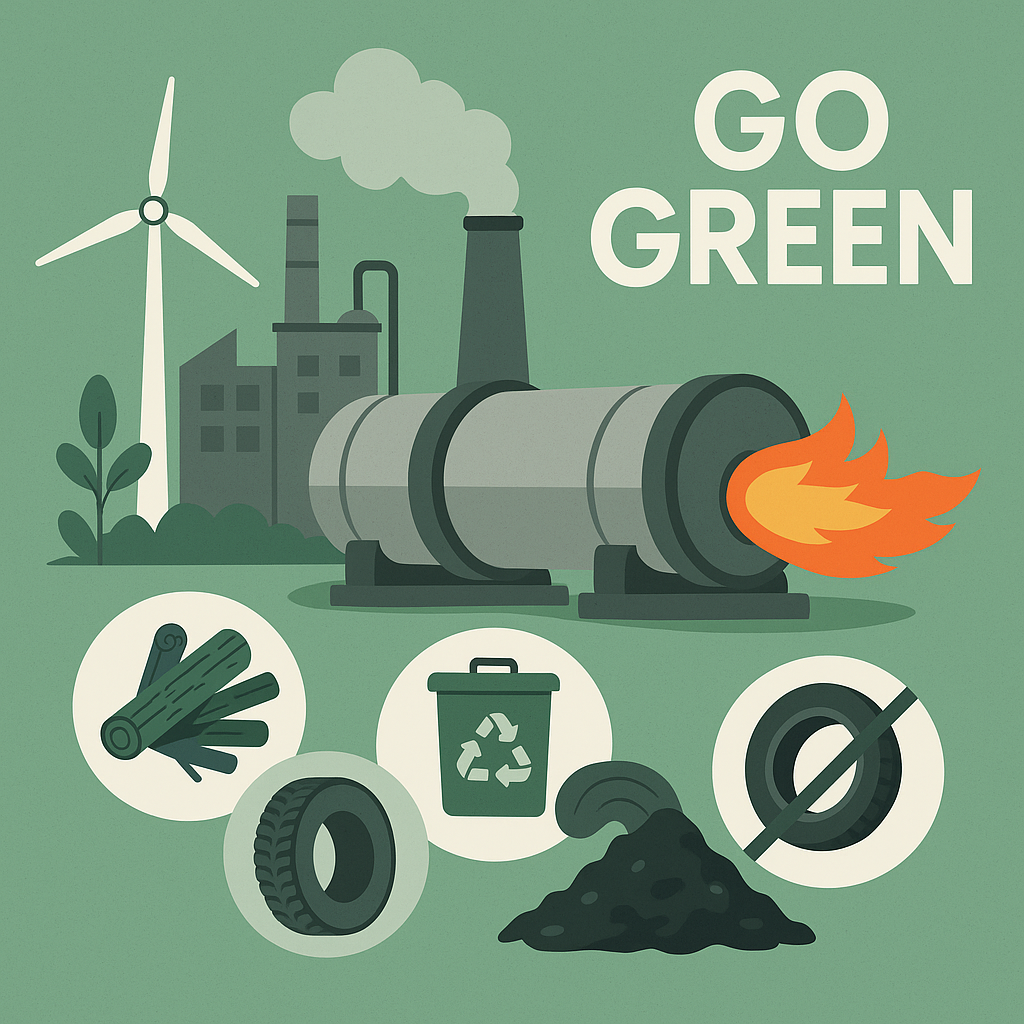
Swapping coal/petcoke for biogenic or waste fuels cuts net CO₂. Biomass, RDF and tire carbon are often counted as biogenic, avoiding fossil emissions. One modeled scenario shows that 50% coal substitution (20% biomass + 80% solid waste) reduced CO₂ by ~160,000 t across multiple plants (MDPI). In Indonesia, Semen Indonesia’s ~0.5 Mt AF in 2024 roughly replaces ~0.4 Mt coal (assuming similar CV), or on the order of 0.4–0.5 Mt CO₂ avoided (≈900 kgCO₂ per tonne coal; sources above: Antara; Kompas). Studies estimate each percent of TSR yields roughly a 0.8–1.0% drop in kiln CO₂ (coal ≈94 kgCO₂/GJ; biomass ~0–30 kg/GJ for dry wood) (ScienceDirect), so lifting TSR from ~7% to 30% could potentially halve fuel‑related kiln emissions.
AF can raise fuel‑bound nitrogen, pushing NOₓ higher; some plants also see slight increases in unburned carbon or CO if combustion is impaired. Large or dense particles may destabilize flame temperature, causing spikes or hot spots (MDPI). Operators retune staged combustion — adjusting tertiary air or injecting reducing gases — to minimize NOₓ, with stack controls like SCR and SNCR remaining applicable (MDPI). Accurate reagent metering supports these systems; plants typically rely on precise equipment such as a dosing pump when implementing SNCR/SCR programs.
Particulates and hazardous emissions are tightly controlled in co‑processing benchmarks. Thanks to high temperatures and long residence times, particulate matter, heavy metals (Cd, Pb, Hg) and dioxins generally remain within limits; volatilized metals tend to re‑condense in dust collection systems (bag filters), and dioxin formation is destroyed in >1,800°C rotary kilns. Still, introduced chlorine, fluorine or sulfur will appear in stack gases unless bypassed (Global Cement). Indonesian standards (Permen LH) set typical limits near PM ≈80–150 mg/Nm³, NOₓ ≈400–800 mg/Nm³ and SO₂ ≈800 mg/Nm³; any rise in CO or VOC signals incomplete AF combustion and triggers process adjustments (MDPI; MDPI).
Retrofit scope and performance outcomes
AF co‑processing can slash fuel costs and CO₂ while demanding tighter operational control. With high‑momentum, multi‑channel burners and modern calciner systems, substitution levels of 70–85% are technically achievable (MDPI; MDPI). Typical retrofits include dedicated pneumatic feeders, new burners, an extra cyclone stage, cooler upgrades, more powerful fans, and alkali/chlorine bypasses (Global Cement; Global Cement).
When engineered correctly, clinker quality remains unchanged — with free‑lime and strength meeting specification — and emissions stay within regulation (MDPI; ResearchGate). A high‑end example — installing a PyroRotor and upgrading to a 5‑stage preheater — delivered an 80% AF rate without loss of clinker quality or compliance (Global Cement).