

Industry: Brewery | Process: Fermentation_&_Maturation
Across the industry, reusing house yeast has become standard operating procedure: many breweries crop and repitch for multiple generations—often 5–10 or more—spreading propagation costs and stabilizing performance (wyeastlab.com; annalsmicrobiology.biomedcentral.com).
The discipline starts with selection: harvest only young, healthy cultures—ideally from the most recent fermentation of a low‑gravity, lightly hopped beer (not high‑ABV or heavily hopped) (wyeastlab.com). Slurry should look thick and creamy and be odor‑free—no phenolic, sulfur, or solvent notes. Any off‑odors or evidence of infection means the slurry is discarded (wyeastlab.com). Yeast harvested from iron‑packed, stressed beers can carry trans‑fer mutation or contamination; brewers test harvested yeast for purity and viability and, if any concerns arise, do not re‑pitch that batch (wyeastlab.com; wyeastlab.com). Consistent harvesting schedules and tight temperature control improve uniformity in cell counts and pitch rates (wyeastlab.com; wyeastlab.com).
Harvest timing and vessel practice
Process varies by tank. In cylindroconical fermenters, fermentation finishes and the tank is chilled (e.g., ≤4 °C), allowing yeast and trub to settle before harvesting a homogeneous bottom yeast fraction (wyeastlab.com). In open or square fermenters, brewers discard the first “dirt skim,” then collect a cleaner second top layer about 24–36 hours after fermentation begins (wyeastlab.com).
Yeast is only harvested from ferments that attenuated and finished with expected body (wyeastlab.com). When using harvested rather than lab‑grown cultures, brewers often adjust pitch rate slightly upward because stored slurry may have lower glycogen/sterol reserves (wyeastlab.com).
Pitch rate targets and by‑volume fallback
Rules of thumb are clear: maintain about 1–2 million viable cells per mL per °Plato (°P; wort sugar concentration) of wort (wyeastlab.com). Example: a 12.5 °P wort (≈1.051 specific gravity, SG) at 1.5×10⁶ cells/mL/°P needs ~1.87×10⁷ cells/mL (wyeastlab.com).
Without lab counts, some breweries pitch by volume/weight: for ales with SG <1.064, roughly 1.0 L (≈1.1 kg) of thick (~40% solids) slurry per 1 BBL (beer barrel), and 2.0 L (≈2.2 kg) per BBL for lagers (wyeastlab.com). In practice, large brews yield tens of kilograms of yeast reused across several batches, with ~5–10 repitches common (wyeastlab.com; annalsmicrobiology.biomedcentral.com).
Quality control and action limits
Repitching programs hinge on rigorous QC: microbial plating or other contamination checks, viability assays, and generation‑by‑generation records (wyeastlab.com). Because cell counts alone may not reveal slow‑growing contaminants, any unusual fermentation profile triggers lab testing (wyeastlab.com). Standardized harvest timing, sanitation, and batch‑to‑batch measurement of cell concentration and purity underpin consistent performance (wyeastlab.com).
Sanitary yeast brink design parameters
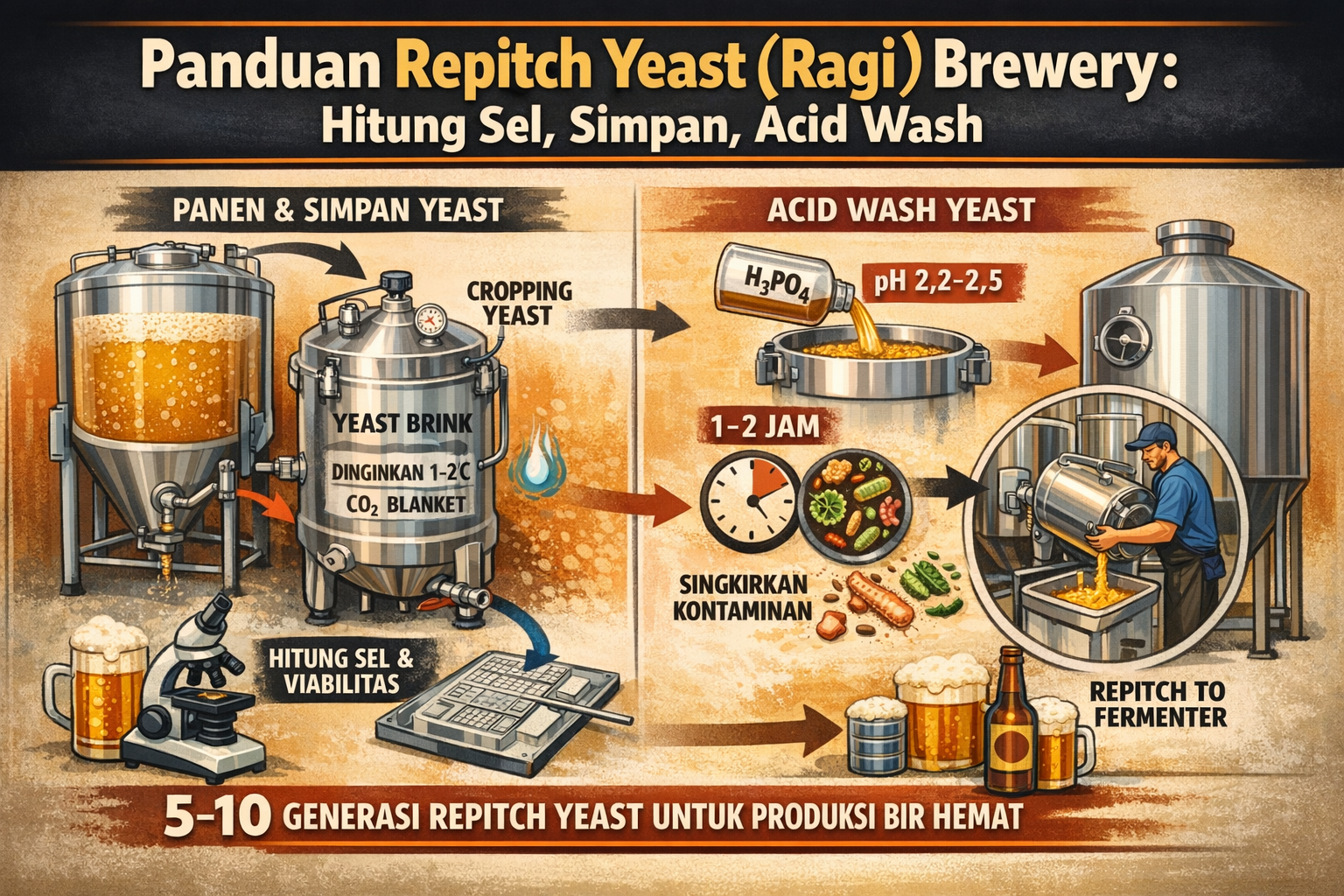
Best practice stores cropped yeast aseptically in purpose‑built “yeast brink” kegs or tanks—pressurized, jacketed stainless vessels that protect sterility and temperature until repitching (frca.paulmueller.com). Construction is food‑grade stainless steel (316L) with polished, crevice‑free interior surfaces (finish #4 or electropolish) to resist bacterial adhesion (frca.paulmueller.com). For reference on hygienic 316L components used in food‑grade service, see stainless steel housings as applied in similar contexts (ss cartridge housings).
Typical brink volumes are ~50–60 L (½ or 1 BBL), sized to daily brew cycles, and rated for moderate pressure (~3–6 bar) for CO₂ flushing and sealed storage (thielmann.com). Key features: a glycol jacket or coil for 1–2 °C storage (thielmann.com; wyeastlab.com); large tri‑clamp manway (8″–10″) or removable lid; a bottom dump (1–2″ tri‑clamp) for gravity pitching; and at least one internal spray ball for clean‑in‑place (CIP; internal circulation cleaning) (craftmasterstainless.com; frca.paulmueller.com).
Modern designs may add an agitator or racking arm to gently re‑suspend yeast for sampling or feeding; Wyeast recommends gentle agitation during acid washing (wyeastlab.com; craftmasterstainless.com). Pressure and temperature gauges with a relief valve support monitoring. Some systems integrate a CO₂ bleed valve and blanketing to minimize oxygen pickup; stainless’s low thermal conductivity helps maintain cold conditions (thielmann.com). Fittings are strictly hygienic—tri‑clamps with FDA‑approved seals, careful welds, no dead legs (frca.paulmueller.com; craftmasterstainless.com).
CIP is non‑negotiable. Breweries often loop the brink into the fermenter’s CIP—recirculating caustic via the bottom port and returning through the top—so the yeast keg is cleaned after each use (craftmasterstainless.com). When selecting a brink, suppliers emphasize ease of cleaning and sanitizer access (craftmasterstainless.com; wyeastlab.com). A decoupled brink allows yeast to sit sealed under CO₂ at ~34–36 °F (1–2 °C) between batches and be flushed and pitched at knock‑in (wyeastlab.com).
Design example: a half‑barrel brink with a rotating arm and dual paddles, an internal CIP spray ball, 1½″ stainless outlet, 8″ top clamp, gauge and relief, and locking casters (craftmasterstainless.com). Such vessels are commonly ASME‑rated (allowing Steam‑in‑Place if desired) with #4 polished interiors to meet food‑contact standards (frca.paulmueller.com; craftmasterstainless.com).
Acid washing protocol and limits
To keep bacterial hitchhikers in check—especially Lactobacilli and Pediococci—many breweries acid‑wash repitch yeast with food‑grade phosphoric acid (H₃PO₄), reducing slurry pH to ~2.1–2.5 (wyeastlab.com; beerandbrewing.com). Some programs use chlorine dioxide (ClO₂) or persulfate + phosphoric acid mixtures (wyeastlab.com; beerandbrewing.com). Standard conditions: hold yeast at ~2–4 °C, gently stir in acid, and hold for 1–2 hours; under these conditions, beneficial yeast remain largely unharmed while many bacteria are killed or inactivated (wyeastlab.com; beerandbrewing.com).
Quantitatively, brewers drive pH to ~2.2–2.5, often by adding dilute H₃PO₄ to ~2.2 and agitating at low temperature for ~90–120 minutes (beerandbrewing.com). Accurate metering supports repeatability in such low‑pH dosing sequences (dosing pump). Some brewers “charge” the slurry with hop acids before re‑pitching to inhibit residual Pediococci, which can survive acid wash (beerandbrewing.com). After washing, yeast is immediately flush‑rinsed with sterile wort or water and pitched; it is not stored post‑wash to avoid loss of vitality (beerandbrewing.com).
Studies show dramatic reductions in lactic bacteria, though a few acid‑tolerant cells may persist (beerandbrewing.com). Yeast health needs monitoring: aged or nutrient‑poor slurries, or those from high‑gravity fermentations, are more vulnerable; pH pushed too low or contact time too long can drop viability, especially in worts >12 °P (beerandbrewing.com). Under standard conditions, however, properly conducted washes leave >90–95% of cells viable (beerandbrewing.com; wyeastlab.com). Brewers treat acid washing “as a life‑saving drug with side effects” and use it only as needed; strong sanitation and limiting repitches (typically <5–10) reduce the need (beerandbrewing.com).
Cell counts and viability methods
Consistent pitch rates begin with measurement. Standard practice is a hemocytometer (counting chamber) with viability staining—dilute slurry, add a vital stain such as methylene blue or methylene violet, and count under a microscope (brewiki.org; wyeastlab.com). Live cells exclude dye (colorless); dead cells stain blue (brewiki.org).
Counting 5–10 large squares yields cells‑per‑mL by:
cells/mL = (average count per square) × dilution factor × 10^4 × (1/volume factor per square)Wyeast’s example: 48 cells in 5 squares at 1:10 dilution with a standard chamber (10^4 μL volume per square, ¾ of each square filled) equates to ~18.0×10^6 cells/mL, matching a ~18.7×10^6 target for a 12.5 °P case; brewers then multiply by slurry volume to compute total cells and adjust pitching so that viable cells meet the target (e.g., 1.5×10^6 cells/mL/°P) (wyeastlab.com).
Viability (%) = unstained ÷ total ×100; programs often require >90–95% for repitching. The methylene blue test over‑estimates viability at low values, so results are most reliable above ~90% (brewiki.org). When in doubt, brewers use fresh propagation. Plate counts (24–48 hours) provide more accurate viability ratios, and fluorescent dyes with automated counters are emerging for high‑throughput labs (brewiki.org; brewiki.org).
Effective viable cells per mL = total count × viability. Breweries log these values by generation and set action limits (e.g., discard yeast if viability <80–90%). During brewing, plating checks for wild yeast or bacteria provide an added safety check (wyeastlab.com).
Measured outcomes and savings
Results are quantifiable. A large brewery repitching a house lager for 10 generations reported no significant dip in viability; skipping fresh propagation saved days and thousands of dollars per year (annalsmicrobiology.biomedcentral.com). One craft case achieved ~20–30% savings on yeast costs with 5–8 reuses.
Integrated brink systems and periodic acid washing have quantitatively kept bacterial contamination below detection in multi‑generational trials (wyeastlab.com; beerandbrewing.com). Routine cell‑count verification has constrained pitch‑rate variance to <5% batch‑to‑batch, producing consistent attenuation (±0.2 °Plato) and flavor profiles. The pattern is consistent: sanitary brinks, targeted acid washing, and precise counts improve yield, cut cost, and protect beer quality (wyeastlab.com; beerandbrewing.com).
Sources embedded inline: Wyeast Technical Center on harvesting, repitching, viability testing, and equipment selection (wyeastlab.com; wyeastlab.com; wyeastlab.com; wyeastlab.com; wyeastlab.com; wyeastlab.com; wyeastlab.com; wyeastlab.com; wyeastlab.com; wyeastlab.com; wyeastlab.com; wyeastlab.com; wyeastlab.com; wyeastlab.com; wyeastlab.com); peer‑reviewed review on repitching performance (annalsmicrobiology.biomedcentral.com; annalsmicrobiology.biomedcentral.com); acid‑wash definitions and parameters (beerandbrewing.com; beerandbrewing.com; beerandbrewing.com; beerandbrewing.com; beerandbrewing.com; beerandbrewing.com); lab methods and caveats (brewiki.org; brewiki.org; brewiki.org); and brink equipment notes and specifications (frca.paulmueller.com; thielmann.com; thielmann.com; craftmasterstainless.com).