

Industry: Brewery | Process: Filtration_&_Carbonation
From centrifuges to crossflow, filtration shapes how beer tastes as much as how it looks. The stakes are practical and sensory: breweries that “pre‑clarify” cold can strip out 70–90% of coarse solids before filters ever see the load, cutting astringency and autolysis risk while protecting aroma (Filtnews; Atlas Copco). Membrane lines, meanwhile, promise the same polish with less oxygen pickup and less waste.
The good news for hop‑forward styles: a peer‑reviewed study reports filtration had little to no measurable impact on hop terpenes, while very tight grades can depress certain fruity esters (MDPI).
Clarification toolkit and pre‑clarification
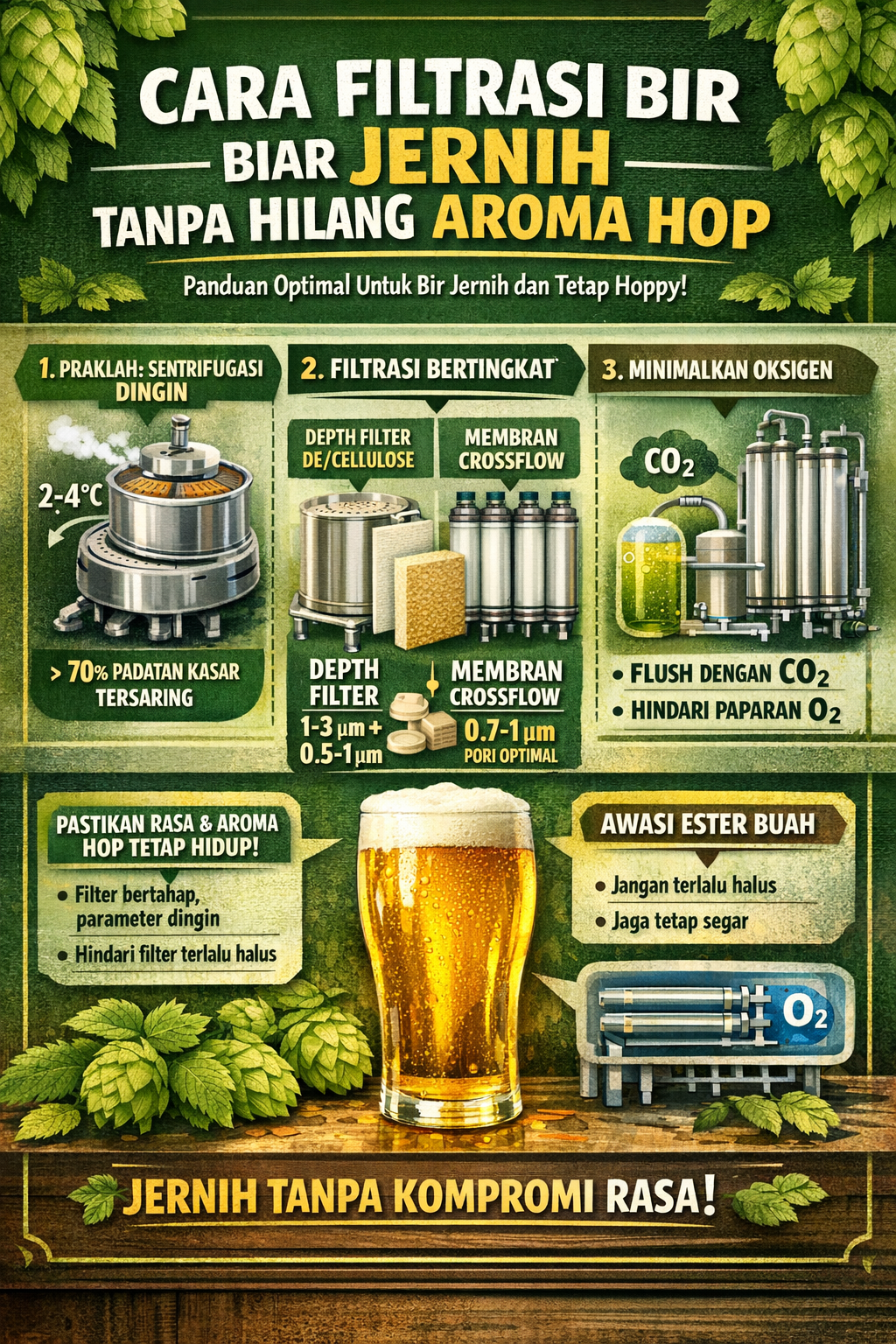
Breweries deploy centrifuges, diatomaceous earth (DE, also called “kieselguhr”), cellulose depth sheets, crossflow/membrane filters, and cartridge polishing filters to remove yeast and protein–polyphenol complexes. A first‑stage cold spin at 2–4 °C (degrees Celsius) right after maturation typically removes 70–90% of coarse solids and avoids autolytic off‑flavors from residual yeast (Filtnews; Atlas Copco).
For final polishing, breweries often integrate hygienic cartridge filters to catch fine particulates as part of a closed, low‑oxygen filtration train.
Depth filtration media and adsorption behavior
Traditional “cake” filtration with DE or cellulose depth sheets captures yeast and large colloids in one step. DE is effective but brings environmental and health burdens: brewers can handle more than 100 t/yr (tonnes per year) of DE and generate roughly three times that mass in spent cake (BeverageDaily) (BeverageDaily).
Because mineral media have high surface area and polar character, they can adsorb some flavor compounds; even so, properly prepared DE filtration has been shown to leave most hop‑derived volatiles intact (MDPI). Cellulose‑based depth filters — including stacked fibrous pads — are gentler and “remove fewer hop oils than mineral‑based filter media” (Filtnews).
Across depth filtration, cold conditions and moderate differential pressure (~0.5–1 bar) limit CO₂ stripping and aroma loss. Specialty options include silane‑treated silica filter aids engineered to bind off‑flavor molecules (trans‑2‑nonenal, cis‑3‑nonenal, diacetyl) while letting other solubles pass (USP 7,989,010).
Membrane microfiltration and oxygen control
Crossflow and cartridge membranes deliver clarity and sterility with less filter aid. Pore sizes around 0.5–1.4 µm (micrometers) in hydrophilic materials such as PES, PVDF, nylon, or cellulose acetate remove remaining yeast and bacteria without DE. Membrane filtration can also improve sustainability — up to ~40% less water use and ~50% lower product loss by avoiding DE handling (BeverageDaily).
Industry guidance notes “membrane filtration is better” than cake filtration at protecting flavor because it minimizes dissolved oxygen during processing (Pall). Breweries typically stop at ~0.45–1.0 µm final filters (or flash pasteurize instead of sub‑0.2 µm) to avoid excessive removal of esters and beneficial colloids. Hygienic 316L stainless cartridge housings are commonly specified for food‑grade membrane service.
Flavor and aroma outcomes by method
In aggregate, the right filtration improves perceived flavor by removing spoilage risks and astringency — “a positive influence on taste and aroma” when proteins/polyphenols are bound out (with PVPP or silica) and yeast is removed (Atlas Copco).
But over‑tight filtration can blunt fermentation‑derived fruit notes. In one study of low‑alcohol beers, coarse pad filtration kept ester levels nearly unchanged, while finer sheets produced “much more pronounced” drops in ethyl esters; even if individual esters hover near sensory thresholds, their combined reduction can mute fruitiness (MDPI; MDPI; MDPI). By contrast, the same trials found hop‑derived terpenes were virtually unaffected by filtration (MDPI).
Operating parameters for aroma retention
Cold filtration near 0–4 °C maintains high dissolved CO₂ and reduces volatility; modest ∆P (~0.5–1 bar) curbs outgassing. Slow, steady flow, avoiding spray or foaming, reduces physical stripping of volatiles. A closed, inert atmosphere — vessels and lines blanketed with CO₂ or N₂ (nitrogen) — limits oxygen pickup; membrane systems, in particular, are associated with lower dissolved O₂ versus cake filtration (Pall).
In practice, each air‑exposed point is a risk; tight seals and closed‑loop transfers are typical. Carboys and kegs are topped with CO₂ to prevent aroma loss.
Process design and pore size strategy
Gradient approaches avoid a single ultrafine step: a coarse precoat or pad in the 1–5 µm range, followed by a ~0.7–1.0 µm polisher. Many brewers regard ~1 µm as a pragmatic “sweet spot,” letting volatiles pass while removing yeast and most colloids (Shun Beer). Finer cartridges down to 0.45 µm are applied where shelf‑stability or pasteurization equivalence is required.
Multi‑stage depth filtration also distributes the solids load and limits pressure rise, which can otherwise force turbulence that shears out aroma‑carrying colloids.
Pre‑ and post‑filtration stabilization and carbonation
Ahead of filters, centrifugation or settling reduces the need for tight grades. Adsorptive stabilizers such as PVPP, silica gel, or bentonite are typically added before filtration to bind haze‑forming polyphenols; the complexes are then removed in the filter with minimal impact on hop oils.
After filtration, packaging and carbonation generally proceed under CO₂. Gentle saturation — just enough pressure to reach the target CO₂ volume — preserves volatiles; excessive post‑filter agitation can knock them out. Accurate dosing of stabilizers and finings is commonly handled with a dosing pump to maintain consistency at low oxygen exposure.
Filter train configuration and media selection
A multi‑stage clarification regime is typical. Step 1: centrifuge (cold, 20–50 °C) or let the beer sediment to remove more than 90% of yeast. Step 2: depth‑filter with a coarse pad (1–3 µm) to trap most solids, then a fine pad (~0.5–1 µm) as a “polisher.” Step 3: where needed, sterile‑filter at 0.45 µm only at keg/bottle fill; otherwise, rely on ~0.7–1.0 µm for a stable beer without excessive aroma loss.
Media choice matters. For IPA and other hop‑forward ales, high‑fiber (glass or cellulose) media are preferred; deep DE beds alone tend to adsorb more hop oils (Filtnews). Some brewers adopt charge‑modified sheets designed to target haze while sparing apolar oils. Filters and lines are flushed with CO₂, filters pre‑wetted with deaerated beer, and operations run at low ∆P with tight closures to minimize oxygen and adsorption.
Clarity is validated alongside aroma. Sensory or GC runs and triangle tests can reveal if fruitiness drops; if so, teams step back to a coarser final grade or revise media, mirroring study results where coarse pads preserved esters better than fine pads (MDPI). Haze tolerance varies by style: hop‑forward NEIPAs accept haze and lighter filtration, whereas classic lagers often target ≤2 EBC (European Brewery Convention) turbidity.
Pilot trials across styles help locate the sweet spot. The reported data indicate most hop volatiles survive careful filtration (MDPI), making clarity without “filter dullness” achievable. Industry commentary adds that modern membrane lines deliver “brilliant beer” with no compromise in taste (BeverageDaily; Pall), provided conditions are optimized as above.
Source notes and analytical trials
Peer‑reviewed and industry sources quantify impacts. Analytical trials found no significant drop in hop oil levels after filtration (MDPI), while ester compounds declined with increasingly fine filter grades (MDPI; MDPI). Filtration experts emphasize cellulose filters “remove fewer hop oils” than mineral DE (Filtnews). Patented silane‑treated filter aids selectively bind stale‑flavor aldehydes while leaving desirable aroma compounds (USP 7,989,010). Analyses (Pall, Atlas Copco, BeverageDaily) note membrane filtration can cut water use by ~40% and product losses by ~50% versus DE systems (BeverageDaily), while protecting flavor from oxidation by minimizing dissolved oxygen (Pall).