
Brewers are staring down high-strength effluent and tightening rules, forcing a choice: spend millions to build and run an in-house wastewater plant or lock in a design‑build‑operate service and pay by the gallon. The tradeoff is capital vs. certainty — and the numbers are stark.
Brewing drinks a lot of water: Asahi pegs a global average of roughly 4.5 hectoliters (hl) of water per 1 hl of beer produced (pall.com). Much of that becomes high‑strength wastewater. Typical brewery effluent contains 3,000–10,000 mg/L biochemical oxygen demand (BOD; a measure of organic load), up to about 30× residential sewage, and up to ~3,000 mg/L total suspended solids (TSS) (aquacycl.com).
The surge in craft breweries — from ~4,600 in 2015 to 8,275 in 2019 — has only tightened the screws on local sewers (aquacycl.com). In Indonesia, new KLHK rules (2025) require online real‑time monitoring and tougher effluent standards for food and beverage plants (greenlab.co.id) (greenlab.co.id). Non‑compliance isn’t cheap: administrative fines, permit suspension, or even revocation are spelled out (greenlab.co.id).
Before advanced steps, many plants start with solids management using primary equipment such as screens and oil removal systems to protect downstream processes.
Onsite ownership: capital, kit, and control
Building an in‑plant wastewater treatment plant (WWTP) is capital‑intensive. A brewery must finance engineering, construction, and equipment — from anaerobic and aerobic stages to membranes and dissolved air flotation (DAF). Major breweries including Sierra Nevada and Red Hook invested in anaerobic digestion systems (researchgate.net), and even modest flows (hundreds of m³/day) can run into the millions. Industry data suggests municipal‑scale WWTPs can cost on the order of $1–3+ million per MGD (million gallons per day; ≈4,000 m³/day) of capacity.
Primary clarification is still common in brewery layouts, often with modern clarifier units that stabilize hydraulics before biological treatment.
Operating costs sit on the brewery’s ledger: labor, electricity, chemicals, sludge disposal, maintenance, and admin. One U.S. guide estimated wastewater — including pumping and oxygenation — at 10–30% of a brewery’s electricity costs (scribd.com). Sludge hauling or disposal adds several USD per m³ treated, and some microbreweries have spent “tens of thousands of dollars per month” on off‑site hauling (aquacycl.com).
Biological stages dominate high‑strength load reduction, with plants deploying anaerobic and aerobic digestion to cut BOD before discharge or reuse.
Return on investment can be compelling. In a study of three craft breweries, anaerobic treatment cut water/disposal costs by up to ~50% — “a substantial amount… even when taking into account the immense cost of purchasing the equipment” (researchgate.net). Owning also gives full control of discharge quality and any resource value, such as biogas or nutrient recovery. The flip side: the brewery absorbs performance, maintenance, and future expansion risk.
Integrated membrane systems are increasingly used where reuse is a goal, with compact membrane bioreactors (MBR) combining biological treatment and membrane filtration in a single train.
In Indonesia, large beverage factories already operate WWTPs to meet Permen‑LHK standards, and the 2025 rule changes will push more breweries to invest in robust treatment (greenlab.co.id). Costs are similar or higher in IDR terms: a $1M plant is about 15 billion IDR. Small breweries often cannot invest, turning to hauling or contracting. Firms may access green financing or tax incentives, but this varies by region. Any downtime or non‑compliance can mean lost production or fines (e.g., IDR tens of millions for serious violations).
Consumables and dosing matter in day‑to‑day operations, from coagulants in primary treatment to precise chemical feeding via a dosing pump that stabilizes pH and aids settling.
Some facilities opt for modular packages to limit civil works, using packaged treatment units that can be expanded as production grows.
Third‑party DBO/WaaS: outsourcing risk for a tariff
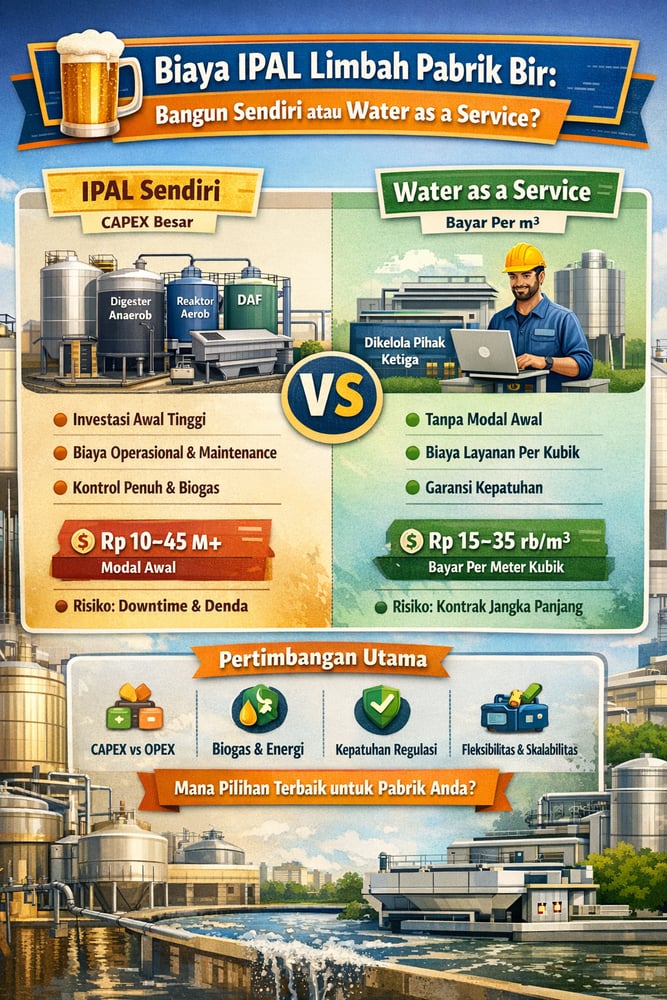
Under design‑build‑operate (DBO) and water‑as‑a‑service (WaaS) models, a specialized water company designs, builds, and often owns and operates the plant. The brewery pays a service fee — fixed monthly, per gallon, or a hybrid (sometimes called an “Inframergization” contract). Cambrian Innovation’s “Water‑Energy Purchase Agreement” (WEPA) “eliminates up‑front capital costs for customers, allowing them to pay for performance on a per‑gallon basis” (watertechonline.com), while providers like Seven Seas Water highlight WaaS deals that “guarantee capacity, quality, and cost” so clients can “focus on their core mission” (sevenseaswater.com).
Service providers deploy their own capital — often private equity or bonds (sevenseaswater.com) — and recover it over 10–15 years through tariffs. In practice, fees can cover treatment capacity, maintenance, and downtime guarantees. New business models let plants add capacity without bond issuance; “The WEPA can also facilitate [financing] without disrupting ongoing plant operations” (watertechonline.com).
Outsourced operation shifts technical risk. Operators run the plant 24/7 — often with SCADA (supervisory control and data acquisition) monitoring and predictive maintenance — and guarantee discharge quality. A leading UK brewery producing 60 million pints/year fully outsourced its WWTP to Nijhuis‑Saur, which provides plant operation, out‑of‑hours callout, maintenance, technical support, and process monitoring (nijhuisindustries.com).
Third‑party plants still rely on familiar unit processes. Skid‑mounted separators remain common, and DAF features prominently in many DBO designs, much like a standalone DAF system at an owner‑operated site.
Results can be measurable. The Florida Brewery (34 million gal/yr wastewater) replaced tanker disposal with an on‑site membrane bioreactor under Cambrian’s DBO contract. The project “eliminate[d] high‑strength wastewater trucking,” cut CO₂ emissions by ~254 metric tons/year, and yielded “significant annual cost savings” (cambrianinnovation.com).
Some providers use novel biology. Aquacycl offers an MFC‑based (microbial fuel cell) service contract, “BETT,” with “no capital expenditures” — customers pay a service fee for guaranteed treatment (aquacycl.com).
Ancillary scope is typically bundled into the tariff, from spare parts to monitoring hardware, much like an owner would source under wastewater ancillary packages.
Cost comparison: capex, opex, and payback
Owning a plant demands a large upfront outlay. One Belgian brewer’s WWTP project led by Veolia (2025) involved a multi‑million € investment in anaerobes, clarifiers, and reuse systems (veoliawatertech.com). By contrast, WaaS may involve minimal or no upfront payment (beyond sign‑up fees). As WaterTechOnline put it: “DBO/WaaS eliminates upfront capital costs… allowing them to pay for performance on a per‑gallon basis” (watertechonline.com).
Operationally, third‑party fees often scale with flow or load. If a brewery reduces wastewater volume through conservation or reuse, it pays less. In some models, the technology owner may capture the biogas value under the service agreement, depending on contract terms (researchgate.net) (cambrianinnovation.com).
Benchmarks help. U.S. breweries producing 100k–1M bbl/yr often spent $1.2–$4.2 per barrel on wastewater (sewer base charges, BOD/TSS surcharges, energy, etc.), or roughly $10–$35 per m³ of wastewater (scribd.com). The Cal Poly study found costs decreased by up to about 50% after installing anaerobic digesters (researchgate.net). If a brewery paid $30/m³ in surcharges, a 50% cut saves $15/m³ — enough to service debt on equipment for many projects.
Where reuse is part of the cost case, treatment trains may add membrane and disinfection steps; pretreatment with ultrafiltration (UF) is a common bridge to polishing and final disinfection with ultraviolet (UV) systems.
Technology menu: unit processes and modules
DAF remains a go‑to for suspended solids and fats/solids control, mirrored by modular offerings like a plant‑scale DAF unit that can be slotted between equalization and biology.
Alternative biological configurations can handle variable loads, including moving bed bioreactors (MBBR) that use carriers to grow biofilm and smooth out shock loads.
Seeding and nutrients are standard tools in start‑up and upset recovery, supported by microbial and nutrient consumables that stabilize biomass growth.
Trends and regulatory outlook
Industry trends favor outsourcing in settings with tight capital or rapid expansion. Since 2015, Cambrian’s WEPA has enabled food and beverage plants to add capacity without capital outlay (watertechonline.com). “SaaS‑like” WaaS models are growing globally; providers argue they avoid lengthy financing and deliver guaranteed performance (sevenseaswater.com) (watertechonline.com).
In water‑scarce regions, breweries increasingly pursue reuse and even zero‑liquid discharge — often implemented by specialized third parties. In Indonesia, with real‑time monitoring and tightened standards, breweries may favor WaaS or PPP to meet obligations with minimal risk (greenlab.co.id).
Nutrient control is also tightening in many jurisdictions, making staged designs with dedicated nutrient removal steps more common in brewery WWTPs.
Decision framework for brewers and controllers
CapEx vs. OpEx: Owning the WWTP means large upfront spending but lower per‑unit costs long‑term; partnering shifts to pay‑per‑use. As a rule, “DBO/WaaS eliminates upfront capital costs… allowing them to pay for performance on a per‑gallon basis” (watertechonline.com). Controllers should compare the Net Present Value — amortizing a $1–3M plant at ~5–10% interest vs. paying $X/m³ for services.
Risk and compliance: In‑house plants deliver control but require expertise and diligence. Service providers assume compliance risk and use advanced monitoring. Given Indonesia’s online‑monitoring mandate and strict sanctions, the warranty of compliance under a service contract can be valuable (greenlab.co.id) (greenlab.co.id).
Cost savings and sustainability: Effective treatment can turn wastewater into value. Whether generating biogas on‑site or avoiding haulage, savings in the tens of percent are possible (researchgate.net) (cambrianinnovation.com). Newer technologies like microbial fuel cells are available under service contracts (aquacycl.com).
Scalability: Third‑party solutions are often modular and scalable. Service contracts can guarantee performance without large installation costs and “scale to meet changing production demands” (aquacycl.com).
Bottom line: For breweries with limited capital or rapid expansion plans, DBO/WaaS offers predictable cash flows and regulatory compliance with minimal internal burden (watertechonline.com) (sevenseaswater.com). Established breweries with stable cash and access to incentives may prefer to build and own — especially if they can capture energy credits or grants (researchgate.net) (cambrianinnovation.com). In all cases, lifecycle costs and the risk of downtime or fines should be explicitly priced.
Sources and methodology
Authoritative industry reports and case studies (Master Brewers Assoc., WaterTech, Veolia, Cambrian, etc.) and Indonesian regulatory updates were used. Key data sources include brewery waste management case studies (researchgate.net) (cambrianinnovation.com), technology providers’ technical briefs (aquacycl.com) (watertechonline.com) (sevenseaswater.com), and official environmental news (greenlab.co.id) (greenlab.co.id). All figures and trends are supported by the cited references.
