
Breweries send out wastewater in punishing pulses — high-strength organics, wild pH swings, and erratic flows. An equalization tank, sized for real-world peaks and run by smart controls, turns chaos into a steady biologically treatable feed.
In breweries, a quiet operational truth drives treatment design: the plant’s dirtiest moments aren’t constant, they come in bursts. Cleaning-in-place (CIP, chemical cleaning cycles of tanks and lines) and washdowns dump spent beer and chemicals that spike organic strength and disturb flow patterns. One research set reported combined brewery streams with COD (chemical oxygen demand, a measure of oxidizable organics) from 3,500 up to 160,000 mg/L and BOD₅ (five‑day biochemical oxygen demand, a measure of biodegradable organics) from 327 to 26,667 mg/L (jurnal.uns.ac.id) — orders of magnitude above domestic sewage.
Spent‑grain press liquors are a big part of the story, often ≈25% of the total plant BOD load (nepis.epa.gov). Water use is heavy too: EPA data shows 5–15 barrels of water per barrel of beer (nepis.epa.gov), so a 10,000 LPD (liters per day) brewery can discharge 50,000–150,000 LPD. Peaks are not just hydraulic; in one facility pH swung 10 units (e.g., pH ~4.0 for 3 h) from acid/caustic CIP pulses, and BOD/TSS/COD (total suspended solids) can double or triple during CIP (nepis.epa.gov).
Those hydraulic and organic shocks can overwhelm clarifiers and biological reactors, wash out biomass, crash nitrification, and push plants into permit trouble unless actively managed (nepis.epa.gov) (nepis.epa.gov). Upstream, physical separation helps: many plants deploy an automatic screen to continuously remove debris >1 mm before the equalization and biological stages.
Equalization basin function and protection
An upstream equalization (EQ) basin is the shock absorber. Properly mixed, it temporarily stores and blends all effluent to “damp out fluctuations” (4enveng.com) in both flow and concentration, smoothing the feed to downstream treatment. Acid from CIP and alkali from cleaning neutralize each other in the tank. With recirculation or light aeration, the EQ stage even achieves about 10–20% BOD₅ removal (4enveng.com) and starts converting complex organics to simpler substrates (acidification) (pmc.ncbi.nlm.nih.gov).
EPA design manuals underscore the protective value: “concentration damping can protect biological processes from upset or failure from shock loadings of … inhibiting substances” (nepis.epa.gov). In one classic case, simply adding EQ nearly doubled primary clarifier suspended solids removal — from 23% to 47% (nepis.epa.gov) — a reminder that stable feed improves performance across the train, including downstream units such as a clarifier and biological systems like activated sludge.
EQ sizing method and retention targets
Sizing is mission‑critical. One full‑scale brewery used an 8‑hour EQ based on average flow to manage hydraulic peaks and stabilize fluctuations in pH and organic load (COD, BOD₅, TSS) (pmc.ncbi.nlm.nih.gov). The general method is graphical: plot flow vs. time and set tank volume equal to average flow × target retention time plus the area under the flow‑averaging curve — essentially, the extra volume above the chosen constant flow (4enveng.com). When variation is great, “the equalization vessel is quite a bit larger than that based on the average flow” (4enveng.com).
Practically, many breweries design EQ volume for 0.5–1 day of average flow — enough to cover a full production/CIP cycle. The tank should be well mixed (floating aerators are commonly used) to prevent stratification and odor, and that light aeration drives the ~10–20% BOD₅ removal observed in EQ (4enveng.com). If highly acidic or alkaline pulses are expected, pH neutralization can be done in the EQ tank; chemical feeds are typically delivered by a dosing pump. Inline EQ (all flow through it) is preferred so no bypassed “shock” ever reaches the bioreactor (nepis.epa.gov).
Automated EQ control and instrumentation
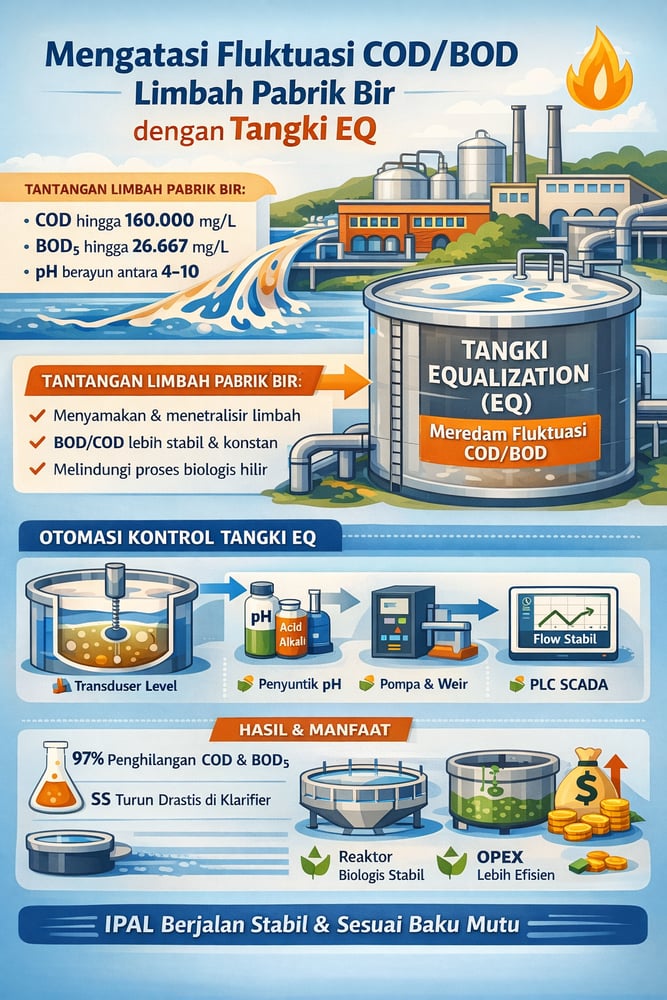
Modern control logic holds the plant near constant flow. A flow‑splitting control using an adjustable weir or pump diverts inflow above a setpoint into EQ; when raw inflow exceeds the target feed, the excess automatically overflows into EQ (nepis.epa.gov) (nepis.epa.gov). Conversely, when raw flow drops below target, stored EQ water is returned by variable‑speed pumps. As EPA notes, “flow equalization requires the capability to divert selected flows to the equalization basin when inflow is above average and to supplement [the plant] with storage bleed‑back … when inflow is below average” (nepis.epa.gov).
Level sensors in the EQ tank and flow meters on the influent line form a cascade control: the controller (typically a PLC, programmable logic controller) adjusts the weir or pump rate so “total plant flow is the controlled variable” (nepis.epa.gov) (nepis.epa.gov). The EQ tank level provides an override — if high, stop/divert flow; if low, stop pumping — to protect against overflow or pump dry (nepis.epa.gov) (nepis.epa.gov).
Reliable instrumentation is central: flow meters on influent/effluent, PLC‑controlled gates or variable‑frequency‑drive pumps, and tank‑level transducers enable the strategy (nepis.epa.gov) (nepis.epa.gov). Additional analyzers — pH, conductivity, or UV–TSS monitors (optical signals correlated to solids) — in the EQ tank can detect incoming shocks; the control system can throttle or isolate that portion. A pH probe could trigger temporary bypass of highly caustic CIP flushes for extra neutralization rather than into a sensitive bioreactor. Supporting field hardware such as mixers, level instruments, and controls are typically covered under wastewater ancillaries.
Downstream, dissolved oxygen (DO) and oxidation‑reduction potential (ORP) control loops keep aeration on target even with some load variability, and the combined EQ plus SCADA (supervisory control and data acquisition) setup logs flows, levels, DO, and pH in real time. The result is steady feed to biological basins and fewer operator interventions.
Stability gains and compliance outcomes
With a well‑sized, aerated EQ and automation, bioreactors see uniform loading and higher efficiency. In a brewery WWTP with an 8 h EQ, removal reached 97.2% for both COD and BOD₅, with final concentrations below typical discharge limits (COD <250 mg/L, BOD₅ <60 mg/L) (pmc.ncbi.nlm.nih.gov). EPA case experience also showed that equalization dramatically improved clarification — primary effluent solids dropped enough that %SS removal roughly doubled (from 23% to 47%) (nepis.epa.gov).
Practically, projects report far fewer biological upsets — less filamentous bulking or pH crashes — after adding EQ control. Capital savings can follow, too: because loads are evened out, downstream aeration basins and clarifiers can often be smaller than if they had to tolerate wide swings. The through‑line is consistent: deploying EQ and advanced controls yields more consistent, efficient operation and significantly better effluent metrics (pmc.ncbi.nlm.nih.gov) (pmc.ncbi.nlm.nih.gov) (nepis.epa.gov).
