

Industry: Brewery | Process: Packaging
Beer is water‑hungry—production uses about 3–10 liters of water per liter of beer, and wastewater volumes are comparable (mdpi.com). In the packaging hall, that effluent is high‑strength and mercurial: think sugars, proteins, yeast, and label pulp, with chemical oxygen demand (COD, a measure of oxidizable organics) around 2,000–10,000 mg/L and five‑day biochemical oxygen demand (BOD₅) near 1,200–3,600 mg/L (mdpi.com).
Clean‑In‑Place (CIP, automated cleaning using alternating acid and caustic solutions) makes the pH yo‑yo: mixed wastewater from these cycles has spanned pH ≈3–12 in studies that describe acid sterilization alternating with alkaline caustic washes (mdpi.com). A real brewery case logged raw COD ≈4,000 mg/L, BOD₅ ≈2,000 mg/L, and total suspended solids (TSS) ≈400 mg/L (id.khnwatertreatments.com).
The fix: a dedicated pretreatment line ahead of the main wastewater treatment plant to protect bioreactors, flatten shock loads, and improve compliance.
Screening for glass and solids
The frontline defense is screening—coarse bar racks or wedge‑wire screens with ~3–10 mm openings—to intercept broken bottles, labels, and other debris. Wedge‑wire bar screens are common; design manuals note they “can operate at very high hydraulic and solids loadings, but do not greatly reduce SS” (nepis.epa.gov). In practice, even high‑performance screening typically removes less than 20% of the finer turbidity (nepis.epa.gov), which matters because unscreened brewery effluent can carry TSS in the hundreds of mg/L (id.khnwatertreatments.com).
Facilities typically choose between a manual bar rack or an automated unit; a coarse bar screen linked to a manual screen at drains is a frequent first step, while continuous debris removal is handled by an automatic screen as flows ramp up. A ~3–5 mm screen followed by a fine mesh or a grit trap is recommended in brewery duty.
Packagers treating primary solids as a system rather than a component often fold screens into broader physical separation trains that also accommodate oil/grit management before chemistry is applied.
Equalization tank for flow and load buffering
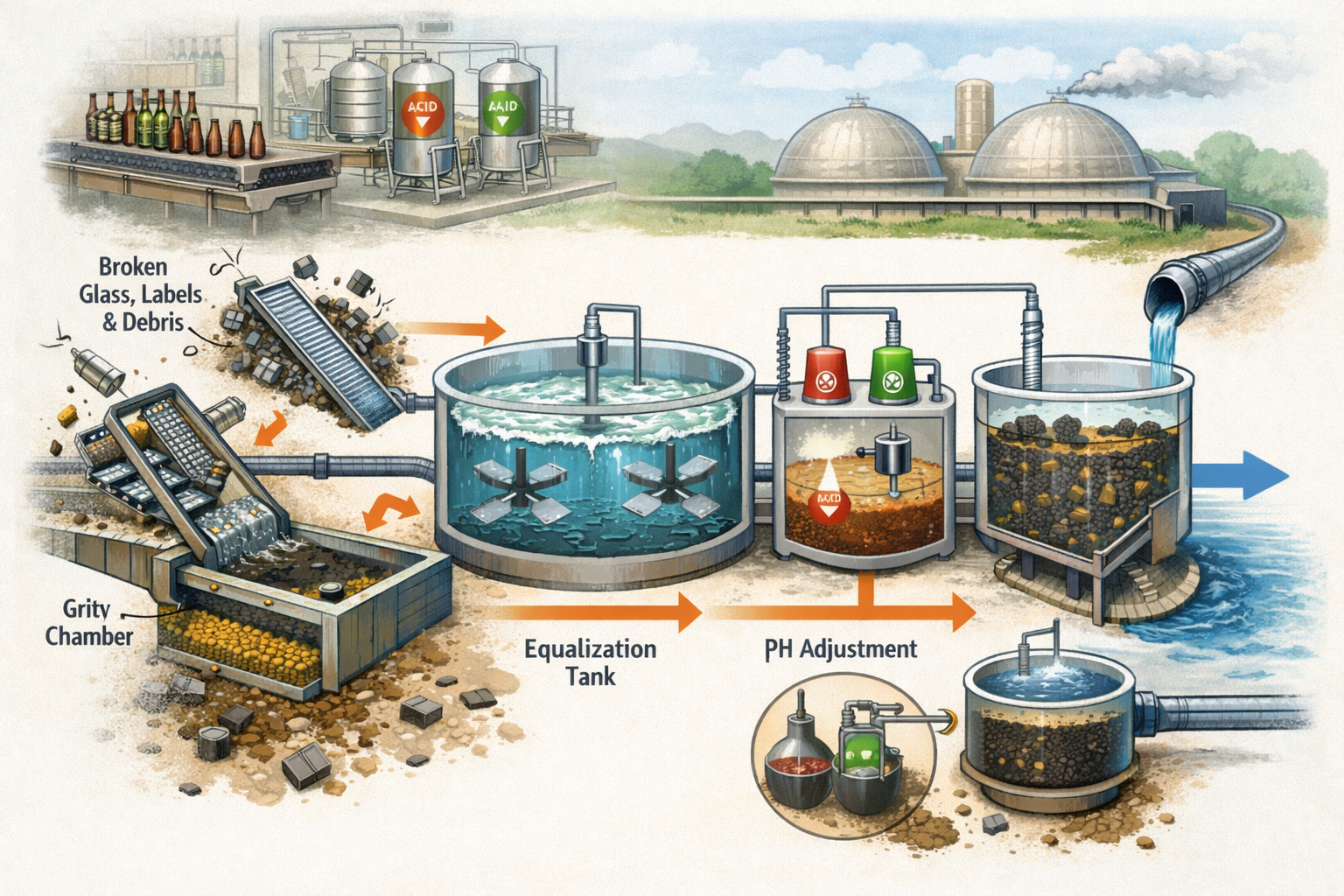
An equalization (EQ) tank—sized for several hours of average flow, often 6–12 hours—is essential because packaging‑hall loads are cyclic, with intense rinses and CIP peaks. The tank is well mixed to keep solids in suspension and to attenuate pH swings; studies confirm EQ primarily stabilizes conditions rather than removing much COD (pmc.ncbi.nlm.nih.gov).
Field data back that up: an 8‑hour retention EQ tank in a brewery reduced TSS by ~9.4%, COD by ~3.9%, and BOD₅ by ~2.9% while smoothing pH and substrate fluctuations (pmc.ncbi.nlm.nih.gov). Designing for an 8–12 hour retention at peak flow is common in this context (pmc.ncbi.nlm.nih.gov). Mixing and level control hardware are typically specified as wastewater ancillaries in the pretreatment package.
pH neutralization and control
CIP drives extreme pH excursions: caustic washes (often 1–3% NaOH) can push pH 11–13, while acid sanitizers (nitric or phosphoric acid) can drop pH below 4 (mdpi.com). Many wastewater plants require pH around 6–9 at the headworks, so pretreatment targets a near‑neutral 6.5–8.0 before biological treatment.
Because coagulation is commonly most effective at ~pH 6.5–7, designs set pH close to 7 ahead of dosing; one jar‑test study explicitly “adjusted to a range close to 7” to optimize coagulant addition (mdpi.com). Automatic neutralization in the EQ tank is typical, using metered acid/caustic addition via a dosing pump under pH control.
Coagulation–flocculation chemistry
After screening and equalization/pH correction, chemical coagulation–flocculation (destabilizing colloids and aggregating fines with polymers so they settle) removes remaining suspended solids and trims organics. Common coagulants in brewery service are aluminum or iron salts—polyaluminium chloride (PAC), aluminum sulfate, ferric chloride—often paired with polymeric flocculants such as polyacrylamide or polyamine. A recent industrial trial identified PAC at ~675 mg/L plus an anionic polymer at 40 mg/L as an optimum combination on brewery effluent (mdpi.com).
Polymer dose is usually <0.1% w/v, and some coagulants prefer lower pH (aluminum sulfate around pH 5–6), while PAC and ferric species can be used near neutral due to hydrolysis acidity (mdpi.com). On procurement, plants typically specify a base coagulant such as PAC and complement it with site‑screened flocculants after jar testing; aluminum‑ or iron‑based coagulants remain standard practice.
Performance and sludge management
Removal rates are robust for solids and moderate for organics. On industrial brewery wastewater, PAC+polymer pretreatment removed ~86.8% of TSS (mdpi.com), with turbidity reductions typically ~85–90% in combined‑chemistry studies (mdpi.com). COD removal ranges from ~25% up to ~60%, depending on chemistry: one large study reported 26–34% COD and ~34% BOD₅ reductions (mdpi.com), while another jar‑test showed polymer alone cut COD ≈59%, aluminum sulfate alone ≈52%, and a combined mix ≈65% (mdpi.com). In practice, pretreatment commonly delivers ~50–90% TSS/turbidity removal and ~30–60% COD/BOD reductions (mdpi.com; mdpi.com).
One example stands out: Carnevale Miino et al. (2025) achieved 86.8% TSS removal and ~95% of phosphorus with 675 mg/L PAC and 40 mg/L anionic polymer, albeit with only ~26% COD removal; they also reported a practiced polymer dose of 0.1% (mdpi.com; mdpi.com). A South African brewery report showed 50–59% COD removal comparing alum vs polymer (mdpi.com).
Chemical pretreatment generates sludge: separated sludge has been measured at ~4.5–5% dry solids, roughly 1.0 kg dry sludge per kg COD removed—about 25–30 L of wet sludge per m³ of treated brewery water (mdpi.com). Because this sludge contains organics and metal salts, designs often follow coagulant dosing with gravity separation; many plants favor compact settlers such as a lamella clarifier to thicken and separate floc.
Pretreatment outcomes and design figures
Combining screening, equalization/pH control, and coagulation–flocculation significantly eases the burden on the main plant: solids are cut by ≈80–90% and the organic load by ≈30–60% (mdpi.com; mdpi.com). As a simple illustration, if raw packaging effluent has COD ~2,000 mg/L, a 50% reduction leaves ~1,000 mg/L at the main plant. Full brewery wastewater treatment trains (for example, anaerobic plus aerobic stages) routinely achieve >90% overall COD removal in the literature (pmc.ncbi.nlm.nih.gov; mdpi.com), so front‑end removal improves stability and energy use. Meeting Indonesian wastewater norms (often on the order of COD <100 mg/L and BOD <40–50 mg/L after full treatment) is materially easier with pretreatment in place.
Typical design figures cited include: a bar screen (5 mm), a grit chamber, an EQ tank sized at ~1–2 days of average flow if space allows (otherwise ~8–12 hours retention), and chemical injection points, with jar‑tests determining the exact coagulant dosage and on‑line turbidity plus BOD/COD tests tracking performance (mdpi.com). Plants often reference packaged primary treatment units for the front end and lean on conventional activated sludge downstream for polishing.