
With brewing water making up 85–95% of beer, getting alkalinity under control can make or break mash pH—and flavor. The industry’s go-to fix is simple acid injection; big plants sometimes “engineer it out” with split‑stream ion exchange and blending.
Brewing water is typically 85–95% of beer, so its chemistry—especially alkalinity—has a major impact on mash pH, enzymatic conversion, and beer flavor (www.horiba.com) (www.brunwater.com). Alkalinity—mostly bicarbonate/carbonate in water—is defined as the amount of strong acid needed to lower water to pH ≈4.3–4.5 (www.brunwater.com).
In brewing, excess alkalinity “buffers” wort and pushes mash pH above the optimal ~5.2–5.4 range (www.horiba.com) (byo.com). Horiba recommends keeping water bicarbonate under 50 ppm (as CaCO₃) to avoid unacceptably high mash pH (www.horiba.com), while broader industry advice targets total alkalinity under ≈100 ppm (blog.hannaservice.eu) (www.horiba.com).
If untreated water has 150–200 ppm CaCO₃ (common in hard areas), mash pH can exceed 5.6–5.8 unless corrected—risking reduced enzyme efficiency and off‑flavors (www.horiba.com) (byo.com). Brewers typically measure alkalinity by titrating a water sample; results are often reported in mg/L as CaCO₃ (www.brunwater.com).
Pretreatment and oxygen control
Standard pretreatment often includes activated carbon filtration to remove chlorine/chloramines and deaeration to strip oxygen and excess CO₂ before mashing. Deaeration—via vacuum or spray—can remove dissolved O₂ to <0.02 ppm for shelf‑life (bbt.corosys.com), and also helps vent CO₂ produced by acid dosing. For chlorine and organics removal, breweries commonly deploy activated carbon; a media system such as activated carbon is a typical front end. UV disinfection can precede alkalinity adjustment as well, since 99.99% pathogen kill is achieved without chemicals and at low operating cost (ultraviolet).
Acidic neutralization (acid dosing)
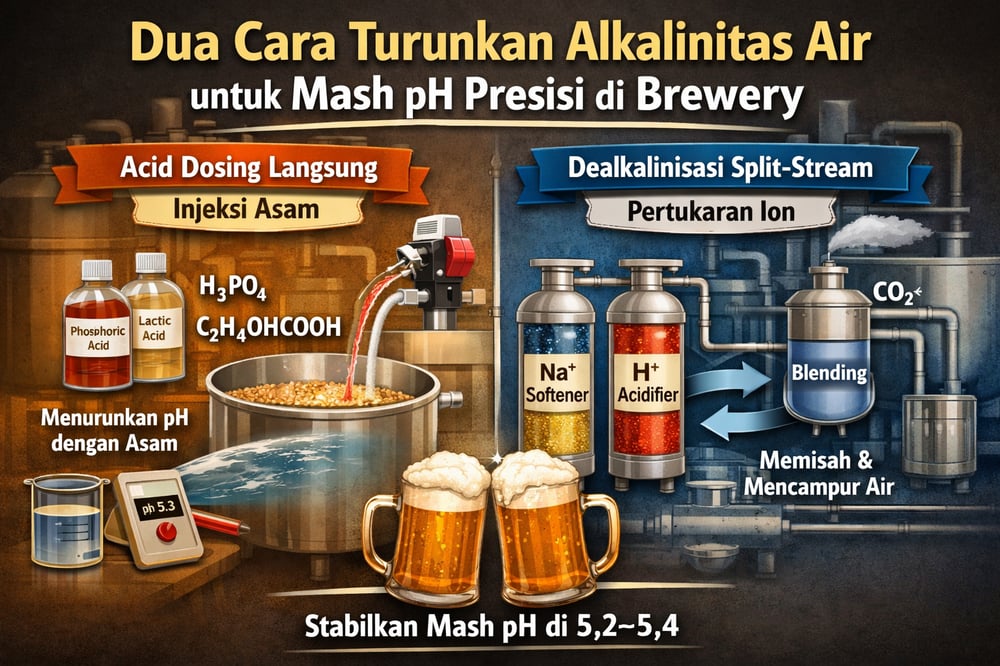
The most straightforward way to lower alkalinity is dosing food‑grade acid directly into the mash or liquor water. Common choices are 85–88% phosphoric acid or 80–88% lactic acid, which neutralize bicarbonate via HCO₃⁻ + H⁺ → H₂O + CO₂. Phosphoric (H₃PO₄) is a strong, polyprotic acid that effectively neutralizes alkalinity; Bru’n Water notes it has little flavor impact and can be used up to ≈0.1% (v/v) without excessive Ca precipitation (www.brunwater.com). Lactic acid is weaker (monoprotic) and contributes lactate, but is very palatable; it is commonly used at ~1–3 mL per gallon in homebrewing.
Dosage guidance: 1 mL of 88% lactic acid per US gallon (~0.37 mL/L) neutralizes roughly 40 ppm HCO₃⁻ (ca. 38 ppm as CaCO₃) (www.brunwater.com). This implies ~2.5–3 mL/L can remove ~100–150 ppm CaCO₃ (approaching the lactic flavor threshold). In practice, brewers add acid incrementally, measuring mash pH or total alkalinity. Bru’n Water reports that 50–300 ppm of water alkalinity can be neutralized by lactic before taste is affected (www.brunwater.com); above ~300 ppm removal, stronger acid or split‑treatment is advised. By contrast, phosphoric acid (with 2 dissociations) neutralizes more alkalinity per volume—often ~0.5–1 mL of 85–90% H₃PO₄ per liter suffices to cut alkalinity by tens of ppm.
Practical steps typically include diluting concentrated acid (e.g., making a 10–20% working solution) and adding slowly to the mash or liquor while stirring, with pH monitored; a reference approach is outlined at www.morebeer.com. After dosing, some CO₂ will evolve, so venting or a deaeration step is used. Mash pH targets are typically ~5.2–5.4 at mash temperature (~65–68 °C), corresponding to ~5.0–5.2 at room temperature. For example, tap water with 150 ppm CaCO₃ might require ~3–4 mL/L of 85% H₃PO₄ (≈0.3–0.4%) or ~3–4 mL/L of 88% lactic (2–3%) to approach the 50–75 ppm target range (ballpark estimates). When uncertain, a trial test can titrate 1 L of water with 1 N HCl to pH 4.5 to measure alkalinity and calculate acid needed.
Outcomes and cost: acid dosing directly removes alkalinity and lowers pH but does not remove hardness (Ca/Mg), so water hardness stays the same—often beneficial for mash enzyme activity. Typical doses are small; for 100 ppm alkalinity, only tens of mg/L acid are required. Food‑grade acids are relatively inexpensive—for example, 85% H₃PO₄ sells for ~฿390 per kg (~$12 USD), or about $0.01–$0.02 per liter of brew water (thaibrewshop.co)—making acid dosing a low‑cost treatment. The main costs are acid purchase and safe handling. The method is highly controllable (start small and titrate up) and equipment needs are minimal; many facilities specify an accurate chemical dosing pump for repeatable injection.
Flavor and safety notes: phosphoric acid adds phosphate but little sensory impact; lactic acid may impart yogurt‑like notes if over‑used. Horiba notes they are “strong alkaline buffers”—keeping bicarbonates low ensures small acid additions suffice (www.horiba.com). Use well below flavor thresholds (Briggs et al. notes ~400 ppm lactic in final beer (www.brunwater.com)). CO₂ should be vented, fumes avoided, and water should never be added to concentrated acid.
Split‑stream ion‑exchange dealkalization
A more elaborate route removes alkalinity via ion exchange and blending. In split‑stream dealkalization, part of the source water feeds two parallel strong‑acid cation (SAC) resin beds—one in Na⁺ form (a softener) and one in H⁺ form (an acidifier) (www.waterworld.com). One portion exits as “soft” water (original alkalinity remains in the Na⁺ stream) and the other exits fully acidified (zero alkalinity, full H⁺ exchange). After resin treatment, the streams are blended; the Na‑treated stream contributes bicarbonate, while the H‑treated stream contributes none but is rich in acidity. The blend then passes through a degasser (vacuum column) to strip out CO₂ formed by neutralization (www.waterworld.com). Adjusting the split ratio dials the final alkalinity to the target. Wayne Bernahl’s review notes that split‑stream dealkalization can achieve “100% of the influent alkalinity” in one stream and 0% in the other (www.waterworld.com).
Pros include precise control of final alkalinity and some reduction in total dissolved solids (TDS). SAC resin capacity is high, enabling large volumes between regenerations (www.waterworld.com). No hazardous acid is added into the batch water itself (only for regeneration), and the system can be automated. Complete systems are typically specified as ion exchange plants; components include media such as ion-exchange resin and a Na⁺ stream created by a softener.
Cons involve high complexity and cost. Regeneration of the H‑form bed requires strong acid (usually sulfuric), and a vacuum or deaerator is used to remove CO₂ (www.waterworld.com). Bernahl also warns of “hazardous acid” use and additional caustic to re‑alkalinize if needed (www.waterworld.com). Capital outlays cover resin vessels, pumps, degasser, and control systems; ongoing expenses include regenerant chemicals and maintenance. This approach is rarely used by small breweries because of cost and complexity, though large breweries sometimes employ similar schemes.
Split‑treatment with lime softening
A related technique (often called “Carlsohn” or “Calcium Cycle”) treats a portion of water with lime (calcium hydroxide) to pH ~10–11, precipitating CaCO₃ out (www.brunwater.com). The water is decanted, then blended with untreated water to restore calcium (~40–50 ppm) and reduce pH (www.brunwater.com). The blended water has much lower alkalinity; a final aeration or acid step is needed to dissolve the CO₂ and lower pH to brewery levels (www.brunwater.com). Bru’n Water notes split‑lime can reduce Ca to ~12 ppm and requires blending to reach desired hardness (www.brunwater.com). Lime treatment avoids introducing sodium, but handling caustic chemicals and sludge is required.
Method outcomes and trade‑offs
Acid dosing: lowers alkalinity by neutralization with an immediate pH drop; no hardness removal. Capital needs are minimal—manual additions or a small dosing skid; operational burden is low (acids plus pH monitoring). Flavor impact is minimal (phosphoric) to mild (lactic up to threshold).
Split ion exchange: can remove ~100% alkalinity from one stream, with final alkalinity set by blend control (www.waterworld.com). It requires higher capital—two resin vessels, degasser, and regeneration systems—and higher operational inputs (regenerant acid/caustic, maintenance) (www.waterworld.com). Flavor impact is none, since no acid is added to product water.
Lime softening (split): removes carbonate hardness (HCO₃⁻) by precipitation. Final alkalinity is lowered via blending and CO₂ release, with equipment needs for tanks, decanters, mixing, and blending. Operational burden is high due to lime handling, pH adjustment, and settling time (www.brunwater.com).
Dilution (RO/DI): removes all ions and requires re‑mineralization. Capital is moderate (an RO unit), with medium operational needs (membrane maintenance, waste rinse water). This route can be flavor‑neutral but water must be profiled afterward. For breweries pursuing dilution, a compact reverse osmosis skid such as a brackish‑water RO plant is a typical choice.
Data points and operating targets
Mash pH target: most styles aim for ~5.2–5.4 (measured near room temperature), balancing enzyme activity (www.horiba.com) (byo.com). Horiba cites an ideal mash pH range of 5.2–5.5, with <6.0 wort runoff pH to avoid tannins (www.horiba.com).
Alkalinity limits: many guides consider >100 ppm CaCO₃ “high alkalinity” requiring treatment. Hanna suggests keeping alkalinity <100 ppm for most beers (blog.hannaservice.eu), and Horiba explicitly recommends ≤50 ppm bicarbonate for most brewing (www.horiba.com).
Acid amounts: Bru’n Water quantifies lactic acid usage—~1 mL of 88% lactic per US gallon lowers ~38 ppm CaCO₃ (www.brunwater.com). For phosphoric, lab calculation shows ~0.03 g (0.017 mL) of 85% H₃PO₄ neutralizes 100 ppm in 1 L, implying a few mL/L for large adjustments.
Effect on flavor: excess alkalinity causes harsh, astringent beers; maintaining proper mash pH improves flavor and mash efficiency (www.horiba.com) (byo.com). Over‑acidifying can cause tartness; Bru’n Water warns against “over‑acidifying,” as beer can become vinegary or metallic (www.brunwater.com) (byo.com).
Regulatory context: Indonesia’s drinking‑water SNI standards require pH ~6.5–8.5 and set hardness limits (e.g., for packaged water (insightof.id)). Brewing water must meet basic potable criteria; chemistry is then tailored per recipe. No local regulations cover final beer alkalinity, so brewers use industry guidelines (often international best practices).
Process integration and planning
Measurement is foundational: operators test source water to determine initial alkalinity (ppm as CaCO₃), hardness, and desired mash pH; calculators such as Bru’n Water guide the dose (www.brunwater.com). For modest corrections, acid injection with phosphoric or lactic is the most cost‑effective route—minimal equipment (e.g., burette or a small skid) and low per‑liter cost (thaibrewshop.co) (blog.hannaservice.eu), with process notes from www.morebeer.com.
Where source water is extremely high in alkalinity (>200 ppm) or volumes justify a plant, partial dealkalization can be considered. A split‑stream ion‑exchange system provides precise control (www.waterworld.com), but requires significant investment and maintenance. Lime softening is another option for large volumes, albeit labor‑intensive (www.brunwater.com) (www.brunwater.com). These methods can “solve” alkalinity without constant acid dosing, at the cost of complexity.
Blending is a constant: in split‑treatment schemes (ion exchange or lime), treated water is blended with raw to restore desired calcium and pH balance (www.brunwater.com) (www.waterworld.com). Sparge runoff pH is kept <6.0 to avoid tannin pickup (www.horiba.com). In practice, breweries often combine methods—e.g., a small acid dose plus dilution with softened or DI water (or partial ion exchange) to hit exact targets (www.morebeer.com). For dilution strategies, compact membrane skids such as RO, NF, and UF systems are commonly referenced in industrial water treatment; breweries typically lean on RO and then remineralize.
System integration puts carbon filters and UV ahead of alkalinity adjustment to ensure clean, chlorine‑free water, with acid injection staged after carbon but before mash‑in. Any CO₂ liberated by acid dosing is vented or removed (deaerated) before heat. In split‑stream dealkalization, the blended water typically passes through deaeration towers to strip dissolved CO₂ and O₂ on its way to the mash/lauter tun.
Cost and capacity notes: for neutralizing 100 ppm alkalinity, adding phosphoric acid might cost only a few cents per batch and requires little automation (www.morebeer.com). WaterWorld notes that when both hardness and alkalinity are high, a Weak‑Acid Cation (WAC) resin can also remove alkalinity efficiently, but with SAC split‑stream you get even higher capacity (www.waterworld.com) (www.waterworld.com). In operations, acid dosing has minimal per‑liter cost (on the order of cents) (thaibrewshop.co), whereas resin regeneration and equipment amortization can run in the hundreds to thousands per month in a larger plant.
Sources: Authoritative brewing chemistry guides and industry resources were used for data and recommendations (www.brunwater.com) (www.horiba.com) (www.brunwater.com) (www.brunwater.com) (www.waterworld.com) (www.waterworld.com) (www.morebeer.com) (thaibrewshop.co). Each citation links to the source text.
