

Industry: Brewery | Process: Milling_&_Mashing
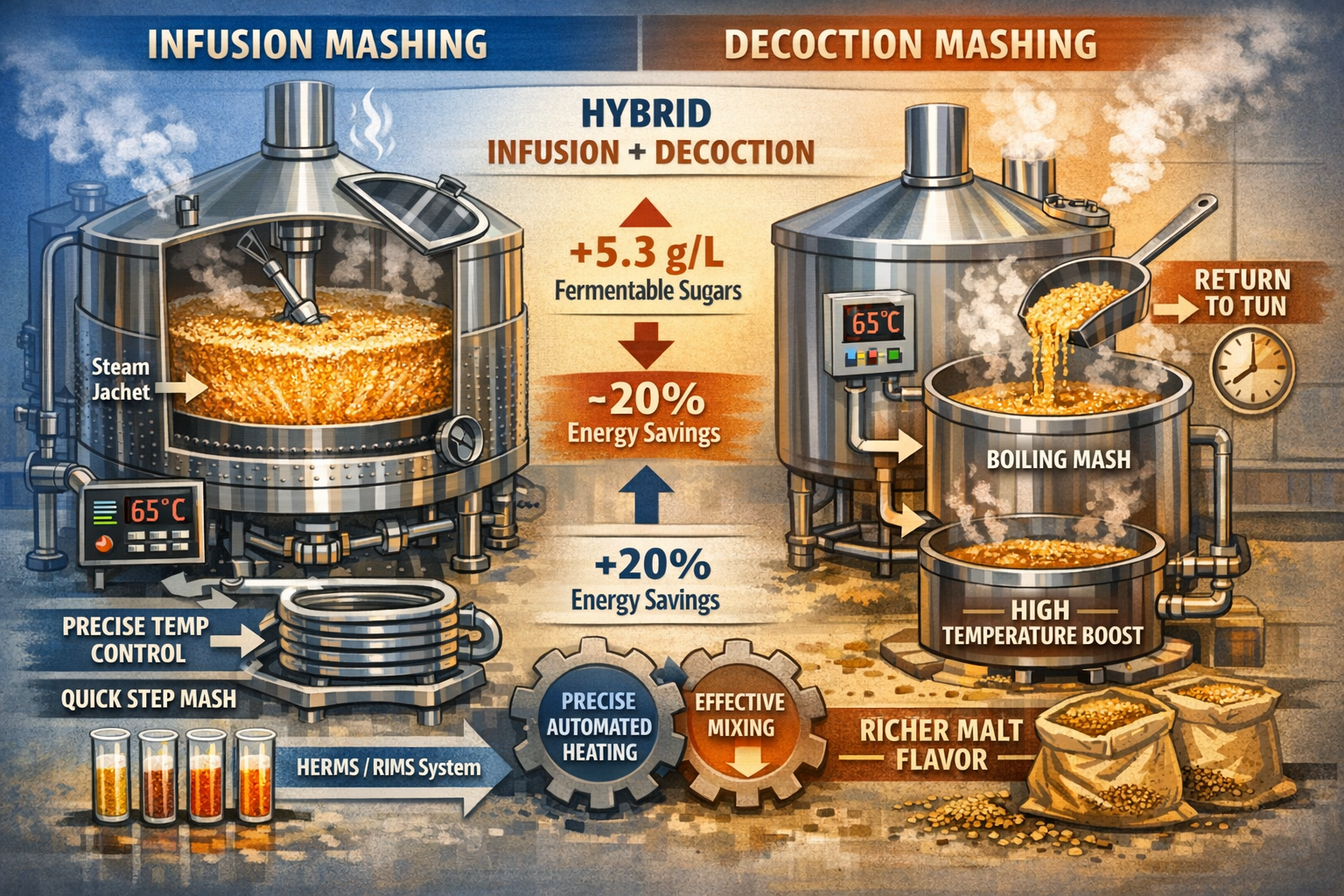
Modern mash control is a choice between adding heat and moving heat. Infusion mashing (mixing crushed malt with heated water) leans on hot water or external heating to climb through rest temperatures, while decoction mashing (removing a portion of mash, boiling it, then returning it) uses a boiled decoction to raise temperature without dilution. Both can make excellent beer when done right; the difference shows up in time, energy, and how precisely you hit and hold your steps.
In large brewhouses, infusion mashing typically runs in a steam‑jacketed mash tun or by recirculating wort through external coils (HERMS/RIMS; heat‑exchanged recirculating mash systems or recirculating infusion mash systems). Small systems may use an insulated cooler or a directly heated kettle. Decoction adds process complexity — extra vessels, pump‑out/boil/return — but reaches boiling heat (100 °C) and can gelatinize starch more thoroughly.
Empirically, a hybrid can win on efficiency. In one industrial comparison, a double‑decoction mash (Method A) was pitted against a single‑decoction plus infusion mash (Method B). Both beers were judged equal in quality, but Method B produced 5.3 g/L more fermentable sugars (≈0.25% ABV increase), delivered higher volumetric yield, saved time (33 minutes shorter), and cut energy by ~20% (researchgate.net; researchgate.net; repeated finding at researchgate.net).
Infusion and decoction temperature control
Infusion systems are fundamentally limited by the temperature of added water or the capacity of applied heat. A step‑infusion mash in a steam‑heated tun can usually be raised only to the temperature of the boiling water added (e.g., ~72–75 °C) without internal heating. Decoction, by contrast, inherently leverages boiling portions of the mash, making precise high‑temperature rests — for example, 72 °C saccharification and 78 °C mash‑out — straightforward via controlled decocting and return.
In practice, infusion mashes are simpler and faster but often require either multiple mash tuns or HERMS/RIMS loops for complex profiles. Decoction needs a pump, a boil kettle, and a mash tun — and time. Many brewers favor infusion for speed and consistency (especially with well‑modified malts), while traditional lagers (Pilsners, Bocks) continue to use decoction for authenticity. As one manufacturer’s summary puts it, “steam jackets provide uniform, controllable heat… enabling precise step ramps and decoction rests” (yolongbrewtech.com), effectively recommending steam‑heated infusion systems for complex profiles and decoctions.
Across styles, infusion mashes tend to be leaner (less dissolution of dextrins) and may finish conversion faster, whereas decoctions — especially double/triple — can increase malt flavor and color and raise dextrin content. The Montanari study’s bottom line: a single‑decoction plus infusion scheme can outperform a pure decoction on fermentability and energy without altering beer quality (researchgate.net; researchgate.net).
Automated steam jackets and electric elements
Automated heating is now standard. Steam jackets — hollow jackets on vessel walls where steam condenses — provide gentle, uniform heat with stable holds (wmprocess.com). They also introduce thermal lag: heat continues briefly after steam is shut off, so operators or controllers must anticipate to avoid overshoot (wmprocess.com; byo.com). Counting boiler losses, steam typically uses ~15% more energy than direct electric heating (yolongbrewtech.com). Even so, it scales well, excels beyond ~10–15 hL, and is widely treated as the “gold standard” for complex multi‑step mashes (yolongbrewtech.com; yolongbrewtech.com).
Electric heating elements — immersion coils or jacketed electric heaters — are common in small/mid‑scale systems. With PID (proportional–integral–derivative) control, they have fast response and high fidelity because power can be dialed instantly; installation is often cheaper because no boiler is needed (yolongbrewtech.com). The risk is local overheating on high watt‑density coils, mitigated by low‑watt‑density elements, vigorous recirculation, and power‑ramping (byo.com; yolongbrewtech.com). One manufacturer notes that low‑wattage coils plus PID ramping eliminate scorching even in high‑gravity mashes (yolongbrewtech.com).
In practice, many small craft brewers use electric mash mixers or direct fire (gas) to run step mashes, but they maintain flow so mash never idles on a hot element (wmprocess.com; byo.com).
Direct steam injection (in‑mash heating)
Another option is direct steam injection: low‑pressure steam is fed into the mash and condenses in situ, imparting latent heat. Industry guidance notes steam “imparts ~540× the heat capacity of water per kg,” with condensing steam releasing 2260 kJ of energy (morebeer.com). Jones (2018) reports raising a mash about 1 °C per minute by bubbling steam, with minimal dilution — roughly 0.9 lb of steam (≈0.4 L water) heated a 5 gal mash from 50 °C to 76 °C (morebeer.com). This eliminates wall lag and reduces scorching risk, making even insulated coolers capable of step mashing. It requires careful safety design (morebeer.com).
Automation and control loops
Whether steam or electric, modern systems rely on automation to hit precise steps. PLCs with PID (and sometimes MPC, model‑predictive control) manage steam solenoids or SCR‑driven electric heaters to ramp through rests. Some breweries report MPC cutting mash‑step overshoot by ~10–20% (yolongbrewtech.com). With multiple temperature probes, cascaded PID loops, and ramp‑rate limits, brewers routinely hold protein, beta‑amylase, alpha‑amylase, and mash‑out rests within ±0.2–0.5 °C.
Real‑world energy and scale data underscore the choice. One industry analysis pegs electric heating at 6–10 kWh per hL of mash volume, while steam (with heat recovery) sits at ~5–9 kWh/hL (yolongbrewtech.com). Electric often fits ≤10–15 hL batches; steam becomes advantageous beyond 10 hL (yolongbrewtech.com). A small‑brewery switch to electric step‑mash control delivered a 12% energy cost reduction and zero scorching incidents over 140 batches (yolongbrewtech.com). A 20 hL retrofit to high‑efficiency steam (economizer included) cut brewhouse energy intensity by 19% and mash time by 28% (yolongbrewtech.com).
Mash mixing and temperature uniformity
Mash is a viscous slurry; natural convection won’t distribute heat uniformly. Mash mixers act like pumps, pushing wort downward from the surface across the hot bottom and up the walls, which “greatly improv[es] uniform heating of the entire volume of mash” (byo.com). Without agitation, the layer in contact with a steam jacket or element can boil or caramelize while the core remains under‑converted (byo.com; byo.com). Even with direct steam injection, stirring is required to avoid local overheating.
The yield penalty for poor mixing is material. Breweries with mash mixers routinely achieve >92–94% of theoretical extract (byo.com). One 3‑vessel brewhouse with a mash mixer/brew kettle averaged ~94% extract for beers up to 15°P (byo.com). Unagitated infusion systems often show noticeably less conversion unless mash time is extended. Mixing also minimizes “dead zones” and reduces product inhibition by continuously renewing enzyme–substrate contact (wmprocess.com; byo.com).
Agitator design and flow patterns
Mash agitators are low‑shear impellers run slowly to avoid grinding husks; designs range from central “dough plungers” to helical ribbon mixers (wmprocess.com; byo.com). The goal is repeated turnover: hot mash from the wall cycles into the bulk, cool mash from the core reaches the heating surface. This bidirectional flow pattern helps prevent local enzyme deactivation.
With uniform temperature and mixing, each rest proceeds evenly. Well‑mixed systems can even use slightly lower rest temperatures than unmixed infusions to achieve the same enzyme activity, owing to improved diffusion and heat distribution (byo.com; byo.com). Industry commentary is blunt: “inefficiencies in mashing cannot be rectified later,” making agitator and heating‑jacket design critical decisions (wmprocess.com; byo.com).
Bottom line and sources
Infusion mashing (with stepless heating or step infusions) offers straightforward temperature control; decoction inherently enables high‑temperature rests with nuanced malt impacts, at the cost of time and energy. Contemporary practice often blends the two: for example, replacing one decoction with an infusion rest delivered equal beer quality with 5.3 g/L more fermentable sugars, ~0.25% ABV more, higher yield, 33 minutes saved, and ~20% less energy (researchgate.net; researchgate.net).
For precise multi‑step control, steam jackets offer uniform heating and scale capacity, while electric elements provide quick, efficient response at modest scale; direct steam injection is a fast alternative where available (yolongbrewtech.com; yolongbrewtech.com). All rely on automation (PID/MPC) to hit and hold rests within tight bands (±0.2–0.5 °C). Finally, effective agitation is non‑negotiable: thorough mixing eliminates hot/cold spots and maximizes conversion, with mash mixers routinely delivering >92–94% theoretical extract and ~94% for beers up to 15°P in one 3‑vessel example (wmprocess.com; byo.com).
Sources: Montanari et al. (2005), Eur Food Res Technol 221:175–179 (mash process comparison) (researchgate.net; researchgate.net); WhiteMountain Process (2017) “Critical Role of Mash Mixing in Brewhouse Operations” (wmprocess.com); Jones (2018) “Direct Injection of Steam for Mash Temperature Control”, BrewingTechniques (MoreBeer) (morebeer.com); Tonsmeire (BYO) “Maximize Your Mash: Impact of Equipment & Temperature” (byo.com); Lewis (BYO) “Mash Efficiency, Mash Mixing” (byo.com); Yolong Brewery Equipment (2020) “Steam vs Electric Heating for Brewhouses” (yolongbrewtech.com; yolongbrewtech.com). Inline citations give exact source lines (e.g., Lxx–Lyy) for verification.