

Industry: Brewery | Process: Packaging
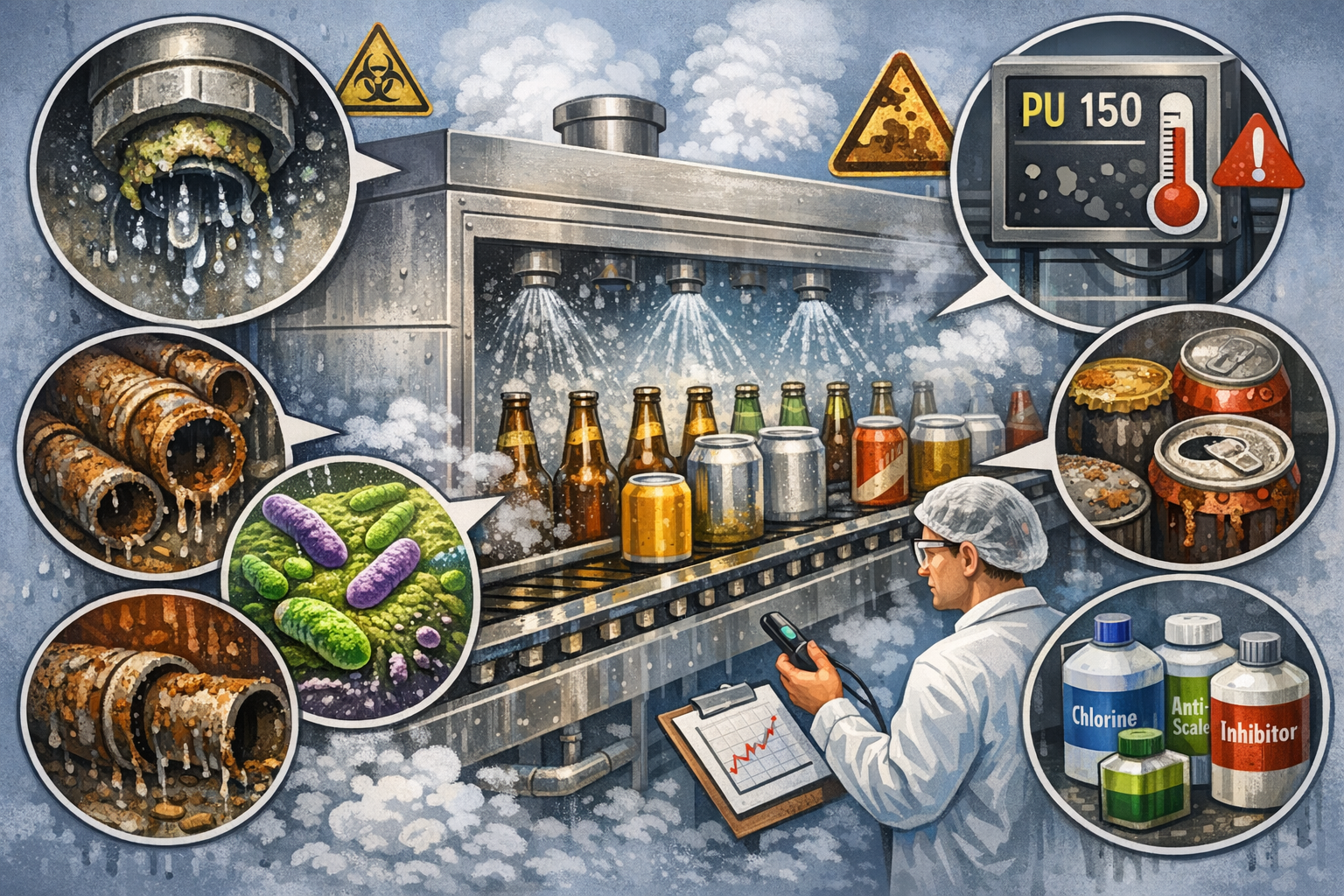
Inside a tunnel pasteurizer, recirculated spray water does the heavy lifting—heating, holding, then cooling packaged beer. It also hauls minerals and organic debris from spills, trapped beer and yeast, and cleaning residues. In Yanjing Brewery’s analysis, spray water is often river or well water that recirculates long-term; “exploding bottles” introduce wort and yeast into the sump, and in cooler zones this forms a “viscous mycoderm” (biofilm) that can plug nozzles and upset sterilization (patents.google.com).
Diversey/Solenis warns spray water can sustain Pseudomonas and other microbes, leading to biofouling that “blocks spray nozzles, screens and filters” and, when hardness salts (Ca, Mg) precipitate, insulating scale that “blocks spray nozzles, reducing beverage shelf-life, heat transference and operational efficiency” (solenis.com; solenis.com). Scale also drives bottle breakage and higher energy/water use, while poor water chemistry can leave rust spots on caps or stain aluminum cans (solenis.com).
Closed-loop water risks: scale, biofilm, corrosion
Untreated pasteurizer water leads to nozzle clogs, poor heat transfer, equipment corrosion, and quality risks (including rust spots on caps and product spoilage). The fix is a managed chemical program that targets microbial control, scale inhibition, and corrosion inhibition—without damaging stainless steel or plastics (eshop.czechminibreweries.com).
Microbial control: oxidants and biofilm sensors
Oxidizing biocides—sodium hypochlorite, chlorine dioxide, peracetic acid or glutaraldehyde—are typically dosed into the spray loop in real time. One method maintains ~0.5–1.0 mg/L free Cl₂ by adding NaOCl every 30–60 minutes (patents.google.com). Inwatec reports a chlorine‑dioxide–based biocide (“INWASAN”) dosed continuously that penetrates biofilms, letting a Belgian brewery extend CIP (clean‑in‑place) from 2 weeks to >8 weeks (inwatec.com). Real-time biofilm sensors (e.g., heat‑transfer probes) can trigger dosing before heavy fouling occurs (inwatec.com; inwatec.com). Any biocide must be compatible with the pasteurizer’s materials, and high‑preservative quats, while effective, can foul sewer treatment and are often avoided (eshop.czechminibreweries.com).
In practice, accurate biocide feed benefits from a dedicated metering skid; a compact dosing pump helps hold tight residuals without overshoot. Where programs call for oxidants, general-purpose biocides are selected for food and beverage compatibility.
Scale control: hardness removal and inhibitors
Upstream, minimize hardness before it precipitates. Guidance suggests softening or purifying feedwater (RO/softener) to <4–6 °dH (~70–100 mg/L as CaCO₃) if possible (eshop.czechminibreweries.com). Breweries commonly deploy a softener for calcium and magnesium and, where source TDS is higher, a brackish-water RO to cut mineral load.
On‑line, antiscalant polymers and chelating acids prevent deposition. One process specifies ≤2.2 mmol/L organic acids (citric, gluconic) to bind calcium, plus ≤0.2 mmol/L of phosphonate inhibitors (freepatentsonline.com; freepatentsonline.com). Phosphonate (e.g., HEDP) and polyacrylate/polyphosphate polymers (≤0.4 g/L) further sequester minerals (freepatentsonline.com; freepatentsonline.com). Some systems also adjust pH to slow CaCO₃ formation, lowering spray‑water pH to 3.5–7.0 with added acids, then adding ClO₂ at ≤0.4 mmol/L (food‑grade acids only) (freepatentsonline.com). Diversey notes that effective antiscalants “inhibit scale deposition and build up,” preventing nozzle clogging and efficiency losses (solenis.com).
For continuous dosing of polymer inhibitors at low ppm, purpose‑designed scale inhibitors can be maintained as a body‑feed to the loop.
Corrosion control: pH and protective films
Corrosion control favors neutral‑to‑slightly‑alkaline pH, with one vendor recommending pH>7 (eshop.czechminibreweries.com). A trace of zinc salt (≤0.06 mmol/L, ~3–4 mg/L) is specified in one scheme as a body‑feed inhibitor (freepatentsonline.com). Some programs use sodium nitrite or molybdate, though nitrite is less common in beverage. Because oxidizing biocides can enhance metal attack, a separate inhibitor is needed. Inwatec measures water redox and injects enough inhibitor so that after pasteurization a protective film remains on bottle caps, preventing rust (inwatec.com). Diversey ties poor water chemistry to “iron rust spots on bottle crowns…or staining of aluminum cans”; proper inhibitors and thorough drainage/drying prevent corrosion‑induced defects (solenis.com).
Packaging halls typically standardize on food‑compatible corrosion inhibitors to maintain that protective film while meeting package appearance requirements.
Dosing skids, setpoints, and verification
Breweries commonly run a closed-loop controller or dosing skid to manage chemistry. A typical program maintains spray‑loop pH ~7–8 (to limit corrosion), residual oxidant ~0.5 mg/L, and scale inhibitors at low ppm. Vendor literature even offers “pre‑installed system for dosing of chemicals – biocide & anticorrosive solutions” with pumps and level sensors for consistent feed (eshop.czechminibreweries.com). All additive doses are tuned based on sensor feedback (hardness, redox, pH) and independently verified by conductivity or titration. Skids often centralize feeds through a single dosing pump per chemical to tighten control.
What the data shows when programs work
With continuous treatment, Inwatec reports a Belgian brewery cut cleaning frequency by ~75% (from bi‑weekly to bi‑monthly), saving water, steam and downtime (inwatec.com). Scale and breakdowns likewise drop; otherwise, scale can force frequent descaling and increase bottle breakage (solenis.com). The net effect is better heat‑transfer efficiency, lower maintenance costs, and preserved package quality.
Pasteurization units (PU) basics and targets
Pasteurization units (PUs) quantify microbial lethality: 1 PU = 1 minute at a base reference temperature, usually 60 °C for beer with Z=7 °C (Z is the temperature change needed to shift the kill rate by one log cycle) (redpostltd.com). Typical stability requires only ~5 PU, but brewers aim for 15–30 PU as a safety margin (redpostltd.com). Over‑pasteurization wastes energy and degrades flavor (oxidative staling).
Temperature profiling across zones
Modern tunnels break into ~10–20 zones, each with its own spray and return. Example setpoints might step 20 °C→50 °C→70 °C→20 °C. PT100 or thermocouple probes at spray nozzles drive PID loops to modulate steam/hot‑water valves and cooling flows. Accuracy is critical: even 0.1 °C error yields ~3.3% PU miscalculation, so sensors are routinely calibrated—lookup table or ice bath—to ensure ±0.1 °C accuracy over 20–80 °C (redpostltd.com).
Cold‑spot monitoring inside the package
Above water temps, brewers measure the “cold‑spot” inside a package using a PU monitor (a dedicated bottle or dummy) with an in‑pack temperature logger, ensuring worst‑case lethality at the slowest‑heating point (typically mid‑depth, center‑line) (redpostltd.com; redpostltd.com). Redpost describes cases where a line thought it was delivering 20 PU but an actual monitor showed >200 PU (redpostltd.com).
PU calculation, cutoffs, and control
PUs are computed digitally: PU = t·10^((T–60)/7) per 1‑minute intervals, using the 60 °C base and Z=7 °C for beer (redpostltd.com). Use a cutoff temperature: below ~50 °C, kill is negligible, so exposure under that is ignored; setting the PU cutoff ~5 °C below the minimum hold‑zone temperature prevents counting “idle” conveyor time as PU (redpostltd.com).
Alarms matter. A clogged nozzle lowers local zone temperature and delivered PUs. Yokogawa notes that unnoticed clogs—e.g., a six‑hour gap between inspections—can permit unpasteurized product to pass; real‑time monitors (infrared cameras or distributed fiber sensors) detect abnormal temperature drops along the tunnel (yokogawa.com). Closed‑loop control can respond automatically—slowing the line or boosting inlet temperature if exit temps or computed PUs are below target.
Validation and trending for consistency
Breweries log PUs for each run and periodically validate with microbiological challenge tests or sterility indicators to confirm “15 PU” achieves the required kill. Trending spots drift; as pumps foul over weeks, average PUs can creep down unless cleaned. Sensors are recalibrated after any significant maintenance or adjustment (redpostltd.com). In regulatory context, pasteurization is defined as killing pathogens (id.scribd.com).
Data‑driven balance for packaging halls
A managed water program—biocide plus inhibitors, with upstream hardness control—keeps the tunnel clean and predictable, cutting CIP frequency and downtime (inwatec.com; solenis.com). For many plants, that begins with mineral control via a softener or RO system, continued with online scale inhibitors and corrosion inhibitors, and stabilized through measured oxidant feeds using a dosing pump and compatible biocides. Cold‑spot PU monitoring and automated cutoffs ensure microbial kill without over‑pasteurizing the beer (redpostltd.com; redpostltd.com).