

Industry: Brewery | Process: Clean
Breweries generate 3–10 liters of wastewater per liter of beer produced, and CIP cleaning cycles are a big part of it (mdpi.com). The chemistry is brutal: alkaline caustic at 0.5–4% sodium hydroxide (NaOH; pH ~13–14) and acidic rinses at 0.5–1% nitric or phosphoric acid (pH ~1–2) (micetcraft.com) (micetcraft.com).
The result is episodic, high‑strength effluent with very high organic load — untreated brewery wastewater often carries BOD (biochemical oxygen demand, a measure of biodegradable organics) in the 2,000–10,000 mg/L range (mdpi.com), COD (chemical oxygen demand) often above 3,000 mg/L, and total suspended solids around 1,800 mg/L (genesiswatertech.com). CIP effluent alone can double or triple the normal organic load entering a plant in a given period.
Then come the pH swings. A flush of caustic or an acid rinse can push pH far outside typical 6–9 discharge bands in Indonesia and many jurisdictions. An EPA training manual warned that if CIP acids/alkalis are “released rapidly…instead of being slowly metered, drastic pH fluctuations” result (nepis.epa.gov). Industry sources say food & beverage CIP liquids “cause a fluctuation in the pH level, flow rates, and temperatures” of discharge (marketscale.com). The stakes: inhibited downstream biology, corroded piping, and non‑compliance.
Automated neutralization architecture
The frontline solution is an automated pH neutralization system that handles both acidic and alkaline CIP waste. In practice, CIP drains feed an equalization/neutralization tank (a mixing and hold vessel) equipped with continuous pH measurement and dual‑dosing capability. When pH runs high, the controller meters acid (often dilute sulfuric or hydrochloric); when low, it adds base (typically sodium hydroxide solution or lime). A recent patent describes a dual‑storage setup — one vessel of acid, one of alkali — each connected via solenoid dosing to a pH‑sensing tank (patents.google.com). In brewery service, metering is commonly managed by dosing pumps, with mixers, pH probes, and panels supplied as water-treatment ancillaries.
Multi‑stage mixing and control
Because CIP chemistry swings between strong acid and strong alkali, designers favor rapid mixing and multiple stages. Process‑control guidance recommends two or three reaction tanks in series, with baffles and agitation to eliminate “areas of unreacted reagent” (eurotherm.com). Control loops must respect the nonlinear titration curve around neutrality; modern systems use proportional‑integral/derivative strategies, sometimes band‑switching dosing rates to avoid overshoot (eurotherm.com) (eurotherm.com).
Operating results and options
Automating neutralization reduces manual handling and error, and can cut chemical use. One wastewater engineering account reported that after adding flow meters, 24‑hour composite monitoring, and pH control loops aligned to CIP schedules, dairy/food clients saw significant reductions in chemical use and operating costs (marketscale.com). The same principles apply to breweries.
Example: A pH‑sensing tank connects to two reagent vessels. When the incoming CIP drain is alkaline, a metering pump draws acid; when the tank becomes acidic, a caustic line opens (patents.google.com). The result is automatic pH drift to ~7. Such systems are widely sold for “acid waste” neutralization in biotech; the Chinese patent illustrates how the design applies broadly to industrial CIP waste. (Patents are not peer‑reviewed, but the design illustrates industry practice.)
Some breweries also use CO₂ dosing (sparging carbon dioxide) to neutralize alkaline CIP effluent by forming carbonic acid. This avoids handling strong acids but depends on the NaOH load; an industry guide notes CO₂ can work in some CIP scenarios but not all (cleanindiajournal.com).
Quantitatively, a well‑tuned neutralizer can hold discharge within 6–9 and often within ±0.5 units of neutral, versus the “drastic pH fluctuations” seen without control (nepis.epa.gov). Chemical savings accrue by dosing to stoichiometry; for example, a CIP batch at pH 12 might call for approximately 25 mM H₂SO₄ per m³ to neutralize, and automation avoids overdosing. Anecdotally, breweries implementing proper dosing report “reduced chemical usage” akin to the dairy case (marketscale.com).
CIP holding and controlled bleed
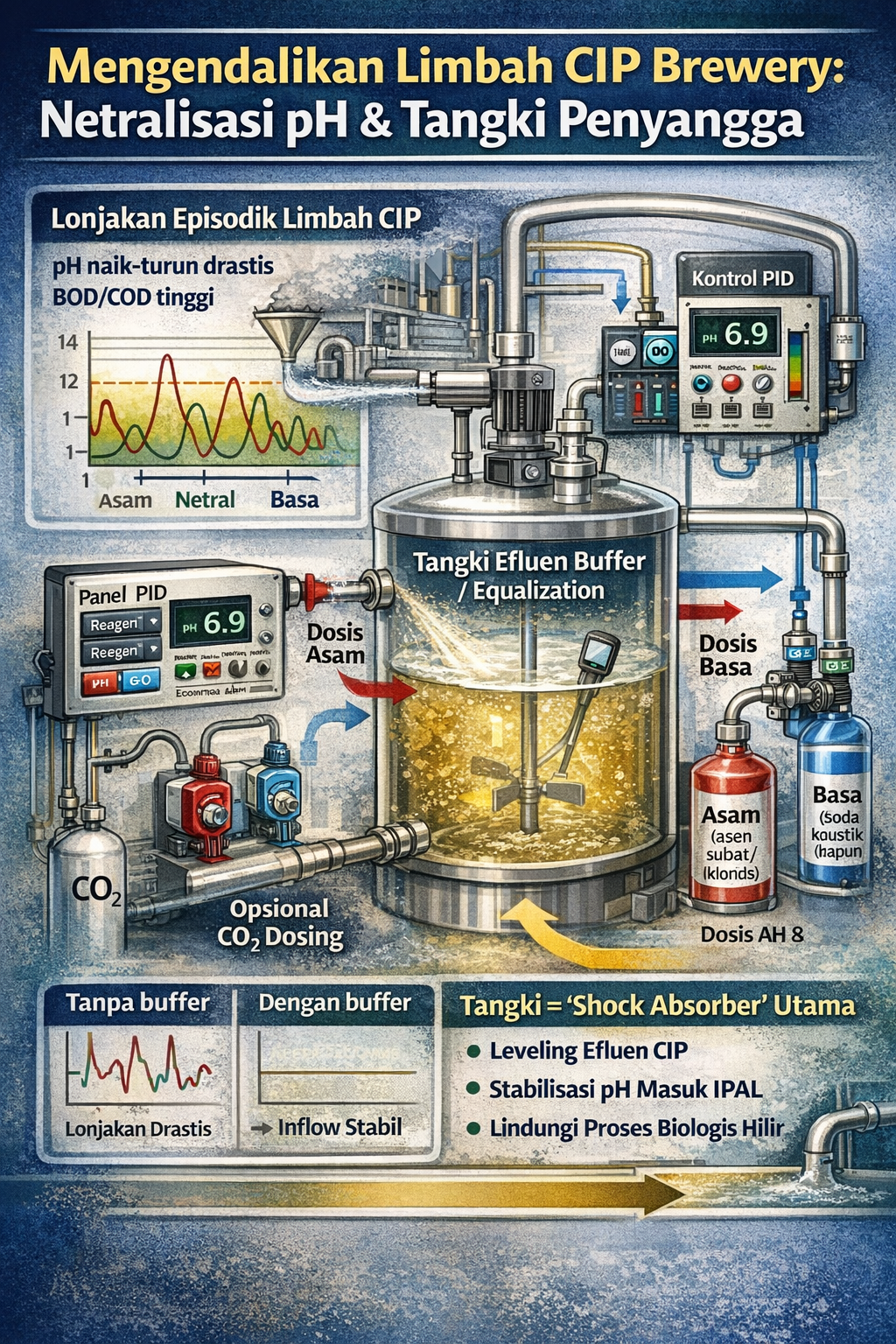
Equalization matters as much as neutralization. A dedicated CIP effluent holding tank — sized to capture the pre‑rinse, caustic wash, acid wash, and final rinse — acts as a surge pool and mixing basin. Instead of dumping directly into the plant sewer or headworks, operators blend and release under control.
- Load leveling: Holding smooths the batchy CIP profile, blending acid/alkali stages and rinses to avoid pH and BOD spikes. As EPA put it, if cleaning solutions are “released rapidly…drastic pH fluctuations” result; slow metering prevents this (nepis.epa.gov).
- Chemical mixing: Acidic and alkaline pulses partially neutralize in‑tank, and proper mixing/detention tempers extremes.
- Automated bleed: Pumping out at a programmed rate — or under a master pH loop — matches the plant’s assimilation capacity. One guide recommends accumulating alkaline CIP water separately and “bleeding this small alkaline stream into the rest of the (more acid) wastewaters under modulating flow control governed by a master pH control” (cleanindiajournal.com).
- Operational flexibility: Decoupling cleaning schedules from continuous treatment prevents off‑shift upsets and enables offline pH adjustment before connection to the main plant.
Sizing, outcomes, and analogues
Dedicated CIP equalization demonstrably stabilizes plants. Operators can maintain near‑neutral pH at the sewer inlet with layered, gentle discharge. Brewery wastewater studies highlight high pH variability as a raw characteristic (mdpi.com); a CIP buffer makes the influent much steadier. Vendors caution that missing this buffer “could result in poor wastewater treatment” (marketscale.com).
As a rough metric, if daily clean‑in‑place uses 50–100 m³ of wash water, a tank of similar capacity provides 24‑hour equalization; blending that 50 m³ slowly into 500 m³ of incoming flow keeps CIP’s instantaneous contribution under roughly 10–20%. In practice, Colorado craft breweries often pipe CIP waste to “brown water” pits for pretreatment before city sewer; with proper flow monitoring and equalization, operators have reduced ammonia spikes and pH upsets during cleanings (marketscale.com).
Protecting downstream biology
The combined neutralization‑equalization approach protects biological treatment — from classic activated sludge basins to systems using biofilm carriers such as moving bed bioreactors (MBBR) — from pH shocks and organic surges. Without it, pH excursions and thermal swings from CIP can inhibit microbes and corrode infrastructure (marketscale.com).
Compliance context in Indonesia
Indonesia is tightening industrial effluent rules in 2025 for food & beverage, including lower limits and real‑time monitoring (greenlab.co.id). Industrial dischargers generally must achieve pH ~5–9; CIP wastes at ~1 or ~13 are far outside that and legally require neutralization and control. Enforcement is rising: Multi Bintang (Heineken Indonesia) recently engaged a licensed transporter to manage “limbah cair non‑B3 ragi” (spent yeast wastewater) as part of a zero‑waste‑to‑landfill strategy (pituku.id). By the same logic, non‑hazardous (“non‑B3”) CIP wastewater must be treated prior to disposal.
Cost and stability, summarized
An automated, dual‑direction pH neutralizer and a CIP holding tank — effectively a “CIP equalization‑neutralization system” — transform a volatile mix of acid, caustic, and organics into a stable, near‑neutral effluent. The payoff: smoother pH profiles, fewer biological upsets, and lower reagent consumption. In one related optimization, halving caustic volume in a microbrewery’s cleaning regime delivered savings of over £1,000 annually — a cleaning chemistry change, but the same conservation mindset applies to neutralization and rinse reuse (academicjournals.org).