
A three-step plant—equalization, high‑rate anaerobic digestion, and SBR polish—can tame brewery effluent, meet discharge limits, and generate biogas. Full‑scale case studies show how to size it and what to expect.
Brewery wastewater is strong, spiky, and perfect for biogas. Think COD (chemical oxygen demand, a proxy for total organics) at 2,000–7,000 mg/L, BOD₅ (biochemical oxygen demand over five days) at 2,000–5,000 mg/L, and suspended solids at 300–1,500 mg/L—paired with a BOD/COD ratio around 0.7 that signals readily biodegradable organics (pmc.ncbi.nlm.nih.gov).
Flows flare during wort runs and clean‑in‑place (CIP; an equipment cleaning cycle), with breweries using roughly 5–15 hL (500–1,500 L) of water per hL of beer produced (sciencedirect.com). That variability is why the proven recipe is a buffer tank up front, a UASB (Upflow Anaerobic Sludge Blanket) to convert organics into biogas, and an aerobic SBR (Sequencing Batch Reactor) to polish to spec.
Here’s the playbook brewery owners and engineers are using—anchored by full‑scale data and design ranges—and where the numbers land.
Wastewater profile and variability
The influent is high‑strength and variable. Reported COD ranges from 2,000–7,000 mg/L and BOD₅ around 2,000–5,000 mg/L; suspended solids (spent grain, yeast) often fall between 300–1,500 mg/L. With a BOD/COD ratio ~0.7, most organics are readily biodegradable (pmc.ncbi.nlm.nih.gov).
Batch brewing and CIP create pulses. Water use typically spans 5–15 hL (500–1,500 L) per hL beer (sciencedirect.com), so an equalization (EQ) tank is recommended to buffer peaks and stabilize pH/organics before biology (pmc.ncbi.nlm.nih.gov; netsolwater.com).
Equalization tank: volume and buffering role
An EQ basin smooths flow and load spikes, typically with 6–24 hours of retention; a Heineken brewery WWTP used an 8‑hour EQ tank (pmc.ncbi.nlm.nih.gov). Peak shaving yielded a small pretreatment effect—~3.9% COD and ~2.9% BOD₅ removal through settling/hydrolysis—but the main role was buffering. The well‑mixed EQ tank enabled partial hydrolysis and pH harmonization (pmc.ncbi.nlm.nih.gov).
Design is driven by flow variation. Example: at 1,000 m³/day (≈41.7 m³/h) average flow, an 8–12 hour EQ (≈350–500 m³ volume) holds a brew‑cycle peak; industry practice often adds 10–20% safety margin (netsolwater.com). Actual removal in EQ is minor (single‑digit percentages) but it greatly improves overall plant stability (pmc.ncbi.nlm.nih.gov). For mixing and instrumentation that keep EQ basins uniform, operators rely on supporting hardware classified as equipment for wastewater treatment.
High‑rate anaerobic treatment (UASB)
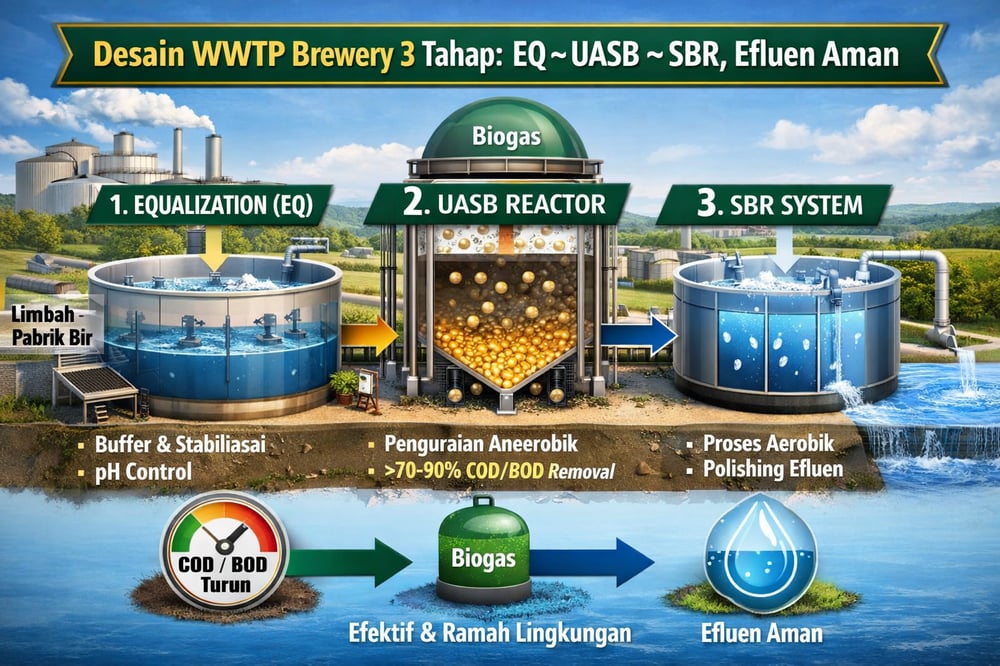
The core stage is a high‑rate anaerobic digester—typically a UASB—running near 30–35 °C (mesophilic; methane‑forming bacteria thrive in this range). These systems handle high BOD cheaply and yield energy, removing roughly 60–90% of COD/BOD in practice. A 500 m³ UASB at ~24 h HRT (hydraulic retention time) achieved 57% COD removal at ambient temperature (researchgate.net), while a 7‑year full‑scale Korean plant averaged >80% COD removal (researchgate.net).
In Ethiopia, one brewery’s UASB achieved 88% BOD₅ and 88% COD removal, with effluent COD ~530 mg/L from ~4,300 mg/L influent and BOD₅ ~156 mg/L (pmc.ncbi.nlm.nih.gov; pmc.ncbi.nlm.nih.gov). Modern high‑rate variants (e.g., internal circulation) can approach >95% organics removal when optimized (eco-business.com; eco-business.com). These systems are widely offered under anaerobic and aerobic digestion categories.
Design anchors: UASBs typically operate at organic loading rates of a few to ~10 kg COD/m³·day; lab models show optimum methane yield near ~8 g COD/L·d (researchgate.net). Biogas yields are ~0.30–0.35 m³ CH₄ per kg COD removed. Scale example: a Thai brewery (17,000 m³/d flow, ~82,500 kg COD/d) produced ~30,000 Nm³/day of biogas at 76% CH₄—enough to supply boilers or generators and cut fuel costs by ~30–45% (eco-business.com; eco-business.com; researchgate.net).
Other notes: anaerobic systems generate little sludge compared with aerobic (lower biomass yield). Cold climates may require heating; in Indonesia’s warm climate (ambient ~28–32 °C as in the Ethiopian case), UASBs often operate unheated (pmc.ncbi.nlm.nih.gov). UASB effluent typically has no dissolved oxygen and can show some ammonia/organic acids and even increased soluble N and P from mineralization—hence the aerobic polishing step to bio‑oxidize residual organics and nitrify ammonia (researchgate.net).
Aerobic polishing with SBR cycles
An SBR (Sequencing Batch Reactor; fills, aerates, settles, decants in time‑sequenced batches) is a common polish for brewery effluent and aligns with batch operations. Typical cycles last 6–12 hours, with ~50% of the time under aeration and mixing (clearfox.com). Commercially packaged options are cataloged as SBR systems.
Run at moderate sludge ages (SRTs), SBRs remove >90% of the remaining COD/BOD; Khumalo et al. report up to ~90% COD removal at 20–25 °C under longer retention (5–7 days), with ~50–60% removal at shorter SRT/HRT (mdpi.com). In practice, with 1–2 day SRT an SBR reliably polishes UASB effluent to meet discharge limits. In the Ethiopian plant, aeration cut BOD₅ from ~156 mg/L to ~38 mg/L and COD from ~531 to ~136 mg/L—values that match commonly cited discharge targets (Poland, Germany, or Indonesia often require BOD₅ ≲50 mg/L, COD ≲100–150 mg/L) and are comparable to industry claims of ~20 mg/L BOD₅ and ~100 mg/L COD (pmc.ncbi.nlm.nih.gov; clearfox.com).
Nutrients can also drop in polishing: in the Heineken case, total nitrogen fell from ~37 mg/L to ~17 mg/L and total phosphorus from ~30 mg/L to ~16 mg/L (pmc.ncbi.nlm.nih.gov). Achieving low ammonia often requires extended aeration or a dedicated nitrification phase. Solids settle each cycle and are wasted as sludge.
Efficiency, energy, and operating costs
Multi‑stage plants routinely deliver very high removal. Combining an 8‑hour EQ tank, UASB, and SBR has yielded final COD ≈100 mg/L and BOD₅ ≈20–50 mg/L—translating to >95% overall removal in some installations (clearfox.com; pmc.ncbi.nlm.nih.gov). Carbon conversion to methane can cover a significant slice of a brewery’s energy needs: the Thai example converted 82.5 tCOD/d into 30,000 m³/d biogas (≈23,000 m³/d CH₄), equating to ~700–800 GJ/day and displacing fossil fuel use (eco-business.com; eco-business.com).
Costs skew favorable once biogas is used. Reported UASB operating costs are about US$0.20–0.31 per m³ of treated water (dropping to roughly $0.1/m³ hydraulically with energy recovery), while SBR aeration typically draws ~0.5–1 kWh/m³. Sludge production is modest at ~0.05–0.2 kg TSS/kg BOD₅ removed (researchgate.net; mdpi.com).
Regulatory outcomes and scalability
Final polishing puts breweries within strict discharge limits. After SBR, the Heineken plant’s effluent measured BOD₅ ~38 mg/L and COD ~136 mg/L—already within stringent thresholds (some standards allow COD up to 75–100 mg/L for rivers), and many jurisdictions (Poland, Germany, Indonesia) often require BOD₅ ≲50 mg/L and COD ≲100–150 mg/L (pmc.ncbi.nlm.nih.gov). If needed, nutrient targets like N < 10 mg/L and P < 2 mg/L for sensitive waters are achievable by adding anoxic denitrification or chemical P‑precipitation (pmc.ncbi.nlm.nih.gov).
These technologies scale from a few m³/d to very large breweries. Beyond UASB, EGSB or hybrid anaerobic reactors have delivered >95% removal in trials (eco-business.com). SBRs are modular—think 50–500 m³ basins per 1,000 m³/d flow—with process control for robustness (clearfox.com).
Sizing benchmarks and takeaways
Data‑driven guideposts recur across studies: an EQ tank of several hours (8 h used in practice) to buffer daily peaks (pmc.ncbi.nlm.nih.gov); a UASB sized around ~24 h HRT with design OLRs of a few to ~10 kg COD/m³·d (e.g., ~500 m³ UASB for 1,000 m³/d flow) (researchgate.net); and an SBR with 4–8 h aeration within 6–12 h cycles to meet final discharge limits (clearfox.com).
Owners should expect ~80–90% overall COD reduction and significant biogas production (~0.3 m³ CH₄ per kg COD removed), with UASB OPEX around US$0.20–0.31 per m³ (about $0.1/m³ once biogas is utilized). Where optimized, overall removal can exceed 95%, and energy recovery can reach ~700–800 GJ/day in very large plants (researchgate.net; eco-business.com).
Sources and citations
All data and metrics are drawn from brewery‑specific case studies and reviews: Shumbe et al. (2024) on a Heineken plant in Ethiopia (pmc.ncbi.nlm.nih.gov); Parawira et al. (2005) on full‑scale UASB performance in a tropical brewery (researchgate.net); Ahn, Min, and Speece (2001) on long‑term UASB costs and removals (researchgate.net); Khumalo et al. (2022) on SBR COD performance (mdpi.com); and Eco‑Business coverage of Asian brewery biogas yields (eco-business.com).
