
Diatomaceous earth (DE) has long powered beer clarity, but its dust hazards, waste, and oxygen pickup are pushing breweries toward cross‑flow membranes and lenticular cartridges. Here’s how performance, capital, operating costs, and beer quality really stack up.
Classic pre‑coat filters using diatomaceous earth (DE, “kieselguhr”) get the job done. They also generate hazardous solid waste, carry recurring media costs, and can introduce dissolved oxygen and metal contaminants. Modern breweries are increasingly looking at two alternatives: cross‑flow (tangential) membrane filtration and pleated depth/lenticular cartridges.
DE pre‑coat filtration context
DE filtration is effective, but every run creates a spent cake that must be handled and landfilled. Operators also cite oxygen pickup risks and trace metal contaminants from spent DE, alongside ongoing filter‑aid purchases and disposal fees.
Cross‑flow membrane filtration design
Cross‑flow systems circulate beer tangentially across a micro‑ or ultrafiltration membrane (often hollow‑fiber or ceramic, about ~0.45 µm pore size; “µm” denotes micrometers). They remove yeast and solids without pre‑coat aids, yielding clarified beer in a closed loop (ResearchGate). For breweries specifying sanitary UF modules, references like ultrafiltration help anchor pore‑size and hygiene requirements.
Filtration flux (throughput per membrane area) is lower than DE: roughly 50–100 L/m²·h, about one‑fifth of a good DE pre‑coat at 250–500 L/m²·h (ResearchGate). In practice, typical cross‑flow achieves on the order of 0.5–1.0 hL per m²·h under cold conditions. New designs, such as Krones/Steinecker Phoebus, use series‑connected modules and targeted back‑flushing to both boost throughput and minimize fouling (Krones).
High cross‑flow velocities (4–6 m/s) with CO₂ backpulsing can reach ~100 L/m²·h on rough lager—at higher energy input (ResearchGate).
Cross‑flow yield and oxygen control
Unlike batch DE filtration, cross‑flow continuously recirculates beer. Losses are minimal—mostly the small retentate and primer. Breweries often recover yeast‑slurry beer separately; one yeast‑recovery cross‑flow unit recovers beer that would otherwise be ~2–3% of volume lost in yeast (COROSYS). Cross‑flow can also filter directly from fermentation to bright tank, eliminating extra settling and pump passes (Brewer Magazine).
Cross‑flow beer quality and stability
Multiple studies found no detectable sensory difference versus DE. In a parallel trial, a Weihenstephan tasting panel reported “no significant difference in taste” between cross‑flow‑ and kieselguhr‑filtered samples (Brewer World). Standard analytical parameters (pH, extract, color, fermentation by‑products) also showed no appreciable change (Brewer World, Brewer World).
Membrane systems routinely achieve final turbidity <0.5 EBC (EBC is a turbidity/color scale) and remove spoilage organisms (bacteria/yeast) entirely, often eliminating the need for pasteurization (Brewer World). The closed‑loop design greatly limits oxygen pickup; a vendor notes “extremely low oxygen pick up” and no contamination by spent DE’s iron or manganese (Brewer World). In short, cross‑flow is at least as gentle as DE on flavor and aroma (Brewer World, Brewer World).
Cross‑flow capex, opex, and automation
Equipment capital is sizable. A mid‑sized (~100 hL/h) skid typically costs in the hundreds of thousands of USD (manufacturers cite rapid ROI for craft brewers, but don’t publish list prices). Systems are skid‑mounted and automated, often replacing an entire DE filtration train plus a yeast separator (Brewer World). More than 150 million hL/yr are filtered by such systems worldwide, indicating rapid growth despite high capex (Brewer World).
Operating cost centers are utilities (pumping energy, heating caustic for cleaning‑in‑place, CIP) and periodic membrane replacement. A feasibility study estimated optimized cross‑flow opex at ≈€0.40–0.50 per hL of beer, including electricity (~66.5 Wh/L of beer) and cleaning chemicals/water (ResearchGate, Krones). Modern series module layouts cut pump power, and targeted backflushing can dramatically reduce CIP volume and chemical use (Krones). Cross‑flow forgoes DE altogether, saving on filter‑aid purchases and waste disposal (no hazardous silica). By contrast, DE filtration often consumes 1–3 kg DE per hL. Multiple brewery comparisons found cross‑flow’s opex per hL can be comparable to or even lower than DE filtration (Brewer World).
Membranes last several years (depending on material) and are cleaned in place. Automation is high (CIP programmable), which reduces labor. Chemical dosing for consistent CIP can be integrated with metering equipment such as a dosing pump.
Lenticular depth cartridge systems
Lenticulars are pleated depth filters (stacked disc cartridges) inside a pressure vessel—functionally similar to plate‑and‑frame but in a closed, vertical housing. They are typically run as multi‑stage dead‑end filters: a coarse depth stage (often using diatomite or perlite billets) to remove bulk solids and yeast, followed by polishing cartridges (cellulosic or bonded‑fiber media, β‑rated) that yield clear beer. Final sterile filters (0.45–0.65 µm membrane cartridges) are usually applied after the liquid is substantially clear to ensure microbial stability (ProBrewer). Systems are modular: a typical 16″‑diameter housing holds 1–6 cartridge modules, and brewers can chain primary, trap, and fine cartridges as needed (see table below).
Food‑grade housings matter in beverage service; 316L stainless designs such as an SS cartridge housing are commonly specified to maintain hygiene and pressure integrity.
Lenticular throughput and clarity
Lenticular cartridges deliver moderate flux with high per‑unit throughput. A 16″×1‑high Suprapak module (~5 m² area) can process ≈7–9 bbl/hr (≈800–1050 L/h) during fine polishing (Scott Labs). Larger modules (32–48 m² Suprapak columns) can handle 14–40 bbl/hr depending on grade (Scott Labs)—roughly 2–4 hL/hr per 32 m² module, i.e., ~200–400 L/m²·h. That’s significantly higher per area than hollow‑fiber membranes (ResearchGate), though still lower than full DE flow. Breweries typically size 1–3 housings to filter a batch in reasonable time. Performance depends strongly on incoming clarity and media grade (coarser media flow faster but retain less haze).
Depth filtration removes haze‑causing particles and most yeast. With appropriate media it yields brilliant beer (turbidity <1 EBC). By itself it does not guarantee sterile beer; a final membrane cartridge is recommended to remove bacteria and remaining yeast (ProBrewer). Industry casework reports modern pleated microglass cartridges passing rigorous flavor tests, with a large brewer switching to 0.45 µm microglass filters without any flavor impact (Global Filter). They do not inherently change beer chemistry, since depth media adsorb very little of flavor‑active solubles.
For the polishing stage, breweries often rely on sanitary cartridge filters that slot easily into existing housings and validated sterile‑membrane steps.
Lenticular cost profile and operations
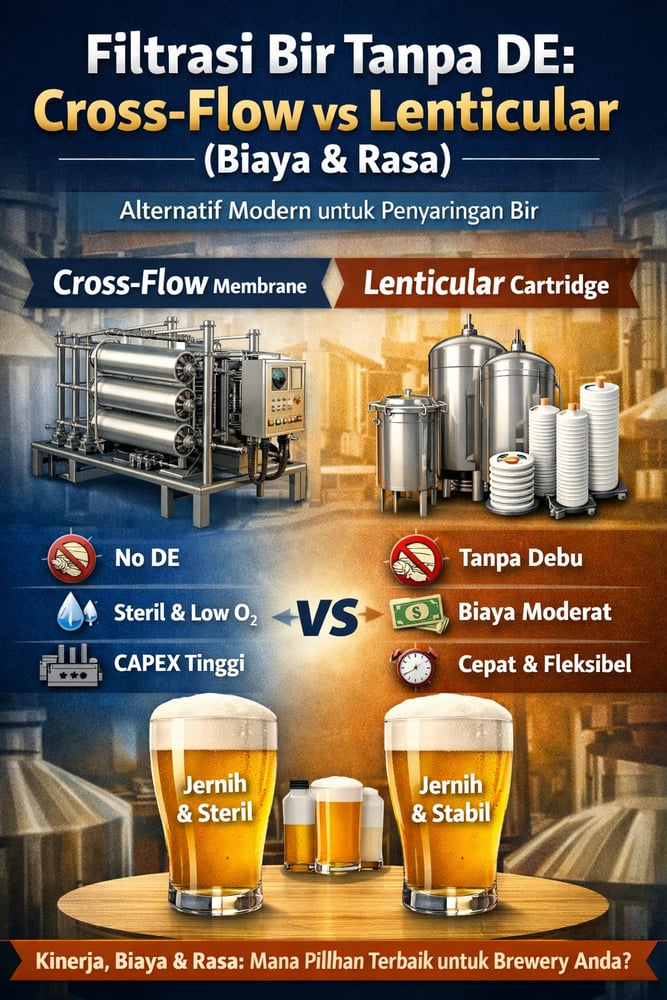
Capex is relatively low. A stainless 16″×3‑high housing (~15–20 m²) is on the order of $10–20k USD, plus pumps and plumbing. Each cartridge module (5″ or 8″ diameter) ranges from a few hundred to a thousand dollars depending on media; a typical 16″ Suprapak module (~10 m²) may cost ~$1k–$2k. A multi‑module setup often totals ~$20–50k. Figures are rough; actual quotes vary by vendor. No complex skids or automation are needed.
Opex centers on filter media and disposal. After each brew—or every few brews depending on ∆P (pressure drop)—cartridges must be replaced. A polisher pack (β‑rated depth media) might filter ~60–100 hL before exhaustion; at 10 m² at $1000 each, that’s ~$10 per hL just for media (compared to ~€0.50/hL for cross‑flow). In practice, lenticular media costs can exceed DE if high flow or very fine final “saltation” (fine cutoff) is needed. There are no hazardous dust issues (unlike open DE powder), and spent cartridges are non‑toxic (though bulky). Water and CIP chemicals are still used, typically every batch. Overall, lenticular opex tends to be moderate—higher than a single DE run (multiple consumable stages) but generally lower than cross‑flow’s energy/CIP cost when operations are scaled.
Head‑to‑head economics and throughput
Capital: a small craft cross‑flow skid (tens of hL/h capacity) often runs ~$150k–300k+, while lenticular setups delivering similar output sit in the mid‑five‑figures (ResearchGate, Scott Labs). Cross‑flow outlays can be weighed against eliminating DE infrastructure and obviating trap/fine steps, which may offset some lenticular capex and vessel space.
Operating expense: cross‑flow removes consumables (no DE, no pads) but adds energy/CIP. A detailed study puts optimized cross‑flow at ≈€0.40–0.50 per hL (ResearchGate). Lenticular opex varies with media life; a representative case at $1k per 10 m² replaced after ~100 hL yields ~$10/hL in media alone. In practice, lenticular opex often sits between DE and cross‑flow: higher than single‑pass DE, but usually lower (especially at scale) than power/CIP‑intensive cross‑flow. Waste disposal fees (only for DE) and environmental compliance (DE is silica; cartridge waste is inert) factor in.
Throughput: lenticulars usually deliver higher throughput per m² of media than hollow‑fiber membranes due to coarser dead‑end flow (ResearchGate, Scott Labs). Cross‑flow’s continuous, closed process can replace multi‑stage depth filtration in one step; guidelines show a 0.65 µm cross‑flow unit substituting for a primary DE filter and both trap/fine lenticular polishing steps (ProBrewer). In practice, this can speed up packaging.
Beer quality: both deliver excellent clarity. Cross‑flow repeatedly matches DE in taste (no significant difference) and offers superior microbial sterility without oxygen pickup (Brewer World, Brewer World, Brewer World). Lenticulars reach DE‑grade clarity and, with final membranes, ensure sterility; tests show no adverse flavor impact from cartridge filtration (Global Filter). The main differences are process‑driven. Cross‑flow’s CO₂‑inert, closed loop offers a subtle edge in yield and stability; dead‑ended lenticulars benefit from extra care (e.g., CO₂ blanketing) to limit oxidation (Brewer World).
Environmental/health: cross‑flow eliminates DE entirely—no siliceous dust hazards or cake disposal. Lenticulars remove open DE dust exposure but still create solid waste (used cartridges). Neither method consumes fresh filter aids after initial setup. Water use is engineered down in cross‑flow via internal recycle and staged backflush to minimize rinse volumes (Krones); lenticulars require rinsing between heads but use moderate water/CIP comparable to DE filters.
Data at a glance (example metrics)
- Cross‑flow opex: ~€0.40–0.50 per hL (power/CIP) (ResearchGate).
- Lenticular media cost: e.g., ~$10/hL (using $1k per 10 m² per 100 hL) (est.).
- Beer flux: cross‑flow ≈50–100 L/m²·h (ResearchGate); lenticular ≈200–400 L/m²·h (Scott Labs).
- Global scale: >150 million hL beer/yr now filtered by cross‑flow worldwide (Brewer World).
Equipment integration notes
Breweries upgrading filtration often standardize on sanitary components across the skid and cellar. Ultrafiltration modules, as referenced under ultrafiltration, align with cross‑flow pore‑size targets. Cartridge‑based sterile steps pair cleanly with a hygienic stainless cartridge housing, and polishing elements are straightforward with a validated cartridge filter.
Bottom line and sources
In side‑by‑side terms: cross‑flow offers high‑quality, sterile beer with minimal yield loss, comparable or lower per‑hL costs once amortized, and major labor/waste savings via closed, automated operation—tempered by higher capital and higher energy/CIP inputs (ResearchGate, Brewer World). Lenticular depth filtration is low‑capex, high‑throughput, and proven, with recurring cartridge costs, more labor, and step‑wise stages as trade‑offs. Microbreweries seeking easy retrofits often favor lenticulars, while larger or fast‑growing breweries find cross‑flow’s long‑term economics and consistency justify the investment; today more than 150 million hL/yr are filtered by cross‑flow worldwide (Brewer World, Brewer World). Relevant regulatory notes (e.g., DE hazards) underline the trend toward alternative methods.
Technical references used throughout include brewing institute studies and industry white papers: Brewer World, ResearchGate, Brewer World, Krones, Scott Labs, Brewer World, ProBrewer, Brewer Magazine, COROSYS, and Global Filter.
