

Caustic wash at pH ≈12.6, acid rinse at pH ≈0.8—brewery wastewater can whiplash in minutes. A compact, automated pH neutralization train is now the quiet hero keeping discharge within 6–9, cutting chemicals, and avoiding fines.
Industry: Brewery | Process: Wastewater_Treatment
Here’s the untold story in craft beer: the same clean‑in‑place (CIP) cycles that keep tanks spotless can leave wastewater swinging from near pH 0.8 to ~12.7 in a single day. Caustic (NaOH) wash cycles often use ~3% NaOH (pH ≈12.6) and acid rinse (~1.5% H₃PO₄/HNO₃ mixture, pH ≈0.8) (onlinelibrary.wiley.com). Spent rinse water can thus range from near pH 0.8 up to ~12.7.
Without intervention, that profile will blow past typical environmental discharge limits—Indonesia and many jurisdictions mandate roughly pH 6.0–9.0, similar to Boulder’s brewery limit of 6–10 (dewco.com). Automated control, in practice, must always clamp final pH within 6–9 (target ~7–7.5). The stakes are practical: balancing these extremes prevents corrosion in sewers and avoids surcharges or fines—Boulder’s regulation was driven by infrastructure damage from corrosive brewery waste (dewco.com).
Scale matters too. Breweries typically use 5–7 L of water per liter of beer (wase.co.uk), so even medium producers push many m³/day. Minimizing violations is essential.
Neutralization tanks and staged dosing
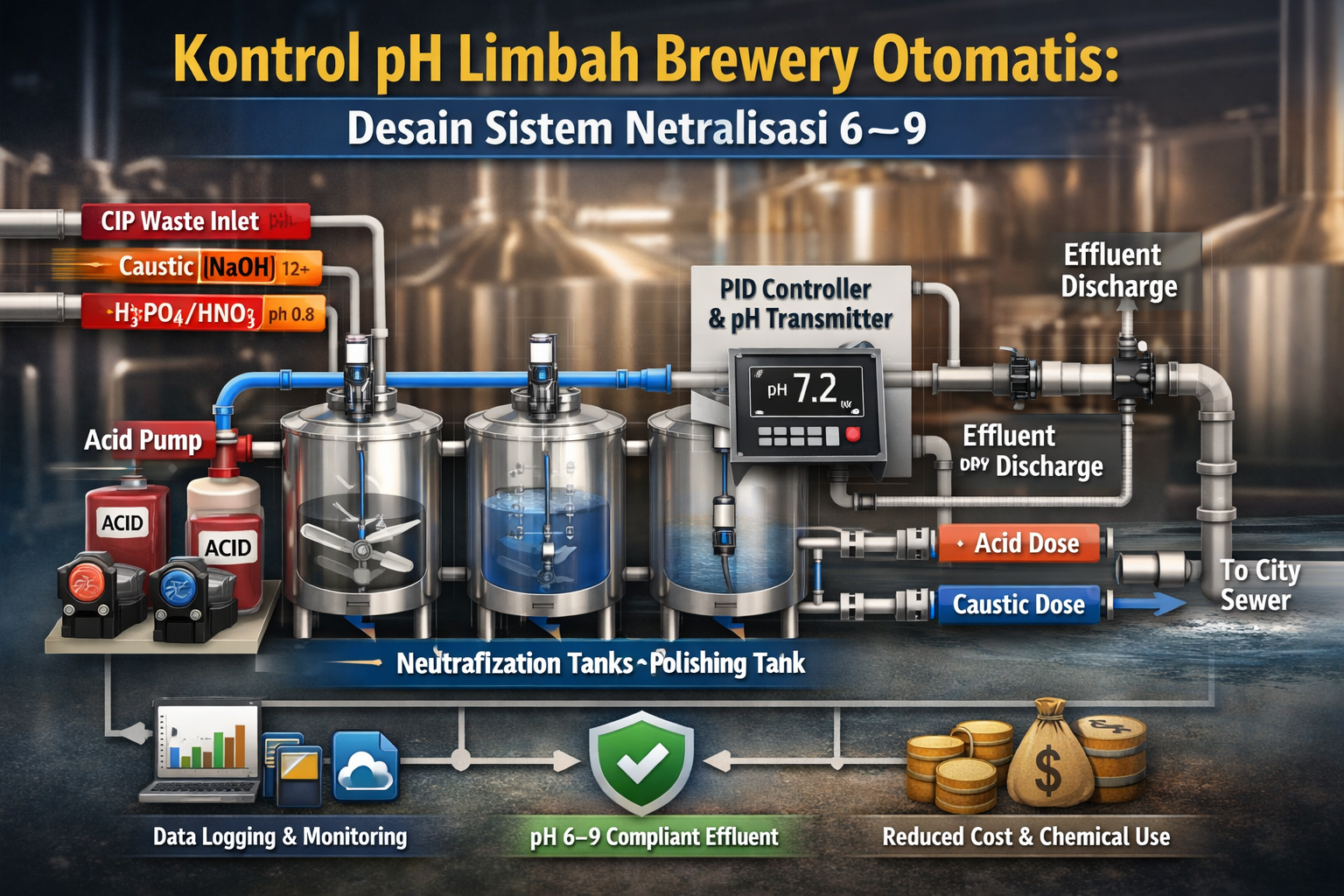
The backbone is a set of dedicated reactor tanks with vigorous mixing and staged chemical dosing (eurotherm.com). Industry practice favors multiple small tanks—two or three in series—for strong acid/alkali neutralization (eurotherm.com). Each tank is baffled and agitated so reagents fully mix before measurement; probe placement matters, so the in‑line pH sensor sits in a well‑mixed zone away from injection points (eurotherm.com). Retention time is kept tight to process CIP bursts quickly, and the typical mode is batch: collect CIP rinses in a holding tank, recirculate and dose until neutralized, then discharge (dewco.com).
Design starts with the largest expected CIP slug (plus safety factor), powerful mixers, and vertical baffles. Two or three tanks let operators bring pH near target in the first vessel and polish in the second (eurotherm.com). Metering happens via at least two chemical pumps—one for acid, one for caustic—capable of precise, low‑flow additions; high‑precision peristaltic or diaphragm units improve accuracy over simple valves (dosing pumps) (eurotherm.com). Double pH probes are standard: an in‑tank transmitter closes the loop for control, while a “safety” probe on the discharge line interlocks a valve or alarm—if effluent slips outside 6–9, the system halts or recirculates to prevent a violation (dewco.com) (dewco.com).
Automated batching in practice
One brewery neutralizer used exactly this setup: two stainless tanks (one mixing, one polish) buffered by recirculation pumps; two chemical pumps (acid and caustic); and two pH sensors (one in‑tank, one at outlet) feeding a PLC (programmable logic controller) (dewco.com) (dewco.com). Once the tank hit a level setpoint, the recirculation pump mixed the fluid; a PID (proportional–integral–derivative) controller modulated acid/caustic pumps until tank pH held at ~7 for a set time, then a solenoid valve opened to discharge (dewco.com). Batching ensures CIP pulses are neutralized before release, and the outlet interlock guarantees compliance.
In‑line sensors and instrumentation
Modern in‑line pH sensors—digital Memosens/ISFET (ion‑sensitive field‑effect transistor) “smart” probes—are built for harsh waste, with sealed, corrosion‑resistant electrodes and automatic temperature compensation (es.endress.com). Memosens (Endress+Hauser) offers digital outputs, built‑in calibration reminders, and data logging for maintenance traceability (es.endress.com). Typical performance: ±0.1 pH and response times under 5 seconds—more than adequate for wastewater control. For longevity, designs allow easy cleaning and may add a pre‑filter to remove solids; supporting hardware is commonly sourced as wastewater ancillaries.
Dual‑channel digital pH transmitters (for example, Endress Liquiline CM448) read both probes and, with onboard PID, can directly drive chemical dosing without a separate PLC; they also support datalogging or SCADA (supervisory control and data acquisition) integration (cromartyautomation.com.au). A flow meter on the effluent line provides totalized discharge and enables feedforward control; in one brewery project, a flow totalizer plus SD‑card logger recorded cumulative discharge and pH history for the utility (cromartyautomation.com.au). Level controls—float or ultrasonic—trigger recirculation and dosing sequences.
The control panel is compact: one or two analyzers/transmitters, pump drives (VFDs or analog), and a simple PLC or microcontroller to sequence Automatic/Manual modes (cromartyautomation.com.au). Some designs even avoid a full PLC, using the pH transmitter’s PID to modulate pump speed and an auxiliary relay for the drain valve (cromartyautomation.com.au).
Control strategy for non‑linear pH
pH control is famously non‑linear—responses are slow at extremes and fast near neutrality (eurotherm.com). Plants counter this with PID gain scheduling: one tuning set near pH 7 for tight capture, and a broader band farther from neutral. Switching proportional bands by pH region helps avoid output bumps (eurotherm.com).
Feedforward by flow anticipates dosing needs during influent surges: monitor incoming rate and proportionally ramp reagent before pH drifts (eurotherm.com). Mixing and sensor response introduce deadtime (process delay), so some systems apply Smith predictor–style model compensation; in small tanks, careful conventional tuning often suffices (eurotherm.com). A small deadband around setpoint prevents hunting—e.g., require pH stable for 1–2 minutes inside 6.8–7.2 before opening the discharge valve (dewco.com).
In operation, fully automated systems—such as Upslope’s—run once configured: the controller measures pH and adjusts both the mixing pump and dosing pumps automatically (dewco.com). Operators set the target pH range and fluidization level; the PLC handles the rest. Maintenance alarms (e.g., sensor drift) and data logging are built in.
Compliance outputs and benefits
By design, the effluent is held in‑spec (6–9) before discharge. If the final check sensor sees an excursion, discharge halts until fixed (dewco.com). For breweries, that translates to 100% compliance with no surprise excursions.
There are measurable outcomes. Upslope reported a “big reduction in process chemical use” after installing neutralization (dewco.com). By neutralizing and reusing some CIP rinse water and avoiding overdosing, they cut NaOH/HCl consumption; efficient control also minimizes overshoot, saving reagent. Disposal is another cost lever: small breweries sometimes pay up to £8–18/m³ to haul waste—totaling ~£250k/yr for medium breweries (wase.co.uk). On‑site neutralization, with the potential to reuse water, can slash this bill.
Automated data logging—flow totals, pH histories—provides audit proof; one case used an SD‑card recorder to archive all discharge events (cromartyautomation.com.au). Some systems push data to SCADA or the cloud for remote compliance monitoring. Modern packages are compact; one integrated panel (no PLC) fit neatly and matched plant aesthetics (cromartyautomation.com.au). Capital cost is offset by eliminating fines and saving on chemicals and hauling.
Bottom line: a properly designed neutralization system—with mixed reactors, in‑line pH probes, and a smart PID loop—transforms raw brewery effluent into compliant discharge. It stabilizes pH in real time (6–9), cuts operating costs (less chemical waste and hauled water; dewco.com; wase.co.uk), and delivers continuous assurance to regulators via sensors and data logs (cromartyautomation.com.au).
Sources cited include case studies and designs (dewco.com; cromartyautomation.com.au), technical guidance (eurotherm.com; onlinelibrary.wiley.com) and water‑use/cost data (wase.co.uk; wase.co.uk).