
Spent grain piles up by the tonne for every brew, yet most breweries still hand it to farmers for little or nothing. Drying can unlock value, but the energy bill (and CAPEX) usually kills the ROI — while traditional whirlpools remain the cheapest way to strip trub from wort.
Brewing generates very large wet wastes: roughly 20 kg of wet brewers’ spent grain (BSG) per 100 L of beer (www.redalyc.org) (pmc.ncbi.nlm.nih.gov). BSG — the fibrous barley/malt residue after mashing — is about 75–80% water (only 20–25% dry matter) (www.researchgate.net) (www.mdpi.com), with one study finding typical wet BSG at ~77–80% moisture (www.mdpi.com).
Scale makes the headache obvious. Global beer output was ~1.89 billion hL in 2021 (hL: hectoliter, 100 L), implying on the order of 38 million tonnes of BSG per year worldwide (pmc.ncbi.nlm.nih.gov). If waste is carted off, one analysis estimates disposal costs up to €13.64 per hL of beer — assuming ~20 kg BSG + 3 kg yeast per hL (www.researchgate.net).
In practice, most breweries avoid disposal fees by giving (or selling) wet BSG to farmers or feed producers; in Europe ~70% is reused as animal feed, ~20% landfilled, and ~10% used for biogas (pmc.ncbi.nlm.nih.gov). Market prices are low: wet BSG is valued only about €35–50 per tonne (wet) (pmc.ncbi.nlm.nih.gov). At 20 kg BSG per hL (0.02 t), that’s just €0.70–€1.00 per hL. Anecdotal evidence from small breweries is that spent grains are often free to take, with one Montana microbrewery reportedly giving away 2 tonnes/week — the rancher’s only cost was diesel to haul it (agupdate.com). The result: selling wet BSG yields essentially zero margin for the brewery and is used chiefly as waste avoidance.
Spent-grain drying economics
Drying and pelleting BSG reduces volume and extends shelf life, but at a steep cost. Industrial dryers (e.g., rotary drum systems with dewatering presses) typically cost tens to hundreds of thousands USD — pilot systems around $10–30k, larger plants >$100k — to handle several tonnes per hour (www.feeddryer.com). Operating energy is also substantial: one manufacturer’s data for an 85%→15% moisture line shows ~34–90 kW of installed power processing 0.4–1.7 t/h (www.feeddryer.com).
Thermodynamics hard-cap the bill. To dry 1 tonne of wet BSG (~0.2 t dry), roughly 0.8 t of water must be evaporated, requiring ~7.5 GJ of heat (~2,100 kWh; GJ: gigajoule; kWh: kilowatt-hour) at best. That implies roughly $150–$250 of heating-equivalent per tonne of wet BSG, or ~$750–$1,000 per tonne of dry product (assuming $0.10–0.20/kWh). While removing water raises energy density from ~2 MJ/kg wet to ~16 MJ/kg dry (www.mdpi.com) (www.mdpi.com) — making BSG a better biofuel or concentrated feed — few small breweries recoup dryer costs.
The potential upside is a higher-value product: dried spent-grain pellets or “brewer’s grain flour” can command higher prices, and the dried-spent-grain market is projected to grow at 4.7% CAGR (compound annual growth rate) in 2025–2035, driven by demand for green feeds, compost, and fertilizers (www.futuremarketinsights.com). In practice, drying 1 t wet (yield ~0.2–0.25 t dry) might require ~$200 in fuel/energy but only produce a few tens of dollars of feed value; dried BSG pellets might sell on the order of $80–150/tonne if high quality. Unless a brewery has cheap waste heat or a guaranteed market (e.g., integrated livestock/pet-food operations), analyses often find the ROI poor for standalone dryers. A Brazilian case study notes small craft brewers generally find BSG valorization (e.g., as flour) economically unviable without subsidy (www.mdpi.com) (www.mdpi.com), so most instead route BSG as-is to farmers or disposal.
Wort–trub separation technologies
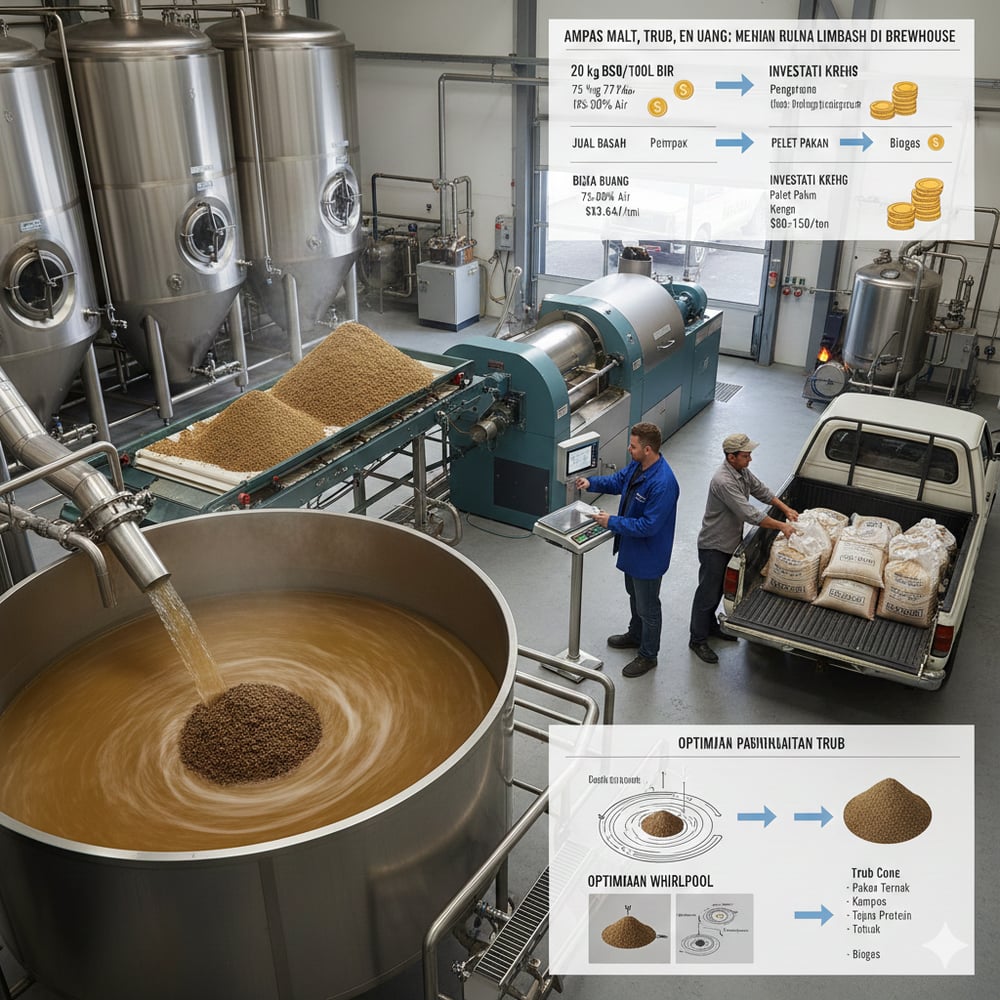
After boiling, breweries must strip trub — hot break proteins and hop solids — from the wort (the sugar-rich liquid that will ferment). Traditionally this is done by whirlpooling: the boiled wort is pumped tangentially into a conical tank and allowed to circulate, creating a centrifugal effect that forces insolubles into a loose cone at the center bottom, with clarified wort around the sides (frca.paulmueller.com) (www.gea.com).
After an appropriate dwell time — often ~20–30 minutes — a valve is opened at the bottom to “knock out” the accumulated trub, and clear wort is drawn off from above it (frca.paulmueller.com). Key design factors include inlet velocity, tank geometry, and flow rate — all tuned to form a compact trub cone (www.gea.com). This passive whirlpool method is generally the most economical for hot-trub removal; analysts note it’s cheaper than using a centrifuge or filter (www.gea.com).
Some modern breweries add specialized separators to boost yield. The BrauKon HopSep, for example, directly connects to the whirlpool outlet, continuously draws hot wort, spins it in a centrifugal clarifier, and pumps most of the wort — now stripped of solids — back into the whirlpool; coarse trub is collected separately in a bin (braukon.de) (braukon.de). Other variations include dedicated hop-separators or filters placed before the whirlpool to remove large hop particles — a setup more common in large or heavily hopped craft systems — and in small craft setups, foam-reduction and whirlpool porting (slow inlet flow) are usually sufficient. Where filters are used, brewers may opt for food-grade elements such as cartridge filters to capture coarse particulates.
Collected trub reuse and impacts
The collected trub is nutrient-rich but bitter and high-moisture; like spent grain, it is ~70–90% water and spoils quickly, so it’s not usually fed raw. When dried or ensiled with other feedstocks (ensiled: preserved anaerobically), trub can serve as animal feed or soil amendment. Trials with dried trub fed to broiler chickens at up to 6% of the diet showed significantly better weight gain and feed conversion than controls (www.researchgate.net), and feed guides note that spent hops/trub — ordinarily discarded in small breweries — can be added to dried brewer’s grain up to ~5% of the mix without harming palatability or nutrition (www.feedipedia.org).
Fresh trub can be composted or co-composted, supplying organic nitrogen; direct field application of very wet trub risks odor and runoff. Over time, composted trub enriches soil, and spent grain (similar to trub) also makes excellent silage without additives (www.vitalgrainmax.com). Trub is degradable in anaerobic digesters, producing biogas, and wet BSG plus trub can be used in biogas plants; one survey found ~10% of European BSG fed to biogas (pmc.ncbi.nlm.nih.gov). For integrated projects, packaged anaerobic digestion systems support co-digestion with manure, though hop oils’ antimicrobial effects mean inoculum or co-substrates may need adjustment.
Other experimental routes include extracting valuable compounds from hop residues (e.g., beta-acids as biopesticides or antioxidants). Worldwide trub quantities are on the order of ~250,000 t/yr (www.researchgate.net), which makes valorization potentially interesting, though mostly still too low-value. Improper disposal has clear downsides: BSG or trub disposed anaerobically yields ~513 kg CO₂-equivalent per tonne (pmc.ncbi.nlm.nih.gov), and nutrient runoff can pollute water, so even limited reuse (feed supplement, fertilizer, or biogas feedstock) helps turn a liability into some value and aligns with circular-economy goals.
Bottom line on wet grain and trub
Selling wet BSG is simpler and almost cost-free — a tool to avoid disposal fees rather than make money — while drying demands heavy capital and energy that only pay back with cheap heat or guaranteed buyers. On the hot side, whirlpools remain the most economical way to separate wort from trub, with inline centrifugal options delivering incremental yield in higher-throughput or highly hopped beers.
References: Peer-reviewed studies, industry reports, and technical datasheets were used. BSG generation rates and disposal costs (www.researchgate.net) (www.redalyc.org), moisture and calorific values (www.mdpi.com) (www.mdpi.com) (www.mdpi.com), and market trends (www.futuremarketinsights.com) (pmc.ncbi.nlm.nih.gov) support the spent‑grain analysis. Whirlpool design and separation methods are described in brewing equipment literature (frca.paulmueller.com) (www.gea.com), and trub reuse potentials are documented in animal‑nutrition studies (www.researchgate.net) (www.feedipedia.org) and industry sources . All figures and statements are drawn from these sources.
