
Packaging halls are the next big water win. High‑efficiency nozzles and closed‑loop bottle rinsers—backed by filtration, UV and ozone—are cutting fresh water use by 90% or more without compromising hygiene.
Industry: Brewery | Process: Bottling_&_Kegging
Modern breweries now use roughly 2–3 L (liters) of water per liter of beer, down from about ~6 L/L around 2000 (cbst.krones.com). About one‑third of that—~0.8–1.0 L/L—goes to filling and washing processes, from bottle washers to pasteurizers and keg rinsers (cbst.krones.com). A state‑of‑the‑art returnable bottle washer uses ~0.2 L per 0.5 L bottle (≈0.4 L/L of beer), with less than <0.1 L/L as fresh‑water rinse after caustic wash (cbst.krones.com).
Even so, the absolute volumes are big. A 6,000 bph (bottles per hour) line might consume 4–7 m³ of rinse water per 8‑hour shift (www.sival-innovation.com). With water costs and ESG pressures rising, some plants now target total water use under <1.5 L/L beer and filling‑line use below <0.5 L/L (cbst.krones.com; cbst.krones.com).
High‑efficiency rinsing nozzles
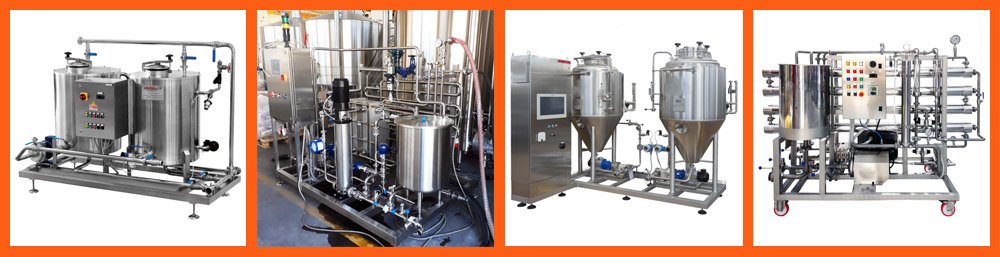
Modern bottle and keg rinsers use precision nozzles and multi‑stage schemes to minimize water. High‑pressure, focused spray nozzles clean effectively at much lower flow than flood‑type rinsers (www.zenithpackagingtech.com; cbst.krones.com). Operators also reuse water across stages: a first rinse with recycled or pre‑treated water removes bulk soil, while the final stage uses fresh water for purity (www.zenithpackagingtech.com; www.solenis.com).
Gains are material. Industry studies report that optimizing bottle washer design, chemistry and rinse programming can cut water use by up to ~30% (www.solenis.com). Krones notes that micro‑filters on spent caustic—or adjustments to caustic temperature—reduce fresh‑rinse demand (cbst.krones.com). Controls such as fresh‑water pressure regulators and “summer/winter” spray‑volume switches ensure only the minimum flow reaches vessels (cbst.krones.com). Together, high‑efficiency nozzles and smart protocols typically cut water per rinse by tens of percent—often halving consumption versus legacy setups (cbst.krones.com; www.solenis.com).
For hygienic filtration backstops on these lines, brewers often specify food‑grade housings; 316L stainless designs are common in beverage service and are available as stainless cartridge housings.
Closed‑loop recycling for bottle rinsers
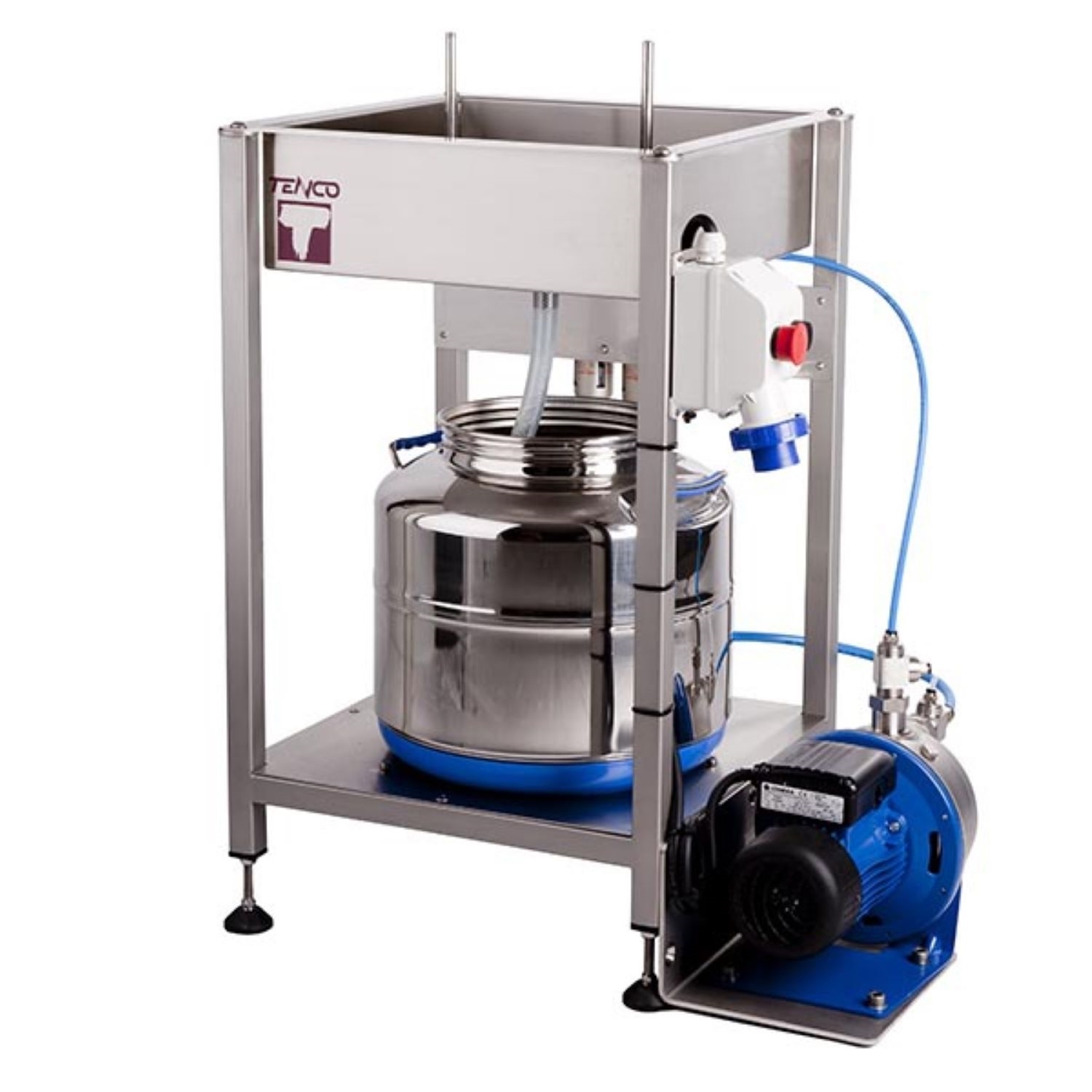
Closed loop means what it says: water from one rinse is captured, treated, and reused in the next. Case studies show dramatic savings. A French brewery running ~6,000 bph used 4–7 m³/day of fresh water; after adding ozone treatment and recovery, its daily draw fell “20 times” (~95%), to roughly 0.2–0.35 m³/day (www.sival-innovation.com). Similarly, a commercial “Bright Blue” ozone‑based rinser cut water use from ~1000 L/hour to ~1000 L/day—a 96% reduction (www.wassertec-ozone.com). In other words, properly engineered loops can reuse ~90–95% of rinse water.
Big brewers point to similar potential. Carlsberg’s Fredericia site achieved >90% reuse of all process water (including CIP and rinses) using closed‑circuit RO (reverse osmosis, a pressure‑driven membrane separation step), lowering intake from ~2.9 hL/HL to 1.4 hL/HL of beer (www.prnewswire.com). Krones’ end‑to‑end “HydroCircle” concept similarly cites up to 80% lower total water use by treating and recirculating all wastewater back as process feed (www.krones.com). In practice, treated rinse water typically feeds the first rinse port and fresh water returns only for the final high‑purity step; modern designs can toggle between fresh vs looped as needed. SIVAL’s ozonated rinser can run with or without ozone, and switch between lost‑water and looping modes (www.sival-innovation.com).
For utilities planning, RO trains typical in industrial reuse are available as brackish-water RO systems, and integrated membrane packages are offered under membrane systems.
Filtration and disinfection requirements
Reusing rinse water hinges on treatment quality. First up is filtration to remove particulates (glass shards, sediment, yeast residues). Trains commonly start with media filtration before polishing; breweries often choose sand/silica filters for coarse removal (www.eco3.co.za), then step down to fine elements such as cartridge filters at 5→1 μm (www.eco3.co.za).
An activated carbon stage is also common to adsorb organics, surfactants or odors; in beverage duty, processors deploy activated carbon media for this polish (www.eco3.co.za). For higher reuse quality, ultrafiltration (UF, a membrane barrier typically in the 0.01–0.1 μm range by mechanism, qualitative) or RO can follow; UF pretreatment options are standard as ultrafiltration systems.
At full‑site scale, Krones’ HydroCircle uses biological pre‑treatment (anaerobic MBR, or membrane bioreactor) then RO to yield “water – as pure as it gets” (<3% total dissolved solids) (www.krones.com). Some reuse skids similarly incorporate MBR or sedimentation‑MBR followed by RO before UV (www.watertreatmentspecialists.com); for line‑level projects, packaged membrane bioreactors are a typical biological option.
UV disinfection parameters
UV‑C (ultraviolet germicidal irradiation around 254 nm) inactivates microbes without chemicals. Systems validated for food use deliver doses on the order of tens to hundreds of mJ/cm². One reuse unit cites ~186 mJ/cm² for >4‑log adenovirus kill (www.watertreatmentspecialists.com), while typical drinking‑water UV doses are ~40 mJ/cm² for 4‑log Giardia/E. coli. Because UV needs very low turbidity, it sits after fine filtration (www.eco3.co.za). Continuous recirculation through a UV unit can maintain sterile conditions in the reuse tank between fills. Breweries commonly specify packaged ultraviolet systems for this duty.
Regulatory guidance in Indonesia explicitly endorses UV for safe water production (water.co.id).
Ozone oxidation in the loop
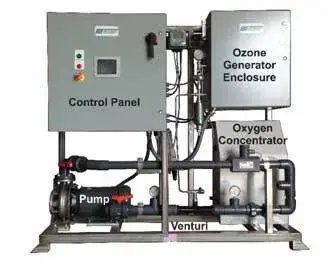
Ozone (O₃, a strong oxidant) is widely used in beverage bottling. Generated on‑site, it is dosed—e.g., ~0.5–1.0 mg/L dissolved—to kill microbes and break down residual organics. With a short half‑life in water (~15–20 minutes), a controlled residual around 0.8 ppm is recommended for bottle rinsing (www.wassertec.co.za). Ozone leaves no harmful residues (reverting to oxygen) and removes tastes/odors. It can be applied in a contact tank or injected into the loop; SIVAL steers purified rinse water through an ozone generator so the rinser and wash tank are sterilized continuously (www.sival-innovation.com). Industry literature notes that ozone simultaneously disinfects water, containers, filler components and even airspace (www.eco3.co.za).
The combination of UV+ozone is particularly robust: UV handles most pathogens, while ozone cleans organics and provides a safety buffer.
Typical closed‑loop treatment train
A common configuration is: coarse filtration → fine cartridge filtration (1–5 μm) → (optionally RO/UF) → UV sterilizer → ozone contact. This multi‑barrier approach produces near‑potable quality water (www.eco3.co.za; www.eco3.co.za). For context, refillable bottled‑water operators in Indonesia use RO+UV+ozone to meet SNI potable standards (www.eco3.co.za; water.co.id).
In a brewery reuse context, the goal is consistent clarity and 0 CFU (colony‑forming units) in supply so recycled water introduces no microbes or off‑flavors. Designs monitor turbidity, dissolved oxygen and ORP (oxidation‑reduction potential); maintenance includes regular filter backwash and sensor calibration. Ancillary hardware such as instruments and controls are packaged as water-treatment ancillaries.
Measured outcomes and payback
Across packaging halls, reports cite 50–80% lower water use from a combination of nozzle upgrades, reuse loops and treatment. Krones asserts up to 80% lower total consumption when breweries recycle wastewater to process feed (www.krones.com). Carlsberg’s system cut site water draw by almost 60% and enabled ~90% reuse of process water (www.prnewswire.com).
Incremental changes matter too: replacing wet lubrication with dry on conveyors can save ~2.5 ML/year (www.solenis.com), and optimizing a bottle washer delivers ~30% savings (www.solenis.com). On rinsing specifically, SIVAL reports daily needs falling from ~5000 L to ~250 L (www.sival-innovation.com), while an ozone/UV rinser cut an 8‑hour shift draw from ~3 m³ to ~0.1 m³ (www.wassertec-ozone.com). Lower wastewater generation eases treatment loads, and heavy‑use plants often see 1–3 year paybacks.
Regulatory note (Indonesia)
Indonesia has limited direct laws on industrial reuse, but any recycled water contacting packaging falls under drinking‑water norms (MOH and SNI for bottled water). Reused rinse water must be free of pathogens (no E. coli, coliforms) and meet purity specs (water.co.id). Adopting UV and ozone aligns with guidance: UV disinfection is explicitly recommended (water.co.id), and ozone is widely used in local bottled‑water plants (www.eco3.co.za).
Bottom line: high‑efficiency rinsing nozzles and closed‑loop recycling can turn the packaging hall into a near “zero‑water” zone. Detailed audits and custom engineering (pump sizing, loop tanks, sensor controls) drive the best results, and filtration with UV and/or ozone lets breweries conserve millions of liters annually without compromising product safety (www.sival-innovation.com; cbst.krones.com). Data‑driven examples show fresh‑water cuts of 90% or more on packaging lines (www.sival-innovation.com; www.prnewswire.com).
Sources: Peer‑reviewed papers, industry reports, and equipment case studies were analyzed, including Krones/Steinecker (2024) and SIVAL (2025) publications (cbst.krones.com; www.sival-innovation.com), DuPont/DuPont (2023) press reports (www.prnewswire.com), and operational reviews (www.watertreatmentspecialists.com; www.eco3.co.za). Inline citations refer to these up‑to‑date technical and regulatory resources.