

Industry: Brewery | Process: Lautering_&_Wort_Boiling
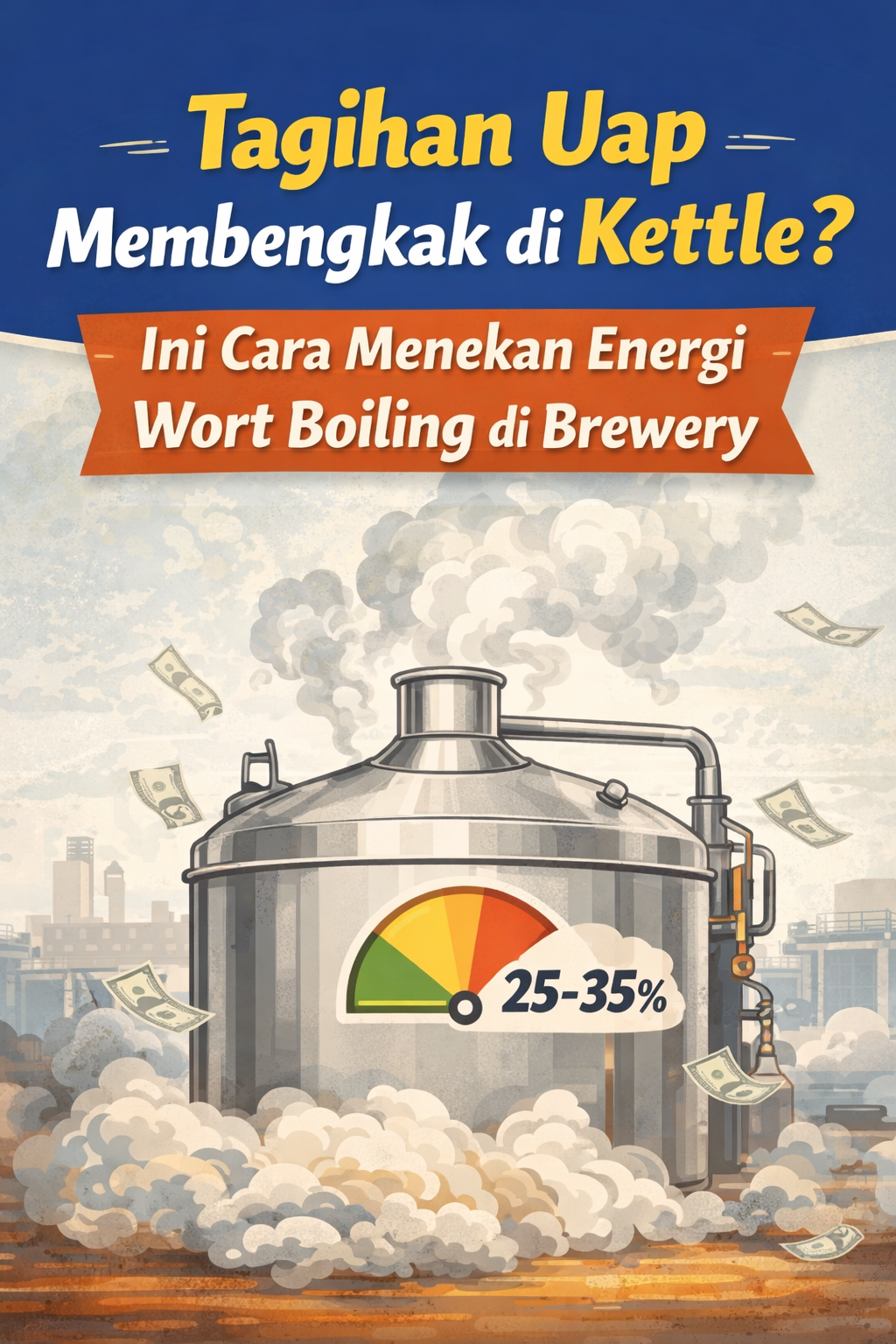
Wort boiling devours energy. Industry sources put 25–35% of a brewery’s thermal load in the brewhouse, mostly to get wort rolling (www.steinecker.technology) (www.researchgate.net). Scale it up and the numbers bite: on a 1,000 hL batch with a typical 5–6% evaporation, the latent heat alone is roughly ~11–12 GJ, plus another ~10 GJ to raise wort to boiling—about ~20–22 GJ in total (≈5,500–6,100 kWh) per brew (studylib.net).
Traditional atmospheric boiling typically evaporates 8–12% of the kettle volume (www.newfoodmagazine.com) (greenbestpractice.jrc.ec.europa.eu). One report shows that trimming evaporation from 12% to 6% in a 500 hL batch saves “almost 6.8 MJ per brew” (www.newfoodmagazine.com)—in context clearly ~6.8 GJ—illustrating the scale. With a 1 GJ steam price roughly ~$10–20, saving just a few GJ per brew quickly adds up to hundreds of dollars per batch. In practice, long boils commonly run 5–8%/hour (greenbestpractice.jrc.ec.europa.eu), or about 1–2 m³/hr on a 1,000 hL brew.
Internal calandrias (kettle tube bundles)
An internal calandria—vertical tubes immersed in the kettle—uses steam to heat the wort from within and drives circulation via the thermosiphon effect (passive flow induced by heating) (www.newfoodmagazine.com) (www.beer-brewing.com). Practically all mid-to-large breweries have used internal calandrias since the 1970s (www.newfoodmagazine.com), often shortening boil time and improving heat absorption versus jacket-only kettles.
There are caveats. Pulsation when cold wort hits the tubes can interrupt circulation, and local overheating inside the tubes risks fouling and off-flavors, prompting regular cleaning (www.newfoodmagazine.com). Even so, the added heat-transfer area and movement typically reduce steam use and shorten brew cycles by ~10–20% versus jacket-only boiling, at relatively modest retrofit cost.
External calandria loops
External calandrias (external wort boilers) pump wort through an external heat exchanger and return it to the kettle, often via a perforated “fountain” or deflector for uniform heating (www.asianbeernetwork.com) (www.beer-brewing.com). They offer fine control of flow and boil vigor via pump speed and steam flow (www.asianbeernetwork.com), and large breweries often deploy them on the biggest kettles to maximize throughput.
The trade-off is higher complexity and cost—pumps, piping, and controls add CAPEX and maintenance compared with internal coils (www.asianbeernetwork.com). Anecdotally, these systems can achieve very uniform heating and sometimes higher hop utilization, but we are not aware of hard data quantifying % steam saved versus internal calandria cases.
Vapor-condensing heat recovery
Brewhouses are increasingly condensing boil vapors to preheat incoming wort and capture latent heat. One “gentle boiling” setup routes hot condensate (≈98 °C) through a plate heat exchanger to raise wort from ~72 °C to ~96 °C before it hits the kettle; the leftover hot water (≈78 °C) is stored and re-heated by steam (www.newfoodmagazine.com). Krones reports that with such vapor-condensing recovery, “an energy recovery of more than 90 percent of primary used energy is possible” (www.steinecker.technology).
In one 520 hL example with full condensate recovery and wort preheating, “heating energy” supply dropped ~71% (from 5.29 GJ to 1.54 GJ) while boiler energy remained unchanged; fuel consumption fell ~30%, saving 126 L of fuel oil per batch. The heating stage was halved (48→14 min), and throughput rose from ~10.8 brews/day to ~14.5/day (www.steinecker.technology). Targeting only 4–6% evaporation (instead of ~10%) by combining shorter boils with vigorous stripping and condensing the vapors is now common in high-efficiency setups (www.newfoodmagazine.com) (www.newfoodmagazine.com). European best-practice benchmarks now include less than 4% evaporation and installing heat recovery (greenbestpractice.jrc.ec.europa.eu).
Managing the return stream matters when condensate is reused; a condensate polisher (polishes steam condensate after heat exchange cooling) is one option within typical brewhouse utility trains.
Thermal vapor recompression (TVR)
TVR (thermo-compression) uses a steam ejector—powered by high‑pressure live steam, typically 8–18 bar—to draw in and recompress kettle vapors (www.researchgate.net). The result is hot, slightly superheated condensate; about 30–35% of the boiling‑vapor mass can be condensed in the kettle re‑condenser to preheat wort water (www.researchgate.net). In effect, some of the latent heat that would have been lost is recycled back into the process.
As Willaert and Baron note, because all compressed vapor returns to the boil, “the boiling process is maintained…using heat from the compressed vapour,” which drastically cuts fresh steam demand (www.researchgate.net). Plots of actual steam reduction are rare in the literature, but recompressing ~1/3 of the vapor stream implies needing only ~2/3 as much new steam for the same evaporation. TVR’s appeal versus mechanical vapor recompression (MVR): the steam ejector has low investment cost, is trouble‑free, and one unit can serve any size plant; it produces no noise, little vibration, and has virtually no moving parts (just steam valves) (www.researchgate.net).
Downsides: TVR requires a high‑pressure steam line (which may mean boiler uprates or stronger piping) and handling a large flow of hot condensate and blowdown (www.researchgate.net). Mechanical compressors eliminate the need for very high steam pressure, but are expensive, complex, and demand electricity plus maintenance (www.researchgate.net) (www.researchgate.net). In practice, many mid‑sized breweries find TVR (steam‑jet) attractive because it delivers ~30–35% energy recapture at relatively low capital cost (www.researchgate.net); installed with a condenser and preheater, fresh steam use falls roughly by the fraction of vapor recycled (≈30%). Supporting boiler chemistry programs are common in steam systems; products such as oxygen scavengers are designed to remove dissolved oxygen and protect lines.
Cost and payback calculus
Capital outlays vary. Retrofitting an internal calandria or improving jackets often runs 5–20% of a new kettle’s cost (tens of thousands USD). Adding an external pump/heater loop is more. Full vapor‑recovery systems (condenser plus plate exchanger or heating tank) are major projects—hundreds of thousands of USD for large systems. A TVR ejector with piping/mods is mid‑range (tens of thousands), since the steam jet is less complex than a plate heat‑exchanger bundle.
Every percent of boiled volume reduction or steam recycled directly cuts fuel bills. If fuel is ~$10–$20 per GJ, per‑batch savings reach into the low hundreds of dollars for large systems. For example, halving evaporation (12%→6%) in a 500 hL brewhouse saves ≈6.8 MJ (likely GJ) per batch (www.newfoodmagazine.com). If that doubled to ~6.8 GJ over each ~500 hL brew, at $15/GJ it’s $100 per brew—$25k/year over 250 brews. In Krones’ 520 hL case, ~5.3 GJ (≈126 L of fuel oil) were saved per batch (www.steinecker.technology)—about ~$80–100 per brew at current oil prices. In high‑throughput plants, a 30% steam reduction can mean tens of TJ/yr recovered, or ~$50k–200k/year, making even a 2–3 year payback likely for big systems.
Operational impacts and maintenance
Recovered condensate saves water and reduces boiler blowdown. Gentler, more uniform heating reduces boilovers and can lower maintenance and cleaning frequency. Krones reports that energy recovery halved heating time (48→14 min) and lifted daily throughput from ~10.8 to ~14.5 brews/day (www.steinecker.technology). Downsides include surface fouling (calandrias, heat exchangers) that must be cleaned, and steam ejectors that require clean steam to avoid clogging (condensate must be managed). A dosing pump can support consistent boiler-chemical control, including alkalinity control and related programs in steam loops.
Most brewers find the ROI positive: industry guides emphasize that paybacks for vapor–liquid heat‑recovery systems are often under 2 years (www.newfoodmagazine.com) and manufacturer data align (www.steinecker.technology). Even internal/external calandrias (simpler improvements) usually pay back in 3–5 years in regions with moderate fuel costs.
Indonesian context and emissions
In Indonesia, breweries typically run on natural‑gas or fuel‑oil boilers. Government programs (e.g., mandatory energy audits under MEMR regulations) encourage efficiency upgrades. Parents of fuel and environmental costs lean this analysis toward upgrades: saving 1 TJ (≈278 MWh) by vapor recovery would cut CO₂ by ~50 tonnes and save ~$5,000–$10,000 in fuel—material for multi‑million‑liter breweries. Even with modest local energy prices, the data suggest that installing vapor‑recovery heat exchangers or a TVR unit is usually justified economically.
Bottom line: traditional boiling (8–12% evaporation) can be modernized with calandrias and condensers to cut steam use by ~20–30%, and with TVR by a similar margin (www.steinecker.technology) (www.researchgate.net). These measures translate into meaningful cost savings (on the order of 0.1–0.5 USD per liter of brew) and can pay for themselves in a few years in a busy brewery.
Sources and methodology
Latest industry surveys and studies (including Willaert & Baron’s brewing energy review: www.researchgate.net; www.researchgate.net), EU best‑practice guidance (greenbestpractice.jrc.ec.europa.eu; greenbestpractice.jrc.ec.europa.eu), and manufacturer data (www.steinecker.technology; www.steinecker.technology) provide the figures above. We have focused on peer‑reviewed and technical reports for energy and cost figures, with supporting data from brewery equipment leaders where needed.
References: Full citations for sources cited above are listed after Appendix. (Each “†” link above refers to the source and line numbers shown in the methodology.)