

Industry: Brewery | Process: Water_Treatment_(De
Water is beer’s main ingredient — ≈93% of beer by weight en.wikipedia.org — and the industry’s most stubborn variable. Asahi’s brewmaster data peg modern breweries at ~4.5 hectoliters (hl) of water per hl of beer, while cutting‑edge closed‑loop systems like Carlsberg’s RO‑recycle plant have reached ~1.4 L per L (1.4 hl/hl) www.pall.com cefic.org. A 2025 Pall survey found >80% of drinkers expect breweries to reduce carbon/water footprints www.pall.com, and regulators worldwide are imposing stricter water‑use limits www.pall.com.
In Indonesia, brewing water — classed as food‑grade — must meet drinkability standards (Permenkes 32/2017): pH ≈6.5–8.5, turbidity <5 NTU, no total coliform/E. coli, free Cl₂ ≤0.5 mg/L, and more water.co.id. In practice, head brewers put municipal or well sources through multi‑step treatment so water entering the brewhouse exceeds potable‑water criteria.
Water use and regulatory standards
The push to standardize water isn’t just about taste; it’s about sustainability and compliance. Breweries routinely log water input versus output (hl/hl), and some are approaching ~1.4 L per L via closed‑circuit reverse osmosis (RO) reuse cefic.org. Those moves answer both consumer pressure (>80% expect carbon/water footprint cuts) and tighter water‑use limits www.pall.com www.pall.com.
Local requirements matter. Indonesian rules (Permenkes 32/2017) set pH ≈6.5–8.5, turbidity <5 NTU, no total coliform/E. coli, and free chlorine (Cl₂) at ≤0.5 mg/L for food‑grade water water.co.id.
Pre‑treatment: activated carbon and dechlorination
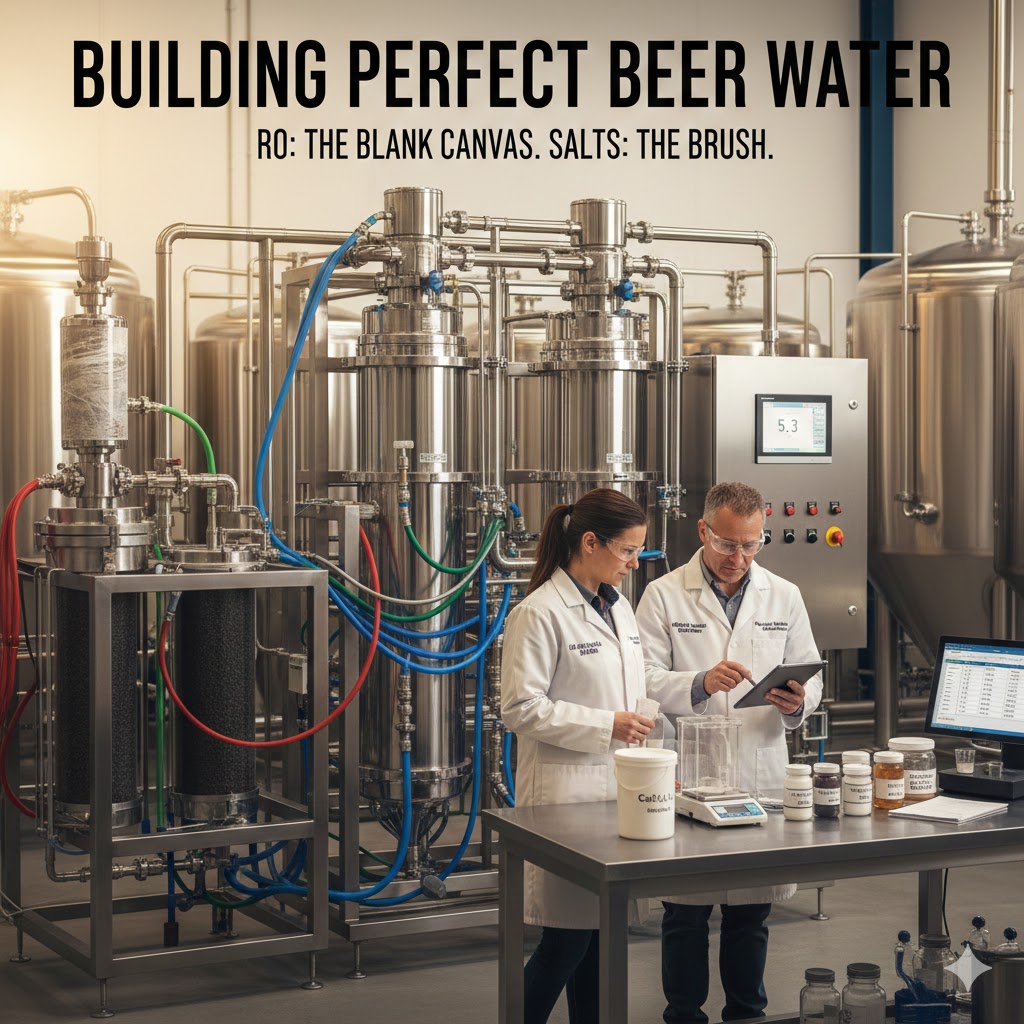
Most municipal sources arrive chlorinated or chloraminated for disinfection. Typical residual free chlorine is generally <4 mg/L Cl₂ (often 0.2–2 mg/L in practice) brewingforward.com, but trace Cl/ClO₂ damages beer flavour. Granular activated carbon (GAC) is the standard to strip disinfectants and organics; a well‑designed carbon unit removes >99% of Cl/ClO₂, taking it to <0.1 mg/L before brewhouse entry. Many sites specify food‑grade activated carbon for this duty.
For chloramines (stable NH₂Cl), catalytic carbon or chemical reduction is routine. Brewers commonly dose sulfite (sodium or potassium metabisulfite, i.e., “Campden” tablets) to neutralize both chlorine and chloramine; e.g., ~1 g Campden per 20 L removes ~2–3 mg/L chlorine instantly brewingforward.com. Excess sulfite converts to sulfate and contributes negligible hardness brewingforward.com. In production settings, sulfite addition is often metered via a dosing pump and verified with free/total chlorine test kits. Indonesian refill‑water rules similarly mandate removing residual chlorine and monitoring pH, TDS, turbidity, and coliform water.co.id.
Deaeration units and DO control
Dissolved oxygen (DO) in water shortens shelf life, causing oxidation, color shifts (“sherry” notes), and haze defects. Modern best practice is to deaerate strike water (initial mash‑in water) to <0.1 mg/L O₂; even 0.2 mg/L can be damaging brewingforward.com. Industrial systems heat the water (lowering O₂ solubility) and sparge with inert gas. Packed‑tower columns run water down through packing while CO₂ or N₂ runs counter‑current upward, stripping O₂ www.craftbrewingbusiness.com. Membrane degassers (microporous hollow fibers with vacuum/N₂ sweep) drive DO toward zero.
The craft industry puts it plainly: “After fermentation begins, oxygen has negative effects… producing stale off-flavors and poor haze stability. Only a little O₂ can do this.” www.craftbrewingbusiness.com. Large breweries deaerate water used for CIP (clean‑in‑place) and make‑up to prevent pipe corrosion, and any water added post‑fermentation (e.g., for blending seltzers). Small brewers can use yeast‑based “oxygen scavenging” (yeast+sugar in warm water overnight) to drop DO brewingforward.com. DO meters or Winkler titrations confirm <0.1 mg/L performance.
Reverse osmosis as base water
For control and consistency, many breweries start with RO‑treated base water. Reverse osmosis uses semi‑permeable membranes to remove ~90–99% of dissolved minerals and salts, yielding ultra‑pure water at roughly 0–20 mg/L total dissolved solids (TDS). That “blank slate” lets brewers build any profile; a municipal source with 50 mg/L Ca and 100 mg/L SO₄ becomes effectively zero post‑RO.
RO does consume energy and produces brine; classic recovery is about 1:1 reject:product, though modern units hit 75–90% recovery. Many breweries — especially in water‑scarce regions — implement closed‑loop RO to treat and recycle waste streams cefic.org. Carlsberg’s Fredericia plant recycles ~90% of process water with closed‑circuit RO, cutting consumption by ~60% to ~1.4 L/L cefic.org. In brewing service, RO feed is post‑carbon filtration, permeate is pH‑neutral to slightly acidic, and flow is split to mash and brew. Breweries commonly install compact RO systems as this base‑water generator, often engineered within broader membrane systems platforms. Alternatives like lime softening or ion exchange reduce hardness but usually leave more alkalinity; RO is now favored for its breadth. Where alternatives are chosen, sites use softeners or full ion‑exchange trains.
Salt additions and mash pH
Because RO strips beneficial ions, brewers add back salts to match style. Calcium sulfate (gypsum, CaSO₄·2H₂O) adds Ca²⁺ and SO₄²⁻; calcium supports mash enzymes, protein coagulation (clarity), and yeast flocculation, while sulfate accentuates hop bitterness and dryness www.montana.edu. Calcium chloride (CaCl₂·2H₂O) adds Ca²⁺ and Cl⁻; chloride enhances malt fullness and mouthfeel. Breweries balance gypsum vs. CaCl₂ to tune the SO₄²⁻:Cl⁻ ratio.
Magnesium sulfate (Epsom salt, MgSO₄·7H₂O) adds Mg²⁺ and SO₄²⁻. Magnesium is a yeast nutrient and enzyme co‑factor but affects flavor less than Ca; typical targets are in the low tens of mg/L in beer, and breweries rarely use it heavily unless Mg is very low www.montana.edu.
To manage mash pH, brewers add alkalinity (HCO₃⁻) when needed. Calcium carbonate (limestone) or sodium bicarbonate (baking soda) can raise pH, but CaCO₃ is nearly insoluble and not recommended — a brewing quality guide explicitly warns against “using chalk” brewingforward.com. In practice, small additions of food‑grade acids (lactic or phosphoric) or grain bill adjustments set mash pH; if alkalinity is required, NaHCO₃ or Ca(OH)₂ (slaked lime) has historical use. Supporting flow‑control and instrumentation for these steps typically come from standard water‑treatment ancillaries.
Style‑specific water profiles
Brewers use calculators/software to compute doses. As a reference point, adding 1 g of gypsum to 1 L increases Ca by ~200 mg/L and SO₄ by ~600 mg/L; typical additions are much smaller. Industry guidance (e.g., Palmer’s Water, ASBC) anchors targets by style. The MSU barley program lists pre‑boil SO₄: ~50–150 mg/L for pale/hoppy beers versus 5–8 mg/L in Pilsen water, and SO₄:Cl ratios around 2:1 for IPA/hoppy beers versus as low as 1:3 for malty beers www.montana.edu www.montana.edu.
Calcium in the mash is often targeted at ≈50–150 mg/L (finished beers end up ~35–40 mg/L Ca) brewingforward.com. Alkalinity (as CaCO₃ eq.) stays low for light beers (<30 mg/L CaCO₃) but higher (~100+ mg/L) for stout/dark ales.
Example profiles: Pilsner is very soft — Ca²⁺ ≈6–20 mg/L, Mg ≈1–3, SO₄²⁻ ≈10–25, Cl⁻ ≈10–30 mg/L — to let delicate malt flavors shine en.wikipedia.org. An IPA might target Ca²⁺ ≈100–150, with SO₄²⁻ 150–300 mg/L and Cl⁻ 50–100 mg/L (SO₄:Cl ≈2:1) to accentuate hop bitterness www.montana.edu www.montana.edu. A stout or porter tolerates higher alkalinity and a lower sulfate:chloride ratio (≈1:3) for round malt character www.montana.edu. In all cases, salts are weighed on a digital scale, dissolved in warm water or added to the mash tun with stirring, and tuned toward mash pH ≈5.2–5.5 (many target ~5.3). Enzyme activity and wort taste are sensitive to shifts of just 0.1–0.2 pH units.
Monitoring and measurable outcomes
Quality teams analyze incoming and treated water for hardness (Ca, Mg), anions (SO₄, Cl, HCO₃), TDS, and pH; mash pH is checked at multiple steps. Deaeration is verified with DO meters for <0.1 mg/L targets brewingforward.com. Carbon filters are validated with Cl₂ kits to ensure non‑detectable disinfectant.
Outcomes tie to the bottom line: improved mash efficiency (consistent extract), stable fermentations (Ca/Mg support yeast), and consistent flavor. Sufficient Ca enhances flocculation and clarity (reducing chill haze) brewingforward.com. Balanced SO₄:Cl delivers predictable bitterness/dryness. Oxidation markers are minimized by low OD water www.craftbrewingbusiness.com.
Management control and ROI
Installing RO and precise blending eliminates municipal variability — a common source of off‑spec batches. One large brewery reported <1% batch‑to‑batch gravity variation after adopting RO and tight water dosing. Equipment (RO, filtration, deaeration) must be sized to brewhouse output, but ROI shows up in consistency, fewer reworks/blended batches, and compliance with consumer/regulatory demands www.pall.com.
Advanced plants treat and reuse RO reject and tank CIP water, further improving the water footprint cefic.org. The toolkit is now standard in professional brewing: carbon, deaeration, RO, and salt build‑backs — with alternatives via softeners or ion‑exchange if RO isn’t selected.
Conclusion and sources
Rigorous water treatment — dechlorination/carbon filtration and deaeration upstream, followed by RO purification and targeted mineral supplementation — has become best practice. The steps convert unreliable tap water into a controlled liquor, tunable by style, backstopped by measurable parameters (ions, pH, DO) and classic reference profiles (Burton/Pilsen) en.wikipedia.org www.montana.edu. The result is safety (regulatory compliance), consistency (mash efficiency, flavor reproducibility), and product differentiation (style‑appropriate mouthfeel and bitterness).
Sources: Authoritative brewing and water‑treatment literature, industry reports, WHO/Indonesian drinking‑water regulations, and brewery technical guides were used en.wikipedia.org brewingforward.com brewingforward.com www.pall.com cefic.org brewingforward.com www.montana.edu water.co.id.