

Industry: Brewery | Process: Water_Treatment_(De
Breweries live and die by oxygen control. Deaerated water (DAW) — water stripped of dissolved oxygen (DO) to protect flavor stability — is now standard for filter precoating, tank purging, final rinses, and high‑gravity blending, with modern targets at ≲0.02 mg/L (≲20 ppb, parts per billion) DO (bbt.corosys.com) (interupgrade.com).
A side note with real process impact: Indonesian drinking‑water rules permit up to 5 mg/L chlorine (id.scribd.com), so breweries pre‑remove chlorine (and organics) using carbon beds before degassing. In practice, that means deploying activated carbon filters ahead of any DAW system.
Three deaeration technologies compared
The toolset is well established: (a) vacuum deaeration, (b) gas‑stripping columns using nitrogen (N₂) or carbon dioxide (CO₂), and (c) membrane contactors. All can deliver sub‑ppm DO; the differences are in energy and gas balances, capital intensity, and scalability (bbt.corosys.com).
Vacuum deaeration (spray/flash under reduced pressure)
Mechanism: water is heated (~70 °C) and sprayed under vacuum so it flashes and releases dissolved gases; multi‑stage designs often use 2–3 packed columns (patents.google.com) (interupgrade.com). These systems are favored for still beverages and where space limits tall towers.
Performance: routinely ≈0.01–0.02 mg/L (10–20 ppb) DO in practice (interupgrade.com). Historically, older designs achieved ≲0.5 mg/L (patents.google.com). Offered throughputs range from dozens to a few hundred hectoliters/hour (hl/h, a standard brewing volume unit): InterUpgrade’s Type32–80 systems handle 6–35 m³/h (60–350 hl/h) at <0.02 mg/L (interupgrade.com).
Capex: robust vacuum chambers, vacuum pumps/ejectors, and heat exchangers drive cost. A small 60 hl/h system: roughly $30–50k; multi‑column units for ~200–300 hl/h can exceed $100k (materials and controls dependent). An InterUpgrade Type65 unit (230 hl/h) indicates ~300 kg/h steam demand at 72 °C (www.interupgrade.com), implying substantial boiler and vacuum infrastructure. Expect higher $/m³/h versus other methods.
Opex: electricity for vacuum pumps and optional pre‑heating dominate. Plants sometimes add small CO₂ doses to enhance stripping (∼0.02–0.05 kg/hl) (bbt.corosys.com). Operating power is often a few kW per 10 m³/h, translating to perhaps $10–20/day at typical electricity rates. Maintenance is moderate; hot operation aids hygiene and standard CIP (clean‑in‑place) regimes apply.
Pros/cons: very low DO and no gas over‑saturation, balanced against high capital, constant power draw, and a multi‑vessel footprint best suited to medium‑to‑large plants. Supporting skids inevitably include pumps and instrumentation; many brewers standardize these as water‑treatment ancillaries.
Gas‑stripping columns (countercurrent inert gas)
Mechanism: packed columns flow water downward while an inert gas (N₂ or CO₂) rises to strip O₂; operated “cold” at ambient or “hot” with ~70 °C feed (www.interupgrade.com).
Performance: properly designed towers achieve ≲0.02 mg/L (www.interupgrade.com) across small to very large throughputs. Models span 12 hl/h to ~860 hl/h (Type125) at 72 °C with steam (www.interupgrade.com), with countercurrent contacting critical to performance (www.interupgrade.com). Gas choice matters: N₂ is more effective at O₂ removal because it is not soluble and maintains the concentration gradient, leaving water unchanged; CO₂ is preferred in carbonated lines because it buffers water and reduces recontamination — and more CO₂ is absorbed into product rather than wasted (www.interupgrade.com).
Capex: a packed stainless‑steel tower, preheater (for hot service), condensers, pumps, and controls typically cost less per unit flow than heavy vacuum systems. As a reference point, a single large column (~20 m height, ~2 m diameter) for ~300 hl/h might be $30–50k. Vendors list systems from 1.2 m³/h (12 hl/h) to 86 m³/h (860 hl/h) (www.interupgrade.com).
Opex: dominated by stripping gas and, for hot columns, steam. Cold columns consume ~0.22 kg gas per hl; about 5% is lost, the rest dissolves in the water (www.interupgrade.com). Hot columns need less gas (~0.10 kg/hl) but add steam (~100–300 kg per 100 hl water) (www.interupgrade.com). If CO₂ is readily available from fermentation, fuel cost is low; if N₂ is purchased or generated, costs rise. Many breweries adopt on‑site PSA (pressure swing adsorption) nitrogen to avoid cylinders — ROI is often ~18–24 months (www.airbestpractices.com). Hot stripping often self‑sterilizes; cold stripping may require UV or chemical cleaning (www.interupgrade.com), where many facilities opt to add UV disinfection.
Pros/cons: stable operation without large vacuum pumps or noise; economical when captive CO₂ exists. Trade‑off: the water is over‑saturated with the stripping gas — desirable for CO₂ workflows, but irrelevant or undesirable in still applications.
Membrane contactor deaeration (hollow‑fiber diffusion)
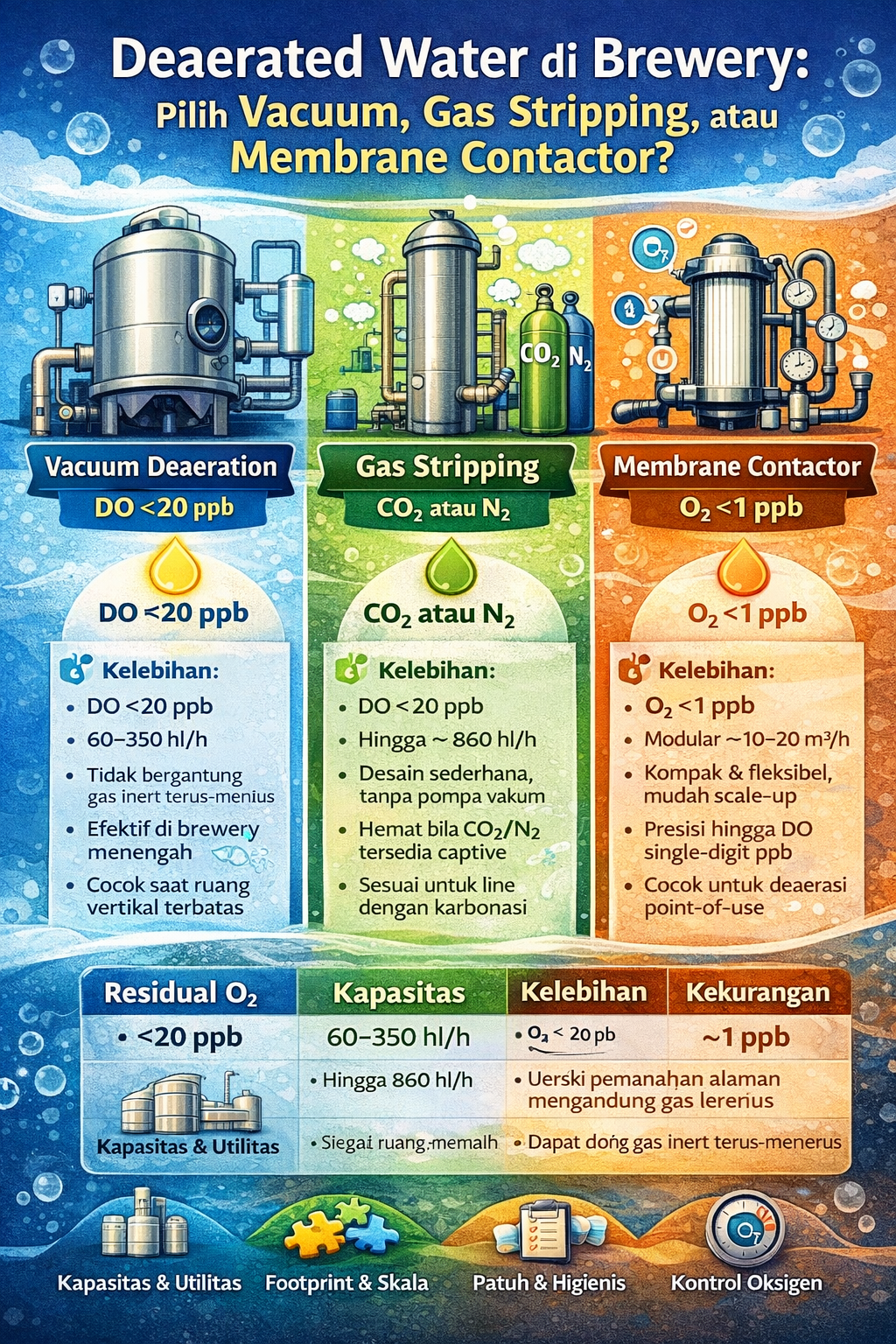
Mechanism: gas‑permeable hollow fibers let dissolved O₂ diffuse into a vacuum or sweep gas; only gas crosses the membrane (bbt.corosys.com). Sweep gas is a small flow of inert gas used to carry away diffused O₂.
Performance: the lowest DO levels of all three, routinely single‑digit ppb in series configurations. One craft installation (Paulaner Brewery) ran 400 hl/h at <20 ppb using four 10×28″ modules with CO₂ sweep and vacuum (www.slideshare.net). Other cases report outlet DO <1 ppb with multi‑module trains (www.slideshare.net) (www.slideshare.net).
Capex: high per unit flow but modular. One hollow‑fiber module might treat 5–10 m³/h and cost a few thousand dollars; a 3M Liqui‑Cel LMH‑5512 module is quoted at $2–3k and handles ~10–20 m³/h. A small craft brewer needing only a few hl/h might spend a few thousand USD; industrial plants needing hundreds of hl/h require many modules (tens of $ks). Skid packages rated for 18–360 m³/h are available (PowerFlow XDO series) (www.pwrfs.com).
Opex: low energy and minimal sweep gas; often <1 kW per module with no continuous gas blowdown. However, membranes are sensitive to strong chemicals and high temperatures; CIP must be gentle and typically <60 °C using food‑grade cleaners (bbt.corosys.com). Chemical additions are commonly managed with standard plant equipment such as a dosing pump.
Pros/cons: “plug‑and‑play” scale‑out, small footprint, and the deepest DO cuts, with the caveat of stricter cleaning envelopes and rising cost at high throughputs.
Activated carbon pre‑treatment (chlorine and organics)
Breweries often precede degassing with bed carbon to remove chlorine, chloramine, pesticides, and off‑flavor organics; carbon filters do not remove DO but are critical for potable‑water specs and yeast protection. Indonesian rules allow up to 5 mg/L free chlorine (id.scribd.com), so breweries drive that to near zero before degassing. Typical systems cost on the order of $1–5k, with media changes around $500–2000/year — modest next to degasser capex. Many plants procure carbon and related parts and consumables alongside carbon media.
What the numbers say on DO, scale, and spend
- Residual O₂: all three methods can hit <0.02 mg/L (20 ppb) under proper design (interupgrade.com) (www.interupgrade.com). Membranes can go even lower to single‑digit ppb (www.slideshare.net).
- Throughput: vacuum units typically top out at a few hundred hl/h (InterUpgrade 350 hl/h: 6–35 m³/h) (interupgrade.com); column strippers reach similar scales and up to ~860 hl/h hot (www.interupgrade.com); membranes are modular (e.g., four modules delivering 400 hl/h) (www.slideshare.net).
- Capital cost: stripping columns generally lower upfront than vacuum (no heavy vacuum chambers). Membrane skids are cheapest at very small flows but costlier per hl at large scale. Ballpark figures: small membrane skid <$10k; mid‑range gas or vacuum degasser ~$20–50k; large custom systems >$100k.
- Operating cost: vacuum relies on electricity and some heat; gas columns consume ~0.1–0.2 kg/hl inert gas and, if hot, steam (100–300 kg per 100 hl) (www.interupgrade.com) (www.interupgrade.com). On‑site N₂ generation via PSA often pays back in ~18–24 months (www.airbestpractices.com). Membrane opex is lowest (minimal power and gas) but demands gentle CIP (<60 °C) (bbt.corosys.com).
Selection criteria and sourcing notes
Industry guidance is pragmatic: select by required flow and DO. Small/on‑demand flows favor membrane units for compactness and low opex (bbt.corosys.com); large breweries often choose gas‑stripping columns or large vacuum towers for scale economies; when specifications are ultra‑tight, hybrid set‑ups (e.g., vacuum + gas) appear in the field. Cold stripping may be paired with UV or chemical cleaning, with dosing handled by standard plant equipment like a dosing pump. Across all packages, breweries typically standardize skid components as water‑treatment ancillaries.
All claims are supported by technical sources and vendor data: bbt.corosys.com; patents.google.com; interupgrade.com; www.interupgrade.com; www.interupgrade.com; www.interupgrade.com; www.interupgrade.com; bbt.corosys.com; www.slideshare.net; bbt.corosys.com; www.airbestpractices.com; and the chlorine standard at id.scribd.com. For membrane system packaging examples: www.pwrfs.com. For cold‑strip data points and model ranges: www.interupgrade.com.