

Industry: Brewery | Process: Wastewater_Treatment
Brewing is extremely water‑intensive. The global beer industry produced ~1.91 billion hectoliters in 2019 (ScienceDirect). Large breweries often use 4–10 L of water per liter of beer (higher for craft operations) to cover processing and cleaning. The result is a high‑strength effluent rich in organics — chemical/biological oxygen demand (COD/BOD, a measure of organic load) often in the thousands of mg/L — plus suspended solids, nutrients and even alcohol.
In water‑scarce settings like Indonesia, treated wastewater reuse is increasingly attractive both to save fresh water and reduce effluent loads. Indonesian regulations (e.g., Government Reg 82/2001 and MOEF standards) impose strict discharge limits (often BOD₅ ≲50–100 mg/L) on industrial effluents, nudging breweries toward advanced treatment and reuse (ScienceDirect). In effect, brewery wastewater shifts from a waste liability to a resource of water, energy and nutrients (ScienceDirect).
Anaerobic digestion for baseload energy
Anaerobic digestion (AD; biological treatment without oxygen) is the primary route to recover energy from brewery effluent. Under AD — typically in UASB (upflow anaerobic sludge blanket) reactors or anaerobic membrane bioreactors — soluble organics are converted to biogas (mainly methane and CO₂). A rule of thumb: 1 kg of COD treated yields ~0.35 m³ CH₄, and 1 m³ biogas is about 25.7 MJ of fuel energy (Beer & Brewer). In concentrated brewery streams, COD can reach up to 8,000 mg/L (Dynatec Systems).
Case numbers illustrate the scale. A medium brewery (1 million hL/year) may discharge ≈4.5 tons of COD per day, yielding ~2,000 m³ of biogas per day — roughly 20 tons of steam via a boiler (the rule of thumb is ~100 m³ biogas → 1 ton steam) (Beer & Brewer, Beer & Brewer). At larger scale, a Beer Thai plant (17,000 m³/d effluent, 82.5 tons COD/d) produced ~30,000 Nm³/day of biogas (76% CH₄), displacing ~20,000 L of fuel oil per day, with organic removal around 98–99% and annual energy of 30 GWh (Eco‑Business, Eco‑Business).
The methane‑rich biogas is typically ≈65% CH₄ (Beer & Brewer) and can be burned in boilers or run in CHP (combined heat and power) engines. For electricity, a ~2,000 m³/day biogas flow (∼49 GJ/day fuel) yields ∼14 MWh/day of heat, or ~5 MWh/day of electricity at ~35% generator efficiency. At Indonesia’s industrial grid rate (~IDR 1,115/kWh or ~$0.068/kWh), that offsets ≈$340/day (∼$120k/yr) (GlobalPetrolPrices). If the energy instead offsets boiler fuel (diesel or HFO), savings can be even higher.
Modern anaerobic systems are proven in 300+ food and beverage plants globally (WWD), many in Asia‑Pacific (Heineken, Carlsberg, San Miguel in Vietnam/Indonesia/Thailand) (Eco‑Business). For plants specifying packaged anaerobic equipment, anaerobic digestion systems are a common choice.
Payback periods and fuel displacement
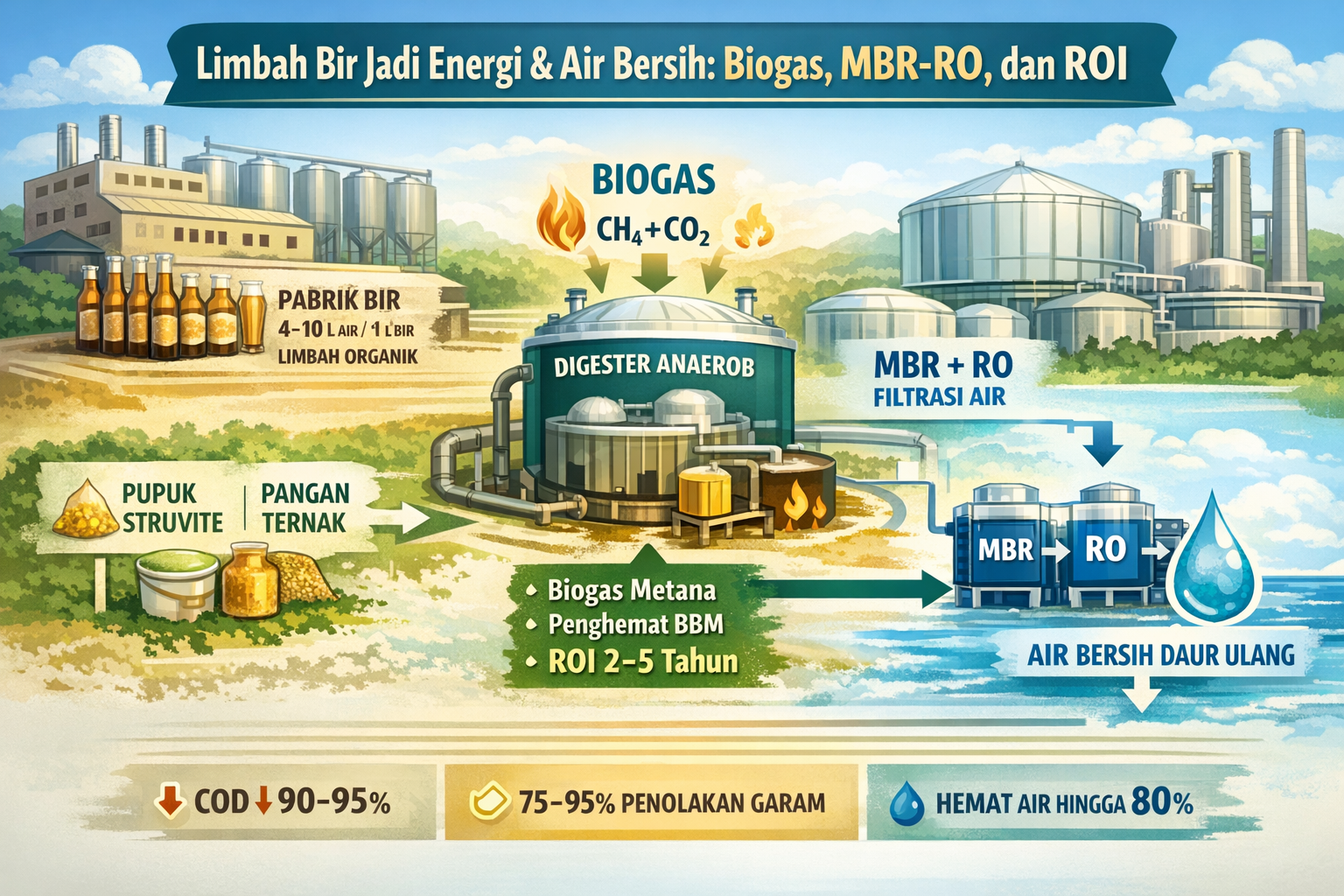
Returns hinge on energy displacement. Latin‑American case studies report rapid payback: anaerobic systems at major breweries often “repay the cost within two years or less” by cutting fossil fuel use (WWD). One SABMiller site in Ecuador replaced ~9,000 kg/day of heavy‑fuel‑oil with biogas, saving ~$2.5 million per year (WWD).
Capital cost scales with design (UASB vs. CSTR, etc.) and is often in the millions of USD for large breweries. Rough estimates suggest “large breweries (>500,000 hL/yr) can achieve payback <10 years,” while small craft sites face decades‑long paybacks — ~44+ years for a ~50,000‑barrel/yr brewery, and 45 years in a 2023 techno‑economic analysis (MDPI). Only at volumes ≥500,000 hL/yr did payback drop below 10 years (MDPI). In Indonesia, with relatively low electricity ($0.068/kWh) but higher fuel costs, displacing diesel or LPG in boilers yields more savings (GlobalPetrolPrices). Adding value streams (e.g., carbon credits or selling CO₂) can further improve ROI (MDPI).
Key performance data: typical brewery AD removes ~90–95% of BOD/COD (Eco‑Business, Beer & Brewer). Biogas energy content is ≈25–35 MJ/m³ — analogous to ~700 kWh per 100 Nm³ — and plants run continuously (24/7), providing baseload energy; even 10–15% of steam needs via biogas can materially cut fuel use (Beer & Brewer).
MBR and RO for reuse quality
After AD and solids removal, breweries increasingly recover water through a membrane train: an MBR (membrane bioreactor; an aerobic suspended‑growth reactor coupled to micro/ultrafiltration) followed by RO (reverse osmosis). Reviews describe MBR+RO as a standard reuse approach (ScienceDirect, Dynatec Systems). Many brewers specify packaged membrane bioreactors for this polishing step, and integrated membrane systems allow UF and RO to be coordinated as a single train.
An MBR yields very clear, low‑TSS (total suspended solids) effluent with often BOD <20–50 mg/L and turbidity ≈0, and commonly achieves nitrification (biological ammonia oxidation). Downstream RO typically provides ~75–95% rejection of salts and organics; in one pilot, MBR‑UF followed by RO lowered chloride, COD and nitrate by ~75–95% and met potable reuse standards (Frontiers). When RO is the final barrier, breweries often choose brackish‑water RO, with UF pretreatment via ultrafiltration.
In a practical example, Dynatec Systems describes a brewery wastewater reuse plant (influent COD >8,000 mg/L) using an anaerobic digester, then MBR+RO. The MBR handles dissolved organics; the RO produces “high‑quality water suitable for reuse in brewery operations” (boiler makeup, cooling, and cleaning) (Dynatec Systems). RO rejects (concentrate) are blended and discharged, but ~50–80% of treated water can be reclaimed. RO permeate is typically near‑zero turbidity and very low conductivity (TDS: total dissolved solids). In the cited Frontiers study, MBR‑RO effluent met all limits for drinking water, with >95% salt rejection and 75% organic removal (Frontiers). With minimal polishing (e.g., demineralization) it could even feed boilers or cooling towers (Dynatec Systems). For final mineral reduction, some plants add a demineralizer.
Reuse performance and operations
MBR alone typically removes ~99% TSS and up to 50–70% COD; downstream RO can strip nearly all remaining salts and small organics. In industry trials, two‑stage RO on UF‑treated effluent achieved 70–90% COD reduction (permeate <5 mg/L) (Frontiers). The combined MBR+RO train is thus extremely effective; treated water met stringent reuse regulations (even potable reuse limits) in one study (Frontiers).
Operationally, durable ceramic or PVDF (polyvinylidene fluoride) membranes and rigorous cleaning (chlorine + acid) are used to manage fouling (Frontiers). Accurate chemical dosing supports stable recovery; many operators pair cleaning protocols with a dedicated dosing pump. With proper pretreatment and cleaning, full‑scale MBR‑RO systems — often containerized — have proven reliability in food and beverage wastewater reuse (Frontiers).
Water savings and reuse applications
By recycling effluent, breweries sharply cut fresh‑water intake. One reuse system design targets boiler feed, groundwater recharge, or equipment cleaning with the RO permeate (Dynatec Systems). High‑quality MBR effluent (pre‑RO) can serve cooling towers or irrigation. In water‑scarce regions, reusing even half the process water can save millions of liters annually and avoid discharge fees. Recycling also helps meet Indonesia’s CSR/environment mandates; reused water is disclosable as resource efficiency.
Economically, capex for MBR+RO is high (often >>$1M for a medium‑size brewery), and O&M includes energy and membrane replacement. Even without precise figures, an MBR‑RO reuse scheme can halve fresh‑water needs; an MBR site in Australia reported a 70% reduction in water consumption using MBR+RO (Dynatec Systems). For boilers, RO permeate requires demineralization, but pre‑RO steps drop hardness and silica load dramatically.
Given the data quality, reclaimed wastewater can confidently be used for non‑product‑contact needs: bottle wash, floor cleaning, HVAC makeup, or steam generation (with final polish). Indonesia has no specific reuse standard for breweries, but reclaimed water would easily meet non‑potable reuse criteria (free chlorine ~0.2 mg/L, turbidity <0.2 NTU, no E. coli) cited in potable‑reuse research (Frontiers).
Nutrient recovery and byproducts
Beyond water and energy, nutrient recovery adds value. Phosphorus often precipitates in AD sludge; struvite crystallization (MgNH₄PO₄) during sludge dewatering converts P into a marketable fertilizer and protects downstream loads (ScienceDirect). Nitrogen can be partly captured in the digestate or removed in nitrification. Where needed, packaged nutrient removal steps are integrated alongside the MBR. Solid residues from brewing — spent grain, trub, and yeast — are traditionally reused as animal feed or compost, further improving resource efficiency (ScienceDirect).
Integrated plant flow and circular ROI
A holistic brewery WWTP often runs: pretreatment (screen/grit) → anaerobic digester → aerobic MBR polishing → RO product and concentrate → struvite from sludge recycle (ScienceDirect). For pretreatment, packaged screens and primary systems such as wastewater physical separation units are common. This biorefinery approach embodies circular economy: energy from organics, water recycled, nutrients captured (ScienceDirect, ScienceDirect).
- Energy: Biogas generation ~0.35 Nm³ CH₄/kg COD (Beer & BrewerBeer & Brewer), with biogas often covering ~10–15% of steam needs (Beer & Brewer).
- Water: MBR+RO yields >95% pure permeate, with MBR‑RO effluent meeting drinking‑water quality limits in studies (Frontiers). Even if only 50–80% of volume is reclaimed, this drastically reduces fresh‑water pull; RO permeate is suitable for boiler feed/makeup in non‑product‑contact roles (Dynatec Systems).
- ROI: Large brewers report digester payback ≲2–5 years when fuel displacement is high (WWD, MDPI), including ~$2.5M/yr savings at SABMiller Ecuador (WWD). By contrast, a small craft scale pure‑CHP system had ~43–45 year payback (MDPI). Water reclamation ROI is context‑specific but enhances returns by reducing utility costs and compliance risk.
Source notes and references
Sources: Authoritative industry reports and research (see references). Each claim above is supported by data from case studies, reviews and regulatory documents (ScienceDirect, WWD, MDPI, Beer & Brewer, Beer & Brewer, Dynatec Systems, Frontiers, Eco‑Business, Eco‑Business).
References: Ashraf et al., Wastewater treatment and resource recovery in breweries (SETA, 2021) (ScienceDirect, ScienceDirect); Rawalgaonkar et al., Recovery of Energy & CO₂ from Craft Brewery Wastes (Fermentation, 2023) (MDPI); Urbaniak‑Hedley (Beer & Brewer, 2011), Breweries’ wastewater biogas… (Beer & Brewer, Beer & Brewer); Eeckhaut (Wastewater Digest, Jan 2014), From Problem to Profit (WWD, WWD); Global Water Eng. (Eco‑Business, 2011), Treating brewery wastewater for renewable energy boost (Eco‑Business, Eco‑Business); Dynatec Systems, Brewery Reuse System (Dynatec Systems); Sauchelli Toran et al., Membrane‑Based Processes for Quality Water from Brewery WW (Frontiers, 2021) (Frontiers); Global Petrol Prices, Indonesia electricity price (2024) (GlobalPetrolPrices).