
Cleaning-in-place (CIP) is one of the biggest sinks for brewery water, energy, and chemicals — and one of the fastest paybacks. Real-time sensors, recovery tanks, and membranes are cutting rinse volumes 20–70% and chemicals ~40%, with 1–3 year ROI.
Beer is ~90% water by volume, yet typical breweries use 5–12 L of water (or ~1.3–3.0 gal) for every 1 L of beer produced (viravix.com; craftbrewingbusiness.com). At one major Carlsberg facility, 60–65% of all that water goes to cleaning — equipment, floors, pipes, and more (grundfos.com). With global leaders targeting ~1.6 L H₂O per liter of beer (Carlsberg’s goal), squeezing waste out of CIP matters for the P&L and the planet (grundfos.com).
The opportunity is large because CIP relies on hot caustic and acid solutions plus heated water. CIP cycles typically recirculate sodium hydroxide (NaOH) and acid through tanks and piping, followed by heavy rinsing; NaOH solutions commonly run ~3–80 °C. Optimizing that choreography can slash water, energy, and chemical consumption.
There’s added urgency where water is tight. In water‑stressed Indonesia, for instance, Java droughts are expected to persist to 2070 (guntner.com). (In Indonesia, electrical costs and any onsite steam costs should be considered.)
CIP resource use and water footprint
Microbrewery data show rinse volumes of ~100–600 L per vessel per cycle (academicjournals.org; academicjournals.org). A brewery running ~300 CIPs per year at 500 L per clean sends 150 m³ of water down the drain. With UK reference tariffs of ~£1.06/m³ for water and £0.77/m³ for sewer (academicjournals.org), shaving even a few hundred liters per CIP translates to thousands of dollars saved annually.
Energy adds up too: heating 100 L of water from tap to ~60 °C uses ~5.3 kWh (academicjournals.org). Chemicals are another major line item; CIP typically runs 2–4% NaOH or acid. Trimming NaOH from 3% to 2% in a 100 L CIP saves 1 L of caustic per cycle. At 312 cycles/year, that’s 13 drums (25 L each) and roughly £344–488/year in chemical costs avoided (academicjournals.org). The financial case to optimize CIP is clear.
Chemical concentration and cycle time
Many breweries over‑dose chemistry. In a UK microbrewery study, lowering caustic from 2.5–3% to ~1.5–2% (v/v) still met cleanliness standards (academicjournals.org; academicjournals.org). In fact, 1.5% NaOH at ambient temperature cleaned as thoroughly as 2–3% at higher heat, achieving ATP swab targets in ~30–40 minutes (academicjournals.org). Cutting concentration or volume is straight‑line savings — halving NaOH from 200 L to 100 L per cycle halves consumable cost (academicjournals.org).
Rinse volumes are similarly ripe for right‑sizing. Measurements found ~100 L of rinse water per 1,000 L tank is usually sufficient (academicjournals.org). Process differences alone have driven >500 L per cycle swings between comparable breweries (academicjournals.org). Most CIP processes suffer from over‑cleaning — running longer than needed provides no additional sanitation but burns extra water and energy (researchgate.net). Practically, once rinse pH approaches neutral, continuing to pump clean water yields diminishing returns (foodengineeringmag.com). Trimming soak or boil times by 25% can save ~1.3 kWh per 100 L cycle (academicjournals.org).
Recycling and recovery technologies
CIP solution reuse is a fast win. By segregating lightly soiled from dirty returns, small storage tanks (“brinks” — portable stainless vessels) and a heat exchanger can recirculate hot caustic/acid for multiple cycles (scribd.com; scribd.com). A 550‑barrel craft brewery that installed two 30‑gal brinks and a small steam heat exchanger cut CIP water use by 20–70% and total CIP chemical usage by ~40% (scribd.com; scribd.com).
Membrane filtration brings industrial‑scale reuse. GEA’s CIP Recovery Unit uses pH‑resistant nanofiltration (NF) to recover >90% of the NaOH solution, concentrating proteins and colorants in the reject while returning near‑pure caustic to service (prod.gea.com). Tetra Pak reports that NF can reclaim up to 90% of caustic CIP liquid in dairy cleanings (tetrapak.com), and beverage breweries can expect comparable returns. Reusing heated cleaning liquor avoids reheating, speeds the next CIP, and saves energy (solenis.com). In projects like these, NF and ultrafiltration (UF) modules are typically delivered as integrated membrane systems, with breweries often specifying dedicated nano‑filtration for caustic recovery and ultrafiltration for solids control.
Water reuse extends the savings. Later rinse stages (not the heavily soiled first rinse) can be reused as the next run’s pre‑rinse; a partial reclaim is advised (solenis.com). Carlsberg’s Fredericia plant demonstrates what’s possible at full scale: its on‑site treatment facility purifies and returns 90% of all process (cleaning) water back into the brewery (grundfos.com), cutting its brew‑house water ratio roughly in half (grundfos.com). Even partial systems pay: in one example, saving 500 L in rinses per clean saved ~£287/year in water plus sewer costs (academicjournals.org).
ROI of recovery and reuse
For mid‑sized plants, CIP filtration/recycle systems typically run $50k–$200k, with payback in 1–3 years via water, sewer, energy, and chemical savings (essfeed.com; essfeed.com). Even modest setups return cash quickly: in the Wooly Pig brewpub case, under $3k of equipment delivered 20–70% water savings and ~40% fewer chemicals (scribd.com; scribd.com), implying four‑digit USD annual savings at larger volumes.
An illustrative small‑plant math: a 1,000 L brew kit cleaned 6×/week with 500 L fresh water per CIP (312 cleans/year). At $1.00/m³ water plus $0.50/m³ sewer, saving 250 L/clean through recycling yields ~78 m³/year saved (~$78/year). Reusing 90% of a 3% NaOH charge (cost ~<$span>$0.7/L) saves ~135 L NaOH/year (~$95). Combined, that’s ~$173/year — modest at microbrew scale, 100× for a 100,000 L/day plant. Beyond OPEX, using less caustic helps avoid effluent treatment fees and chemical discharge penalties. For credibility and compliance, those reductions also align with corporate programs such as Carlsberg’s “Zero Water Waste,” where Fredericia reuses 90% of cleaning water and halves its brew‑house water ratio (grundfos.com; grundfos.com).
Real‑time monitoring and automation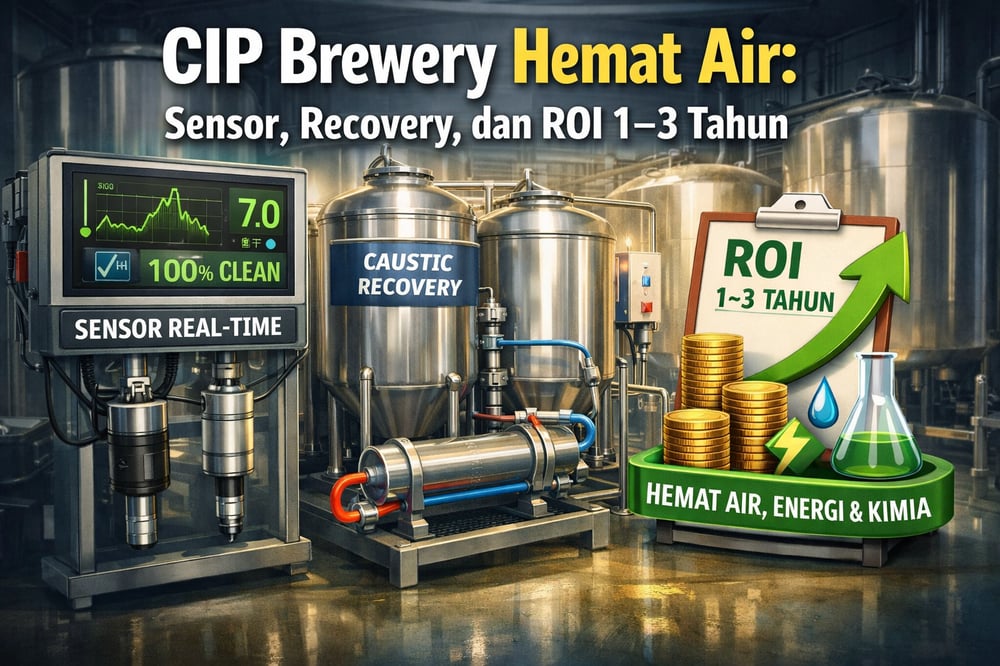
Sensors turn CIP from a fixed timer to a data‑driven sequence. Inline pH, oxidation‑reduction potential (ORP), conductivity, and turbidity show cleaning progress as it happens. In one craft brewery, a conductivity probe blinked red during caustic wash and green once the rinse was chemically clean; operators halved rinse water use by shutting off the water the moment the tank hit “green” (craftbrewingbusiness.com; craftbrewingbusiness.com). Inline turbidity meters can trigger automatic transitions when detergent‑laden water clears (foodengineeringmag.com).
Automated CIP skids in large breweries already use these signals to dose precisely and change stages. Smaller operations can retrofit smart sensors on manual carts. Closed‑loop controllers that maintain setpoints with a metering unit, such as a dosing pump, deliver exact concentrations and shut off promptly. The result is precise endpoints and audit trails for quality — and no over‑cleaning. Research on intelligent sensors underscores that most CIP suffers “over‑cleaning,” and sensor‑led control can reduce unnecessary rinses; predictive approaches are expected to boost resource efficiency further (researchgate.net).
- Conductivity signals endpoints: when ionic strength falls to baseline, the rinse is done — the approach that helped one brewery cut rinse volumes immediately (craftbrewingbusiness.com; craftbrewingbusiness.com).
- Turbidity tracks soil removal: once return flow holds near zero turbidity, solids are flushed and the next stage can advance (foodengineeringmag.com).
- PLC dosing control: sensor data can feed a PLC to maintain target chemistry and stop when surfactants are gone; hygienic sensor assemblies benefit from 316L housings suited to food service, such as stainless cartridge housings.
Purchasing and sustainability checklist
- Benchmark current CIP: track water and chemical use per CIP; verify clean with ATP/pH/turbidity to reveal over‑rinsing or excess caustic.
- Pilot sensor upgrades: add a conductivity/turbidity sensor to one circuit and stop rinses by signal rather than time. Basic meters (~$500–$1,000) have halved rinse volumes in practice (craftbrewingbusiness.com; craftbrewingbusiness.com).
- Install CIP recovery tanks: for $3k–$10k (small/medium), set up reclaim with brinks and heat exchange; some modern skids include integrated recovery (scribd.com).
- Evaluate membrane reclaim: large sites should assess NF/UF for caustic reuse; GEA, Pentair, and Alfa Laval offer turnkey modules recovering ~80–90% of caustic (~>90% for GEA’s unit) with potential <2‑year ROI if water/chemical prices are high (prod.gea.com). Integrators often package these as membrane systems sized for brewery duty.
- Leverage energy recovery: preheat CIP inlet water using hot returns. One brewery’s simple shell‑and‑tube unit (~$180) lifted solution from 60→80 °C without extra energy, reducing boiler duty (scribd.com). (Equipment/installation in the same project noted at ~$1,000.)
- Track metrics and ROI: document m³ of water saved and drums of NaOH avoided; many breweries see 1–3 year payback on CIP upgrades (essfeed.com).
Combined, leaner chemistry, reuse systems, and sensor‑controlled endpoints typically cut CIP water and chemical use by 20–50% or more. One craft brewery reported a nearly 50% reduction in rinse water overnight after adding a conductivity sensor (craftbrewingbusiness.com; craftbrewingbusiness.com). In regions facing prolonged scarcity, from Java’s expected drought horizon to industrial hubs worldwide, the economics and the environmental case point in the same direction.
