

Industry: Brewery | Process: Fermentation_&_Maturation
Beer fermentation literally exhales the stuff brewers buy: roughly 2–4 kg of CO₂ per hectoliter (hl, 100 L) of beer, with a common rule of thumb that ~2.066 g of wort extract yields 0.956 g of CO₂ — implying ≈2 kg CO₂/hl (ResearchGate). Modern recovery systems can capture on the order of 50–95% of this CO₂, and breweries typically recover about 2 kg/hl in practice (Cassman).
There’s a catch: raw fermentation gas is wet and tainted by flavor‑active impurities. Early in batch fermentation the vent gas “contains sulfur components, alcohols and aldehydes” and is of poor quality until cleaned (beverage.matterofgas.eu). That’s why capture systems route, wash, compress, dry, and polish CO₂ to beverage‑grade, with suppliers emphasizing removal of taste and odor compounds like H₂S, dimethyl sulfide (DMS), and mercaptans (NORIT) and the need for very pure gas (≈95–99.7%) with negligible O₂ carryover (Cassman).
Fermentation CO₂ volumes and impurities
Across brew styles, fermentation yields about 2–4 kg CO₂/hl, with the “~2.066 g extract → 0.956 g CO₂” stoichiometric rule pointing to ≈2 kg CO₂/hl (ResearchGate). Vendors report breweries can practically recover around 2 kg/hl — roughly on par with a typical brewery’s own CO₂ demand (Cassman).
Uncleaned off‑gas contains moisture and volatile impurities — notably sulfur compounds, alcohols, aldehydes, and occasionally oxygen entrained into the fermenter — that can affect flavor and shelf life (Cassman; NORIT). In the first days of fermentation the vented stream is especially “of poor quality” for reuse (beverage.matterofgas.eu).
Fermentation gas capture and washing
CO₂ is piped off the fermenter headspace into a recovery skid that first uses a foam trap or gas/liquid separator to catch yeast or beer droplets carried with the gas (Cassman). A booster compressor maintains a slight over‑pressure in the fermenter — often ~0.2–0.5 bar — and pushes the stream through purification (Cassman).
The first clean‑up stage is a CO₂ scrubber (a packed column, i.e., internals that increase gas‑liquid contact) that washes the gas with potable water to dissolve water‑soluble impurities. This bulk wash targets ethanol, acetic acid, mercaptans, and even ungelled proteins (Cassman).
Compression, drying and liquefaction
After scrubbing, the gas is re‑compressed — often via one or two‑stage refrigeration compressors — to enable liquefaction, then chilled by an aftercooler/precooler. Breweries commonly tie this precooler into the glycol loop to condense out remaining moisture and even some liquid‑phase CO₂ (Cassman). A dryer/adsorber (e.g., molecular sieve or desiccant; ppm–ppb means parts per million to parts per billion) removes residual water vapor before final cooling under pressure liquefies the CO₂ for storage in a cryogenic tank or high‑pressure vessel (Cassman).
For small brewers, vendors have collapsed equipment footprints. GEA’s “Craft CO₂” system highlights designs that eliminate an extra refrigerant and integrate with existing glycol lines (GEA), a trend echoed alongside conventional aftercooler/precooler trains (Cassman).
Activated‑carbon polishing for flavor control
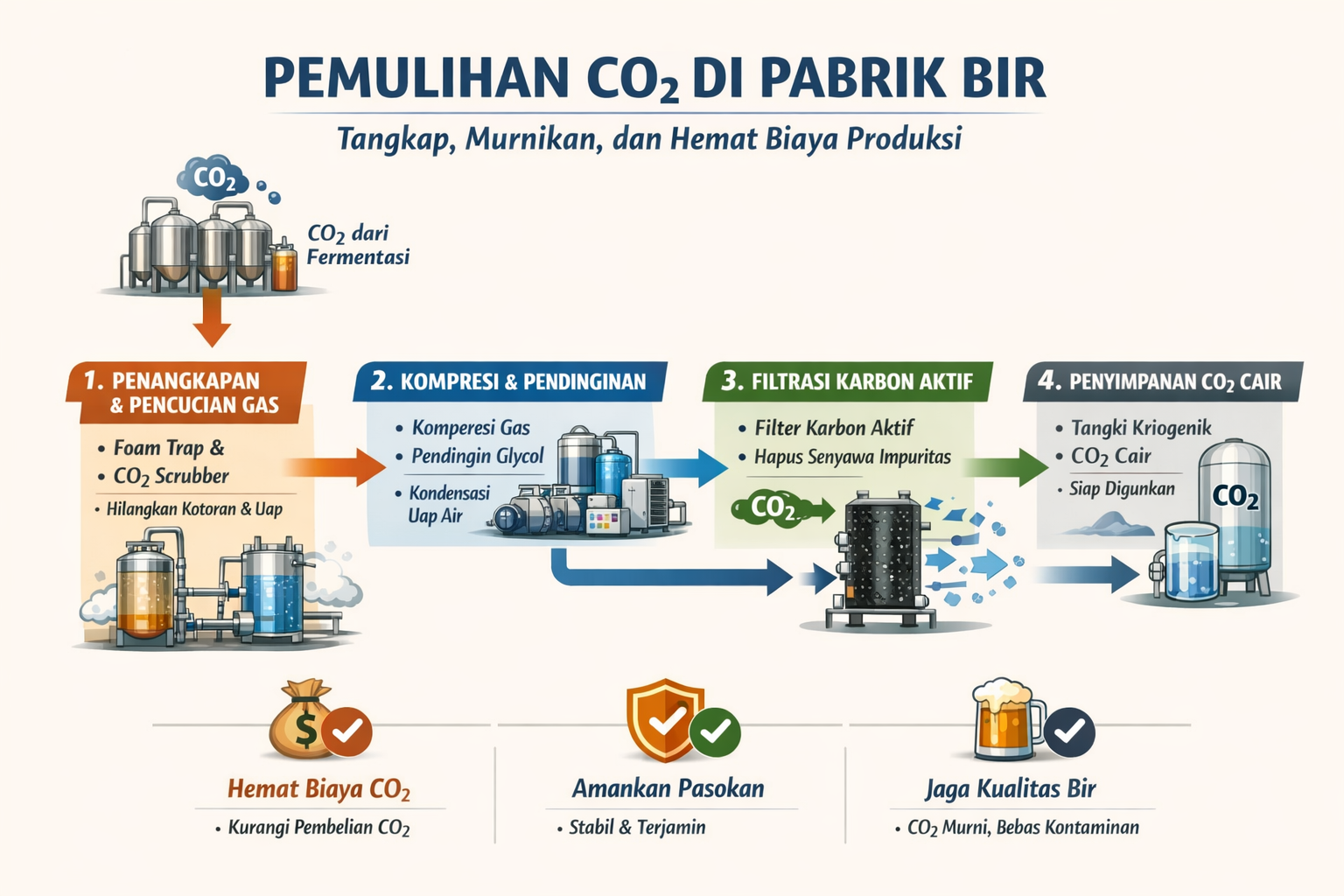
Even after washing and drying, trace organics remain at ppm–ppb levels and must be stripped because H₂S, DMS, mercaptans and similar compounds are intensely flavor‑active. Polishing is done with activated‑carbon filters that adsorb these molecules without capturing CO₂; suppliers specify removal of taste and odor compounds as the goal (NORIT). In breweries, carbon beds are typically extruded pellets with very high surface area and are periodically regenerated or replaced.
Beverage‑grade specs demand essentially pure CO₂ (≈95–99.7% purity) with oxygen held to negligible levels — cited as O₂ <0.6% — and without sulfur or aldehyde off‑notes (Cassman; NORIT). Many plants use food‑grade media such as activated carbon specifically for this flavor‑critical polishing step.
Costs, prices and ROI scenarios
Capex spans a wide range. Compact “craft” units are quoted in the tens of thousands of dollars — about ~$70–120K for small systems (CraftBrewing Business) — while larger continuous plants run several hundred thousand to over a million; one study cites ~€650K for a 500 kg/h plant sized for a 1 million hl/yr brewery (ResearchGate). Operating costs are dominated by electricity for compressors and refrigeration, plus maintenance for scrubbers and filters.
On the savings side, recovered gas displaces purchased CO₂ (often >95% food‑grade) and reduces exposure to supply volatility. Industry reports describe tight supply and price hikes for beverage CO₂ as feedstock costs rise (ChemAnalyst). Using €180/ton (≈$200/t) as a typical wholesale price, a million‑hl brewery with ~1.5 Mt CO₂ demand would spend ~€270K/yr on gas — implying a ~2.4‑year payback for a €650K system (650,000/270,000), or savings of about €0.0027 per liter of beer (ResearchGate; ResearchGate).
With higher utilization — for instance, selling excess gas or achieving fuller capture — the same study suggests payback near ~1.6 years (ResearchGate). GEA similarly points to “around three years” amortization for installed units, contingent on local CO₂ pricing (GEA).
Scale limits and adoption signals
Economics are scale‑sensitive. While systems “can be sized for all scales,” micro‑scale breweries may find them unattractive due to high specific costs (Cassman). At $100K‑plus, the up‑front is heavy for low‑volume operations (CraftBrewing Business). Recovering 95% of CO₂ in a tiny brewery that needs only a few tonnes per year could push payback toward a decade, whereas higher CO₂ usage in larger facilities tightens ROI dramatically.
Intangibles matter, too. Recovery reduces dependency on external suppliers — helpful during “CO₂ bottleneck” episodes that have idled breweries — and it lowers a beer’s CO₂ footprint by minimizing purchased gas (with the caveat that the recovery plant itself consumes power and cooling) (GEA; Cassman; Cassman). In surveys, over 80% of craft brewers interviewed expressed willingness to invest in available CO₂ recovery, with one considering near‑term adoption (Taylor & Francis Online).
Specification targets and reuse in the cellar
Recovered gas, once polished, is routed as needed for carbonation or blanketing tasks. The specification that the reusable CO₂ be very pure (≈95–99.7%) with O₂ <0.6% is emphasized to avoid off‑flavors and keep oxygen ingress negligible in final products (Cassman). The purification goal “is the removal of taste and odor compounds” such as H₂S, DMS and mercaptans before the gas returns to service (NORIT).