
Packaging lines that once sprayed torrents of soapy water are switching to precision “dry lube” films. Case studies show millions of liters saved, cleaner floors, and ROIs measured in a few years.
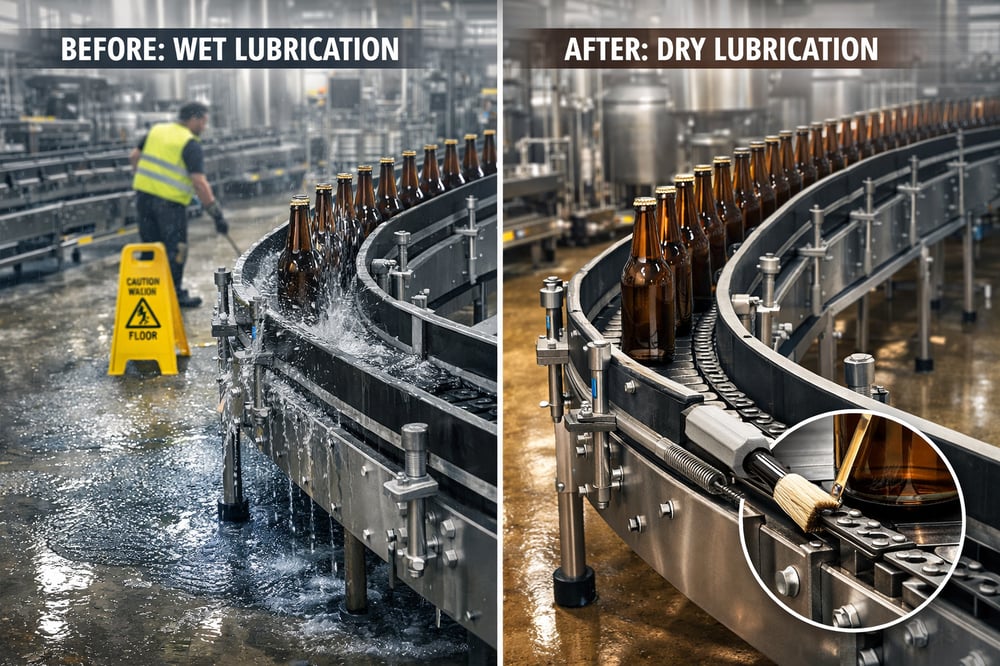
On a bottling line in Germany, the conveyor’s “lubrication” was basically a hose: 800–1,000 liters per hour of water mixed with chemicals, running 15 hours a day — and pooling on the floor (Klüber). That’s the traditional wet conveyor lubrication program in action. It works, but it comes with washdowns, slippery aisles, and the kind of residues that invite microbes.
Dry lubrication — minimal, targeted oil films or solid coatings, often applied by brush — is rewriting that script. Diversey’s DryFormance, for instance, uses an NSF‑approved oil that’s applied via brushes with no mixing with water, keeping lubrication confined to chain guides and product flow zones and eliminating overspray (Diversey).
The shift isn’t just about greener optics. In breweries and dairies, it’s about fewer slips, less effluent, and lower bills — with some lines reporting five-figure annual savings. Here’s how the math and mechanics stack up.
Conveyor lubrication categories and media
Industry practice falls into four categories (Traktech):
- Wet lubrication: water dosed with low‑concentration, food‑grade lube (old standard). Systems continually dose soaps or biocides.
- Semi‑dry: more concentrated wet formulas (less common) (Traktech).
- Dry lubrication: only oil‑based coatings or thin films. Examples include brush‑applied silicone oils and aerosol PTFE (polytetrafluoroethylene, commonly known as Teflon) sprays; PTFE solids in solution are typically ≤1% by weight (Traktech).
- Micro‑dry (CHP): high‑solids systems (up to ~6% PTFE) with precision routing and minimal over‑spray (Traktech).
Water, chemical and energy reductions
High‑speed beverage lines historically consumed millions of liters of lubricating water yearly. A single large canning line can use 2.5 million liters per year for wet lubrication, with returnable‑glass lines often higher (Diversey). Ecolab reports plants have cut conveyor water use by up to 97%, saving as much as one million gallons (3.8 million liters) annually per line (Machinery Lubrication).
At Craft Brew Alliance’s Redhook brewery, a switch to a low‑friction, dry‑running conveyor chain eliminated 111,000 gallons per year of water and 675 gallons per year of detergent — a 60% net cut in line water use even before a site‑wide retrofit (Packaging Digest) (Diversey).
Beyond volume, dry lube slashes chemical load. With wet lube, constant soap or biocide dosing drives chemical purchases and effluent treatment. Dry‑lube effluent carries essentially zero chemical load, easing biological oxygen demand and avoiding contamination risk in waste streams (Diversey). Energy use also falls: reduced friction “load‑reduces” conveyor motors. Field data show roughly 10% lower motor power draw in plastic‑belt lines (7% for stainless steel) (Diversey).
Putting numbers on it: a line saving 3.8 million liters per year (one million gallons) avoids around $3,800 in utilities if raw water and sewage each run $0.50 per kiloliter; removing about 2,500 liters of detergent at $2/liter adds ~$5,000; and a 10% motor energy drop (e.g., a 5 kW base, 8 hours/day, 300 days/year at $0.10/kWh) saves only a few hundred dollars. Taken together, a typical line can save on the order of $5,000–$10,000 per year in direct utility and chemical costs alone — consistent with an industry case of a 24,000 cph canning line saving >$12,000/year (Food & Beverage Business).
Quality adds more upside: without a water or soap film on primary containers, sites report fewer broken bottles and fallen packages when friction is controlled zone‑by‑zone (Diversey).
Hygiene, safety and PFAS considerations
Dry lubrication keeps machines and floors drier and cleaner. About 90% of slip accidents in food plants trace to wet or contaminated floors, so eliminating conveyor spray “creates a safer working environment” (Diversey). One East Africa brewery reported clean, dry floors with no slip hazards after conversion (Innovations Food) (Food & Beverage Business). At Redhook, teams stopped cleaning the conveyor after every shift once on dry lube (Packaging Digest).
Microbiologically, removing the lubricating water film reduces conditions for biofilm growth and improves sanitation (Diversey). In that Tanzania case, no “biological growth on the floors” was observed after conversion (Innovations Food). Regulatory expectations (NSF H1/ISO 21469 food‑grade lubricants; ISO/FDA emphasis that conveyor surfaces be easily cleanable) align with dry systems that don’t tack or drip; in Indonesia, food‑safety laws (BPOM) effectively require incidental‑contact lubricants to meet such approvals, and dry systems using trace amounts of compliant oil fit that hygiene stance.
One caveat: PTFE (Teflon) — a common dry‑film additive — is a PFAS (per‑ and polyfluoroalkyl substance), a durable class that persists in the environment and human tissue. Packaging experts warn PTFE residue can accumulate on bottles and conveyors and require extensive cleaning; Teflon is non‑biodegradable and can contaminate soil and water (Innovations Food). Modern dry conveyor oils often avoid PFAS; DryFormance is PFAS‑free by design (Innovations Food).
Dry lubricant families and cleanability
Silicone‑based oils (polydimethylsiloxanes) are clear, inert fluids (often NSF‑H1) that leave thin hydrophobic films. Because silicones are siloxanes, not PFAS, they don’t bioaccumulate like Teflon; over‑application can cause buildup, but modern systems meter precisely.
PTFE‑based lubes (Teflon powders or emulsions) provide extremely low friction — often 20–50% lower than oil alone — but, as PFAS, they can be harder to remove and come with environmental concerns (Innovations Food). Some “microlub” systems use up to ~6% solids to balance performance and cleanability (Traktech).
Oil‑based lubes (synthetic or mineral) act “dry” because they’re applied in tiny, targeted doses (brushes or direct injection). Diversey’s DryFormance uses H1‑approved oil, with no water in the mix (Diversey). Vegetable‑oil derivatives can be used similarly but may oxidize faster and require more frequent replenishment than synthetics. Graphite or other solid powders are rare in beverage lines and generally avoided due to grit.
The balance to strike is lubricity versus cleanability: any film must not smear onto bottles or packages. Suppliers like Matrix promote NSF‑H1 silicone or PTFE dry‑film sprays for conveyors (Matrix Lubricants). The safest designs meter lubricant only at the chain‑and‑guide interface via brush contact, preventing overspray onto packages or floors (Diversey) (Traktech).
Cost model and ROI illustration
Utility savings stack up quickly. Eliminating 3.8 million liters/year (one million gallons) of conveyor water can save roughly $1,900 in raw water and $1,900 in sewage treatment at $0.50 per kiloliter each (local tariffs vary; see reference on industrial wastewater pricing, Porvoo). Chemical cuts add more: Redhook saved ~675 gallons of lube soap per year, worth a few thousand dollars; conservatively estimating 2,500 liters at $2/liter yields another $2,000–$5,000/year (Packaging Digest).
Energy paybacks are smaller but additive: a ~10% friction drop can trim drive power. For a 10 kW motor running two shifts, 240 days/year, that’s 1 kW saved — about $200/year at $0.10/kWh. Energy is secondary to water/chemical savings (Diversey).
Maintenance can improve, too. Diversey reports >200% increase in plastic chain life under dry lube (i.e., doubling lifetime). Bearings and sensors last longer when not drenched, and fewer stops from chain issues or floor spillage boost throughput. Ecolab notes dry lube “can increase conveyor speeds and reduce broken bottle counts,” which translates to fewer losses (Diversey) (Machinery Lubrication). Safety/compliance impacts are positive but harder to monetize; some manufacturers link such gains to lower insurance and OSHA costs (no public data cited).
Investment varies. A retrofit typically adds a dispensing system (brushes, pumps, controls) and sometimes new chains/belts. Redhook swapped an entire conveyor to a dry‑running design, but many plants convert existing conveyors with metered applicators; industry anecdotes range from tens to a few hundred thousand dollars depending on scope (Packaging Digest).
One reported brewery in Tanzania (24,000 cans/hour) saved >$12,000/year from water, lube, and effluent alone, with a 36‑month payback — implying roughly $36,000 invested (Food & Beverage Business). In markets with cheaper water but higher usage, ROIs of 2–4 years are plausible. For example, if total annual savings are $8,000 and the upgrade costs $20,000, payback is 2.5 years (ROI ~40%/year).
A synthesized ROI model: water saved 3.8M L × ($0.50 + $0.50)/1,000 ≈ ~$3,800; detergent saved 2,500 L × $2/L ≈ ~$5,000; energy saved ~1–2 MWh × $0.10 ≈ ~$200; maintenance spares reduction ≈ ~$1,000 (assumed). Total annual savings ≈ ~$10,000. If installation costs $30,000, payback ≈ ~3 years. With water scarcity and sustainability pressures rising — and given case studies from Packaging Digest and Food & Beverage Business — many breweries see dry lube as both an environmental and financial win (Packaging Digest) (Food & Beverage Business).
Sources and further reading
Industry case studies and product data (Diversey, Ecolab, Klüber, ChemTreat, Packaging Digest) report water/chemical savings, slip‑prevention, and ROI with dry conveyor lubrication (Packaging Digest) (Diversey) (Innovations Food) (Machinery Lubrication) (ChemTreat). Figures cited above are representative to inform cost–benefit analyses in brewery packaging lines.
