

Industry: Brewery | Process: Clean
In beer, “clean” is a profit center. Every post-batch cycle, fermenters, bright tanks, and miles of piping are blasted with hot caustic and acid soaks plus rinses to keep out yeasts and lactic acid bacteria that can compromise flavor and yield (academicjournals.org), and because “machinery will appear clean” even when residues remain invisible on plant surfaces (www.food-safety.com).
Validation isn’t just about safety. Downtime runs on the order of $30–50K per hour of lost production (www.processingmagazine.com), and CIP typically accounts for roughly 30% of a plant’s water and energy use (www.processingmagazine.com).
Regulators such as FDA, FSANZ, and Codex, and standards like HACCP, SQF, and FSSC 22000, mandate “effective cleaning…disinfection” but don’t define numeric cleanliness criteria—so breweries set their own acceptance limits and sampling plans (academicjournals.org; easconsultinggroup.com). The real-world goal: remove visible soils, microbial biofilms, and chemical residues while minimizing cycle time, water, and chemical use (www.luminultra.com; easconsultinggroup.com).
Standards, risks, and the CIP brief
Clean-in-place (CIP) refers to cleaning equipment without disassembly; in brewing, that typically means caustic and acid cycles plus rinses. The target is “unwanted microorganisms” and organic residues that undermine beer quality and yield (academicjournals.org; www.food-safety.com). Because guidelines stop short of numeric limits, validation rests on brewery-defined thresholds, tiered testing, and data logging (easconsultinggroup.com).
Traditional validation methods
Visual inspection has zero cost and instant feedback, but “looks can be deceiving”: even gleaming stainless may harbor invisible films or microorganisms (www.food-safety.com). It offers no quantitative guarantee, so it must be supplemented.
Microbiological swabbing with culture plating is the gold standard for viable counts—think Lactobacillus, Pediococcus, coliforms, and yeasts—delivering specificity and even species identification. But incubation runs 24–72+ hours, swabs cover only a tiny fraction of the total surface, and only a small percentage of environmental microbes are culturable (many enter viable-but-non-culturable states under stress), so CFU counts “do not reveal the true surface hygiene” (www.researchgate.net; www.researchgate.net). Typical limits might be “no visible colonies on a 25 cm² swab,” but a clean result only indicates culturable organisms were below the detection limit.
Chemical and physical residue checks—monitoring CIP effluent for conductivity, pH, or turbidity—confirm detergents were adequate and fully rinsed. For example, conductivity in final rinse water can confirm removal of caustic. These are fast and automatable but indirect: they do not measure microbial cleanliness.
Rapid ATP and modern screening
ATP bioluminescence testing uses a handheld luminometer to read Relative Light Units (RLU) from a swab in 1–2 minutes, indicating total organic residues (microbial ATP plus food soils). It is widely used for hygiene screening in food plants because results are immediate and require minimal training (www.food-safety.com; www.food-safety.com).
In a brewery study, surfaces were considered “clean enough” if ATP was under 30 RLU, with under 10 RLU ideal, and many plants use similar cutoffs (often 10–30 RLU for stainless) based on manufacturer guidance (academicjournals.org; academicjournals.org; www.food-safety.com). If RLU is high after CIP, crews can correct immediately—continue or repeat cleaning—before production restarts (www.food-safety.com).
Limits matter: ATP reports total organic ATP, not live viable counts, and disinfectant residues can interfere with the luminescence reaction. A low RLU does not identify specific pathogens, and a high RLU flags soils or biofilm rather than organism type. Guidance is clear that ATP indicates sanitation efficacy and should complement, not replace, periodic microbial plating (www.food-safety.com; easconsultinggroup.com).
Other rapid methods exist. UV-fluorescence systems can reveal remaining organic films in real time (www.ncbi.nlm.nih.gov). “2nd-generation” ATP systems may test water samples online (www.luminultra.com). Emerging bioluminescent kits or immunoassays can detect specific residues within minutes, but ATP remains the most common rapid hygiene test in practice (www.food-safety.com; www.food-safety.com).
Method comparison: pros, cons, timing
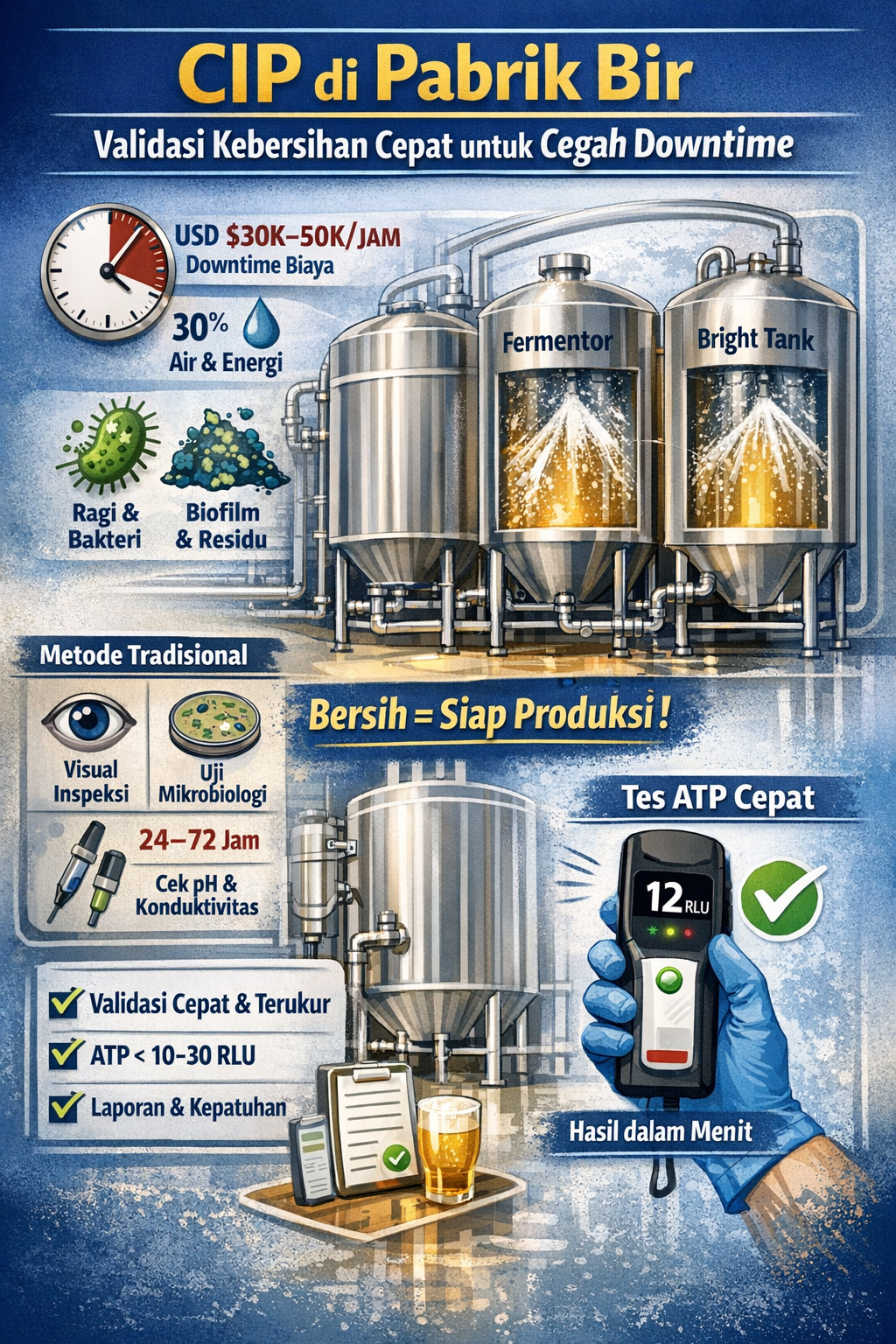
- Visual inspection: no cost and immediate, detects gross dirt; subjective and cannot see biofilms or invisible soils; immediate, qualitative (www.food-safety.com).
- Microbial swab (culture plating): specific viability counts and organism identification; slow (24–72+ hours), labor-intensive, spot-samples only, misses viable-but-non-culturable cells; detection often ≈1–10 CFU per sample; CFU counts “do not reveal the true surface hygiene” (www.researchgate.net; www.researchgate.net).
- ATP swab: rapid (about 1–5 minutes per swab) and sensitive to any organic residue; ideal for immediate pass/fail; nonspecific for live organisms and can be affected by sanitizer residues; thresholds commonly set at under 10–30 RLU for stainless surfaces (www.food-safety.com; academicjournals.org).
- Rinse-water tests (conductivity, pH, turbidity): automatable and confirm CIP flush efficiency; indirect measure with no microbial information; continuous or metered during CIP.
Data from a microbrewery and savings
A UK microbrewery survey found high ambient-temperature washes were as effective as hot washes, and that 2% (v/v) caustic for 35 minutes reliably met cleanliness criteria (ATP under 30 RLU), followed by a sterilisation stage (academicjournals.org). Optimizing that CIP—2% caustic and one 100 L rinse per 1,200 L tank—saved over £1,000/year on chemicals, water, and energy (academicjournals.org).
Program design: tiered validation steps
Define hygiene criteria with quantitative targets such as “ATP under 10 RLU desirable, under 30 RLU acceptable when surfaces are dry,” and “no detectable spoilage organisms on 25 cm² swab,” aligned to manufacturer guidance (Hygiena) and risk assessment, and document acceptance criteria as control limits (academicjournals.org; easconsultinggroup.com).
Map and sample hotspots: fermenter spray balls, gasket seals, filter outlets, krausen line, sidewall below the krausen line, valves, and sensors have all been used as swab points in brewery studies (academicjournals.org). Visual checks remain a basic screen after CIP.
Use ATP for daily checks after each CIP—or at least each shift—on major vessel surfaces and pipework. Any RLU over threshold triggers immediate re-cleaning before start-up. Many plants use handheld luminometers at shift start and train operators on swabbing technique (consistent contact area) (www.food-safety.com).
Layer in periodic verification: weekly or monthly culture swabs for total yeast/LAB or indicator organisms, and checks on rinse-water conductivity and pH to confirm full detergent flush. These verify that ATP thresholds correlate with microbial cleanliness (easconsultinggroup.com).
CIP parameter monitoring and dosing control
Modern CIP skids record temperature, flow rate, time, and chemical concentration, with alarms or analytics to flag anomalies like low flow or short cycles; formal monitoring can reduce energy and water use roughly 40% and cut CIP time about 10% (www.processingmagazine.com). Chemical concentration control can be paired with an accurate chemical dosing pump as part of the CIP skid design.
Documentation, revalidation, and culture
Treat CIP as a food safety preventive control (FSMA) or oPRP; validate scientifically with a written protocol, records of each cycle (parameters, ATP results, corrective actions), and revalidate after changes (equipment, chemistries, cycles) by repeating swab/ATP tests under “worst-case” conditions (easconsultinggroup.com; easconsultinggroup.com; easconsultinggroup.com).
Train sanitation crews on the Sinner circle (time, temperature, chemistry, mechanics) and on interpreting test results; emphasize that “just because it looks clean” is not enough (www.food-safety.com). Practical advice from brewers includes installing “validation systems” (ATP, swabs) and auditing procedures to keep standards high (www.whitelabs.com).
Measured gains and audit readiness
By combining visual inspection with objective tests, a brewery can require post-CIP ATP readings under 30 RLU on key surfaces, monthly culture plates at under 1 CFU for spoilage bacteria, and rinse-water conductivity/pH within spec—triggering immediate re-cleaning if anything is out-of-bounds (academicjournals.org). Trend charts of ATP or microbial counts over time reveal drift—worn spray balls, creeping biofilm—and drive continuous improvement.
Measurable outcomes include reducing batch-to-batch contamination risk to near zero, minimizing overcleaning, and shrinking non-productive downtime. Studies report optimized CIP, guided by testing, can trim 30–60 minutes from each cleaning cycle while maintaining hygiene (academicjournals.org; www.processingmagazine.com). Tracking ATP results catches sanitation slips immediately, avoiding costly rework or recall, and auditors look for documented validation—recent ATP and swab logs—as evidence that cleaning is under control.
Each method’s pros/cons and the validation steps above align with FDA/Codex cleaning-validation guidelines (easconsultinggroup.com; easconsultinggroup.com). A data-driven plan—rapid ATP for daily go/no-go plus periodic microbiological assays for confirmation—keeps breweries hygienic, protects product quality, and optimizes CIP efficiency (www.food-safety.com; easconsultinggroup.com).