

Industry: Brewery | Process: Boiling
A real-world kettle stack measured ≈0.7 gal/min (≈2.65 L/min) of saturated steam during the boil, with hydrogen sulfide (H₂S, rotten‑egg odor) at 15–22.5 ppm (parts per million) and dimethyl sulfide (DMS, “cooked veg.” odor) >15 ppm in the raw exhaust (industrialodorcontrol.com and industrialodorcontrol.com). Condensable volatiles — hop oils, low‑boiling aldehydes/ketones — ride along.
That vapor is energy leaving, too. Wort boiling consumes ~14 kWh per hectoliter (kWh/hl; ≈56,000 BTU per barrel) (scribd.com) and represents ~40% of facility steam usage (patents.google.com), with packaging/pasteurization the rest. Uncaptured, this waste steam (and its dissolved organics) escapes as odorous emissions.
Regulation isn’t always a clear driver. Indonesian air‑emission rules (Permen LHK No. 7/2007 and 21/2008) set limits on SO₂, NO₂, particulates, opacity, etc. for industrial stacks, but do not specifically cover brewery VOCs (volatile organic compounds) or odors (intilab.com). Many breweries act anyway due to odour complaints or voluntary sustainability targets.
Kettle vent vapor condensation and odor removal
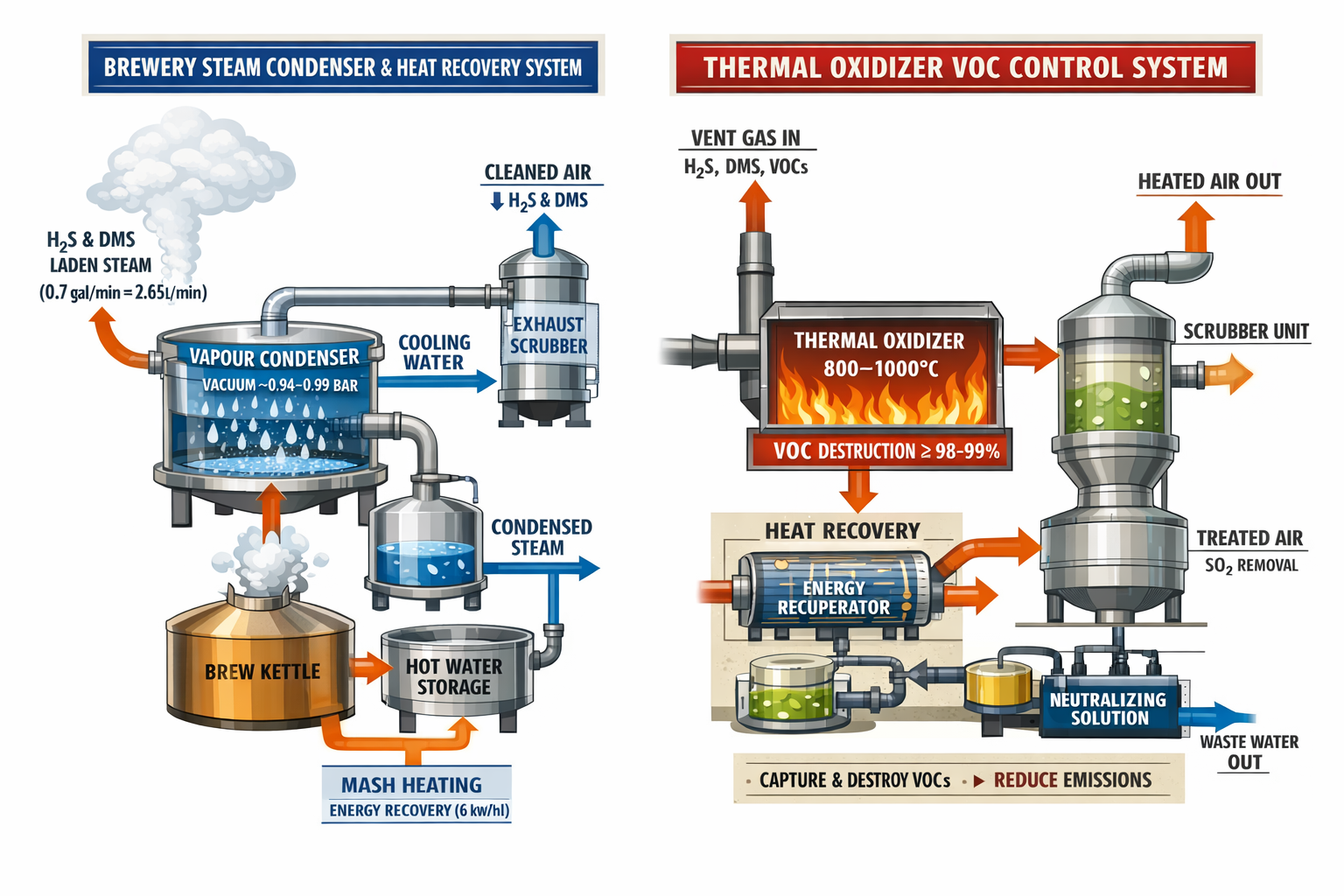
“Vapour condensers” intercept kettle steam and recover its heat. In a typical design, exhaust steam is drawn through condenser piping where a cool‑water spray creates a slight vacuum and causes steam to condense (brewiks.eu). Vendors report makeup cooling water on the order of tens of liters per hour — ~60 L/h to condense boil‑off (brewiks.eu). Systems run under mild vacuum (∼0.94–0.99 bar), avoiding kettle collapse while inducing vapor flow out of the vessel.
The energy math is compelling. With wort boiling at ~14 kWh/hl and brewhouse thermal efficiency ~80% (scribd.com and scribd.com), ≈80% of steam energy can be harnessed. If ~80% of boiler heat is reclaimed via condensation, only ~6 kWh/hl is drawn from fuel (versus ~14 kWh/hl uncontrolled) (scribd.com and scribd.com). One pilot analysis showed stored condenser heat reduced net boil energy to just 25% of baseline (campdenbri.co.uk).
Odor falls with the condensate. Steam carries both desirable and “unwanted volatile compounds,” and condensing “helps to minimize emissions” (brewiks.eu). Highly water‑soluble gases like H₂S and some mercaptans scrub out. In one industrial case, condensing vent steam and then scrubbing drove H₂S and DMS in the exhaust from ~20 ppm to essentially 0 ppm; air was also bled in to lower exhaust relative humidity and promote droplet separation (industrialodorcontrol.com). The condensate can be reused (e.g., as boiler feed or for CIP cleaning — clean‑in‑place), or routed to drain; its heat content (often near 100 °C) is available for reuse. Where reuse loops need polishing after heat exchange, plants deploy a condensate polisher to protect downstream equipment.
Thermal oxidizers: high‑temperature abatement
Thermal oxidizers (often “vapor incinerators” or, in heat‑recovery form, RTOs — regenerative thermal oxidizers) combust VOCs at ~800–1000 °C long enough to oxidize them to CO₂ and H₂O. Well‑designed systems achieve ≥98–99% destruction of hydrocarbons (studylib.net and studylib.net). Their use in brewing is less common than in solvent‑heavy industries, but they can handle fermenter or boil‑vent VOCs if needed; any DMS or higher aldehydes in the vapor would be eliminated by oxidation.
Caveats are practical. Burning sulfur compounds (H₂S) generates SO₂, so a thermal oxidizer treating brew vents typically requires a downstream scrubber for sulfur. In such scrubbing setups, accurate chemical feed is handled with a dosing pump. Capture efficiency (complete hooding of vents) is crucial because total VOC abatement = capture % × destruction %. RTOs recycle some heat via ceramic media and reach >99% VOC destruction (studylib.net). Units are sized to give ~2–10 in of retention for 99% removal per pass, with redundancy doubling for safety (studylib.net). Costs are high, so oxidizers are usually justified when rules mandate >95% VOC removal; EPA and others recommend best‑available oxidizers for photochemically reactive VOC abatement (studylib.net). Practicality depends on VOC concentration and whether resultant SO₂ or CO₂ emissions are acceptable or need further treatment.
Stack condensate heat recovery integration
Heat recovery turns plumes into preheat. One German brewery installed an insulated hot‑water tank charged by its wort condenser; the 95 °C water preheated the next mash from ~74 °C to ~93 °C, so the final boil required only ≈25% of the energy it would otherwise consume (campdenbri.co.uk). Boil‑off was halved (from ~10% to ~5%), and the €400K investment paid back in ~3 years via fuel savings (campdenbri.co.uk and campdenbri.co.uk).
Industry programs echo the gains. A global initiative drove brewery energy use from ~247 MJ/hl down to 85 MJ/hl (−65%) by measures including vapour recovery (forbesmarshall.com). Recovering high‑temperature condensate reduced boiler make‑up water by ~70% (forbesmarshall.com). Mechanical vapor recompression (MVR) or multiple‑effect systems can push further — one study claims up to 95% primary energy reduction under ideal MVR, though such systems are capital‑intensive (scribd.com). Analysis suggests breweries can still cut another ~20% of energy use with “available, cost‑effective” steam recovery technologies (forbesmarshall.com).
By the numbers: emissions and energy
Brewery boiler heat demand sits around ~14 kWh/hl with brewhouse efficiency ~80% (scribd.com and scribd.com), with the kettle representing ~40% of facility steam usage (patents.google.com). Condenser cooling water usage is ~60 L/h (brewiks.eu), and measured vent emissions reached ≈0.7 gal/min steam with ~15–22.5 ppm H₂S and >15 ppm DMS (industrialodorcontrol.com). Commercial condensers and hot‑water storage can cut boil‑off from ~10% to 5% of volume (campdenbri.co.uk), capturing ~95 °C condensate (≈6 kWh/hl) to preheat wort (campdenbri.co.uk). Sector benchmarks show energy use dropping from 247 to 85 MJ/hl (−65%) alongside better condensate reuse and steam optimization, with quick paybacks (~3 years) reported on recovery systems (forbesmarshall.com and campdenbri.co.uk).