

Industry: Automotive | Process: Pre
In automotive pre‑treatment and e‑coating (electrodeposition paint), zinc phosphating remains a workhorse for corrosion protection — and a prolific producer of sludge. The ferric/zinc phosphate precipitate accumulates in tanks, hurts coating efficiency, and inflates waste bills.
How prolific? One expert forum post recalls about 17 lb/day of sludge on a 1.4 million ft²/year phosphating line (Finishing.com). Researchers add that phosphating baths “generate a large amount of sludge containing metal ions” and require frequent desludging (iopscience.iop.org).
Conventional zinc‑phosphate regimes
Traditional zinc‑phosphate systems are multi‑stage (often 6–8 tanks) and run hot — typically ∼80–85 °C. A review notes phosphating baths “operate above room temperature, from 30 to 99 °C (typ. ~50 °C higher)” and produce large amounts of metal‑bearing sludge (iopscience.iop.org). Coating weights are substantial: iron‑ or zinc‑phosphate layers routinely measure hundreds of nanometers thick (500–1000 nm) (Henkel).
Low‑sludge thin‑film alternatives
A contrasting path is “thin‑film” zirconium/titanium conversion coatings (e.g., BONDERITE M‑NT). These nano‑ceramic layers (20–30 nm) deposit at room temperature, with no heavy metals or polymers, cut process steps, and nearly eliminate sludge (Henkel; Henkel). One UK OEM swapped a 7‑stage zinc‑phosphate line at 55 °C for a 5–6 stage zirconium pretreatment run at ambient, trimming process cost 10–30% and reporting “very little sludge or scale” (Henkel; Henkel).
Fermob in France, which processes ~3,200 tonnes of steel per year, moved from thick iron‑phosphate (500–1000 nm) to a 20–30 nm zirconium thin film and improved salt‑spray corrosion resistance by about 30% while using far less material (Henkel). In short, shifting from conventional Zn/Mn phosphate to ambient Zr/Ti conversion baths or nickel‑free formulations can dramatically reduce sludge generation (iopscience.iop.org; Henkel). Note: alternatives like trivalent phosphates or plasma/sol‑gel coatings are also under study, but industry uptake is nascent.
Temperature and acidity control
Within any phosphate system, tight control of bath parameters is decisive. Temperature must be uniform: ∼80–85 °C is typical; running below 180 °F (~82 °C) can stall the reaction and yield poor, grainy deposits, while overheating spikes free acid and risks substrate attack (Hubbard Hall). Gradual heating is advised to avoid hot spots; immersion coils, jackets, and insulated tanks help maintain stability (Hubbard Hall).
Acidity is tracked via total acid (TA) and free acid (FA) titrations; phosphoric acid is triprotic, so both matter. An optimal TA:FA (typically ~6:1 at make‑up) keeps deposition on target (Hubbard Hall; Hubbard Hall). If FA is too low, metal dissolution is insufficient; if FA is too high, the bath etches the substrate and dissolves extra metal (Hubbard Hall). Plants commonly adjust FA with measured additions of phosphoric acid or neutralizers; accurate chemical dosing is aided by equipment such as a dosing pump. Deviations can show up as bath color changes — for instance, the loss of a “green” Ni²⁺ tint — signaling instability (Finishing.com).
Accelerators and iron management
Accelerator salts (commonly nitrates, fluorides, nitrites) boost reaction rate by promoting anodic dissolution and/or oxidation of Fe²⁺ to Fe³⁺, which directly affects sludge chemistry. Overdosing accelerator or dragging in alkali from cleaners tends to increase sludge — as one practitioner puts it, “High accelerator causes higher sludge levels” (Finishing.com). Insufficient accelerator yields thin coatings and poor performance, so supplier ranges are the reference point.
Some systems add mild oxidizers intentionally to precipitate excess iron, effectively running “iron‑free” so the bath stabilizes at a controlled Fe content (Hubbard Hall). Maintaining the coagulation point — keeping near saturation with Zn(H₂PO₄)₂ — minimizes uncontrolled precipitation.
Turnover, filtration, and capture
Bath engineering matters as much as chemistry. Frequent circulation and partial overflow help strip solids from the process zone; many processors route agitation or overflow drains to a sludge hopper or clarifier to capture nascent precipitates away from the main tank (innovationfilter.com; Finishing.com). Plant Q&A’s suggest turnover rates of 4–7 tank‑volumes per hour to limit buildup (Finishing.com).
Inline filtration and centrifugation catch larger particles before they settle; plants often specify a cartridge filter in the recirculation loop and choose robust steel filter housings for industrial duty. Continuous filtration, however, is not the same as a filter‑press approach and can be problematic if the goal is cake dewatering (see below).
Filter press dewatering and disposal
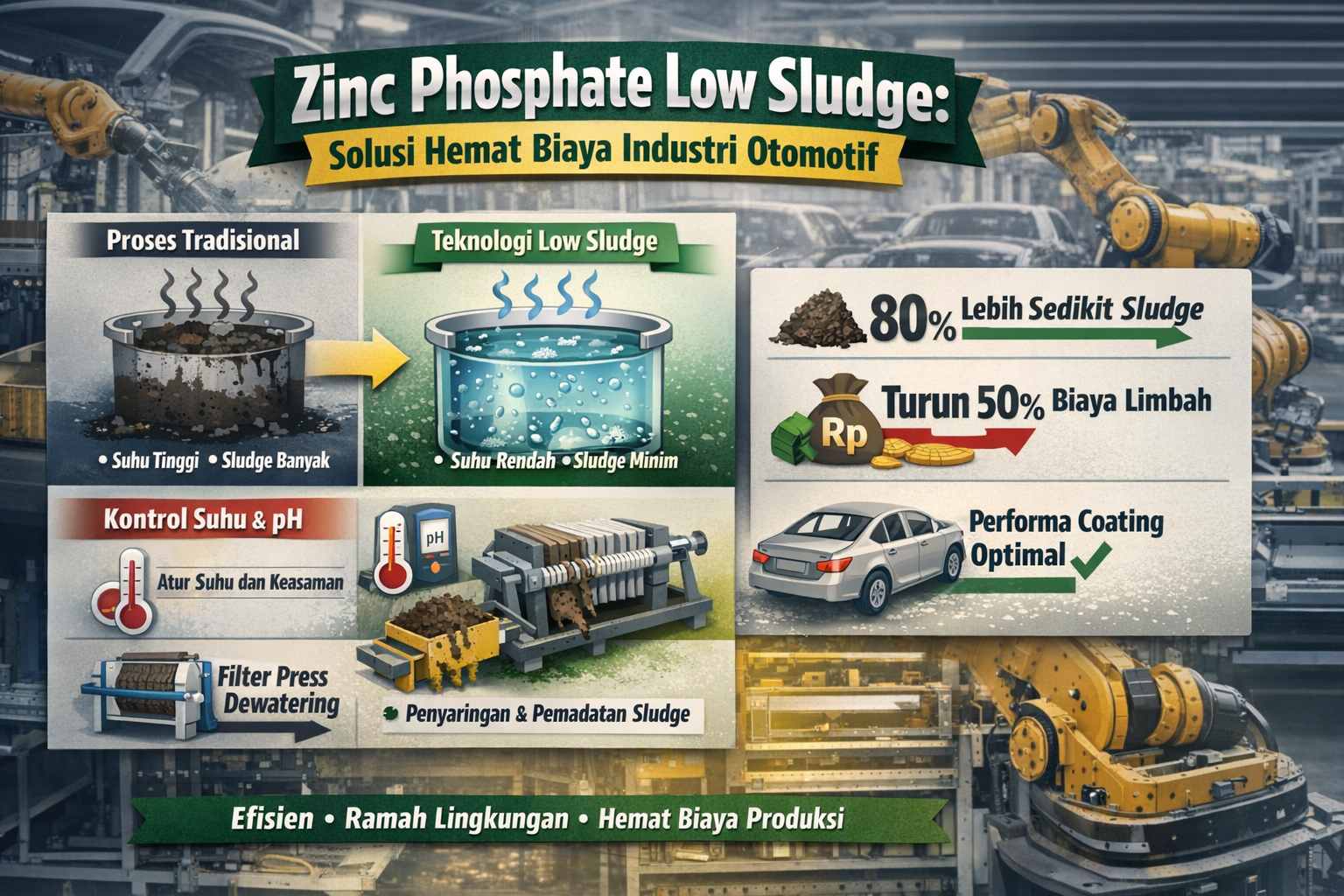
Once sludge accumulates, a filter press can remove solids and squeeze them into a high‑solids cake; high‑pressure presses are common for metal finishing sludges and operate in batch mode. Practitioners caution against “running the bath through” the press; a clarifier or sludge hopper upstream concentrates the slurry so the press produces a workable cake rather than a viscous “toothpaste” mass. The settled sludge is stirred at the hopper bottom and pumped to the press; the process bath itself is not pressurized (Finishing.com). Many lines integrate a dedicated clarifier ahead of the press for this reason.
Dewatering performance metrics
Filter presses can dramatically shrink sludge volumes. Reported trials show cakes reaching 45–50% total solids (nepis.epa.gov), including studies of industrial nutrient sludges at ~45–50% dry cake via vacuum/diaphragm pressing (nepis.epa.gov). Starting from ~2–5% solids, concentrating to ~40% yields roughly a 4–5× volume reduction. A tonne of wet sludge might become only ~200–300 kg of dewatered cake. Denser cake — often >30% solids — is cheaper to transport and treat; some plants incinerate or cement‑stabilize the cake, further cutting disposal weight.
Because phosphate sludge carries heavy metals (Fe, Zn, Ni, Mn), many jurisdictions (including Indonesia) classify it as hazardous/B3 waste. Minimizing mass and moisture therefore yields large savings; using a press avoids hauling ~70–80% water.
Outcomes and line economics
When these controls are implemented, mature plants report measurable gains: lean phosphating regimes can delay full bath changeouts from monthly to quarterly. One case study: switching from a 5‑stage phosphate to a thin‑film Zr coat slashed energy use (ambient vs. 55 °C immersion) and “maintenance was also reduced considerably as very little sludge or scale is produced” (Henkel). Others report process cost savings of 30% or more with modern low‑sludge chemistries (Henkel; Henkel).
Even within phosphate chemistry, discipline pays off: anecdotal reports suggest 1–2 g of sludge per m² of steel is achievable in a well‑tuned system, versus perhaps 5–10 g/m² in a sludge‑heavy bath (actual yields vary with part volume, metal mix, and regimen). Regular monitoring of TA/FA, bath temperature, and sludge thickness remains essential (Finishing.com). Taken together — lower temperature swings, correct free‑acid balance, and efficient solids removal — plants can reduce sludge volume (often by >70%) and disposal cost, while sustaining high‑quality e‑coat adhesion.
Sources and data trail
Peer‑reviewed and industry sources underpin the data above: Milosev & Frankel (2018) discuss sludge generation and desludging needs (iopscience.iop.org); Henkel publications provide case metrics including 10–30% cost reductions and ~30% performance improvement (Henkel; Henkel); chemical supplier guides emphasize temperature and acid control (Hubbard Hall; Hubbard Hall); practitioner forums document TA/FA practices and dewatering tips (Finishing.com; Finishing.com); and US EPA reports show 45–50% cake solids from presses (nepis.epa.gov).