

Industry: Automotive | Process: Pre
A modern automotive paint shop can burn through about 400–500 kWh (kilowatt‑hours) per vehicle, with pretreatment — degreasing, acid wash, phosphating or conversion coating, and rinsing ahead of e‑coat — taking a large slice of that load (Automotive Manufacturing Solutions). Pressure is mounting in Indonesia and globally to cut this energy use: Indonesia’s 2025 target is a 17% reduction in industrial energy consumption (business‑indonesia.org), and regulations (e.g., Pres. Decree 43/1991, GR 70/2009) mandate energy management in large plants (business‑indonesia.org).
In practice, the biggest levers sit where most of the energy goes: fuel to heat tanks and water (often natural gas or steam) and electrical power for pumps and heaters.
Low‑temperature cleaning chemistries
One proven move is to switch to low‑temperature cleaning chemistries that work at near‑ambient or moderately warm temperatures (about 25–40 °C) instead of the 55–70 °C typical of conventional alkaline degreasers. Because heating spray or immersion baths dominates fuel use, this can cut heating fuel dramatically.
At OSRAM’s SITECO lighting factory — a process analogous to an automotive pretreat line — replacing a 60 °C spray degreasing step with a new alkaline “BONDERITE” low‑temp cleaner used at roughly ambient delivered a 30% annual reduction in natural gas consumption, essentially allowing the gas burner to be shut off for most of the year (Henkel case study). In aluminum‑can spray washers, lowering the cleaning bath from ~60 °C to ~43 °C cut natural gas use by 32% and carbon emissions by ~38% (Henkel press release, 2023). Although not automotive‑specific, these results indicate the scale of savings: in practice, a 30–40% cut in cleaning energy is achievable with validated low‑temp cleaners.
The side benefits are material: lower bath temperature reduces water and chemical losses; one supplier reported ~75% less foam and evaporation, 5–20% lower water consumption, and better plant comfort due to fewer hot vapors (Henkel press release, 2023) (Henkel case study). Modern low‑temp cleaners drop into existing spray or immersion hardware — no equipment changes — and bath life is often extended 2–3× before make‑up (Henkel case study) (Atotech technical note).
Capital cost is minimal (chemistry change only), while fuel savings can pay back any price premium within weeks. For illustration, if low‑temp cleaning saves 1 GWh/year (gigawatt‑hour per year) of gas (≈3.6 GJ) at $0.03/kWh, that is about $30,000 per year saved for a large line. Operations teams focused on control often emphasize accurate chemical feed; equipment such as a dosing pump supports maintaining target concentrations at lower temperatures.
Phosphate‑free conversion coatings (zirconium/titanium)
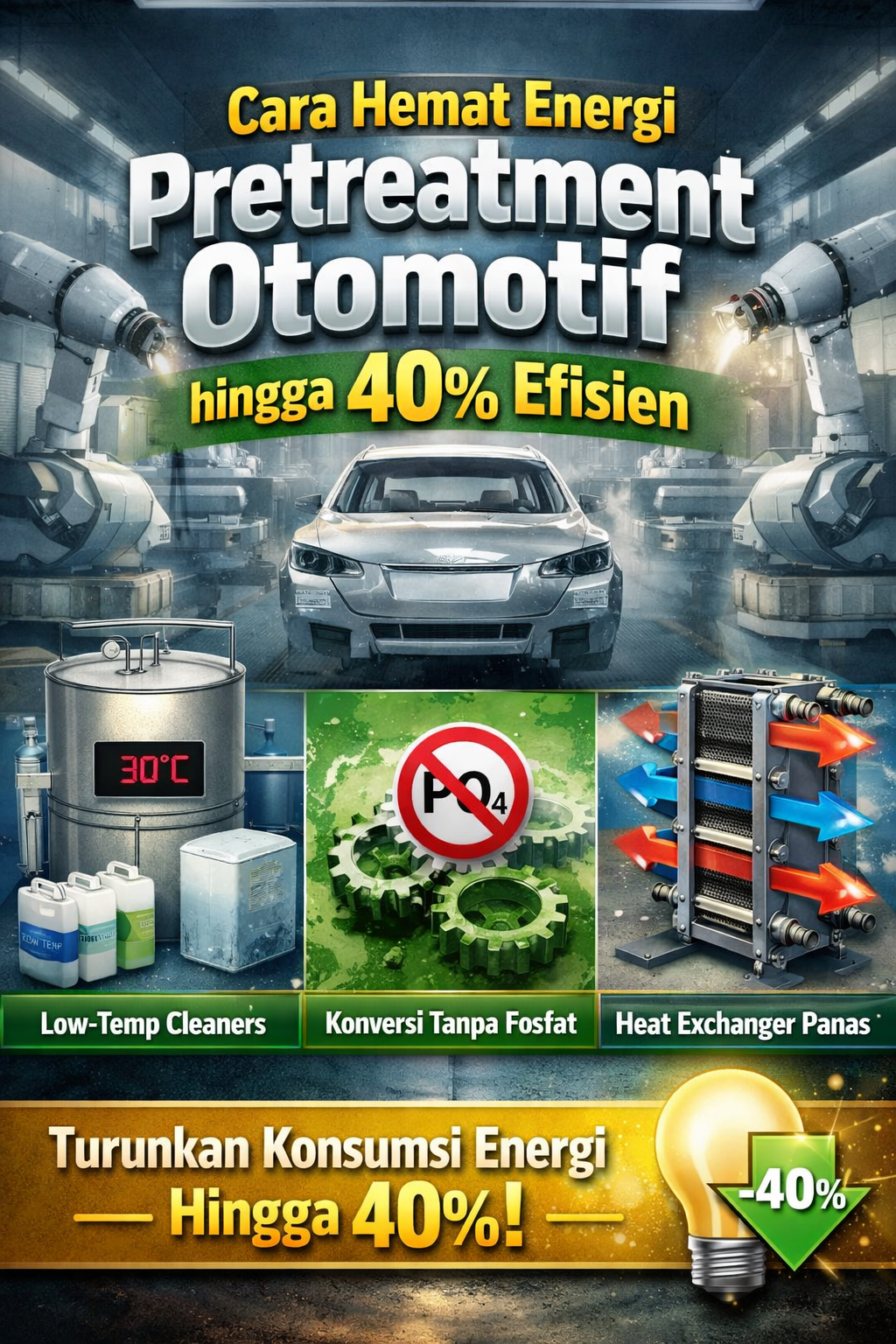
Conventional pretreatment often relies on zinc or iron phosphate conversion coatings (a thin chemical layer that improves paint adhesion and corrosion resistance) applied at elevated temperature with heated post‑rinses. Newer “green” chemistries — notably zirconium‑ or titanium‑based — operate at room temperature (20–30 °C). As Hitachi High‑Tech frames it: unlike phosphate systems, zirconium‑based coatings are applied at room temperature so “only the cleaning stage is heated; the coating is done at room temperature,” delivering substantial energy savings (Hitachi High‑Tech).
In practice, an automotive line switching to a zirconium process can eliminate heat in one or more steps. Happy Day (BASF) Bonderite M‑NT technology is a phosphate‑free conversion that operates at ambient and completes in ~1–3 minutes, replacing multi‑minute phosphate tanks (Henkel, 2024).
The water story matters, too. Traditional phosphating needs heavy rinsing with large throughputs; zirconium processes use counter‑flow rinses with far less water, cutting both water‑heating loads and phosphate‑bearing effluent — a plus for zero‑discharge compliance (Hitachi High‑Tech). Suppliers summarize the advantage plainly: “Zirconium‑based coatings … use less energy… less water… and contain no phosphates,” improving both OPEX and compliance (Hitachi High‑Tech) (Hitachi High‑Tech).
Plate‑and‑frame heat recovery (counterflow)
Even after optimizing chemistry, heated solution tanks — especially intermediate rinse tanks — often overflow or discharge hot water. Plate‑and‑frame heat exchangers (thin corrugated plates that separate alternating channels of hot and cold liquid in counterflow) can capture that heat. Hot rinse effluent (say 50–70 °C) can run opposite cold make‑up water (20–30 °C), preheating feed and cooling waste.
Modern gasketed plate exchangers can recover about 70–90% of the sensible heat (temperature energy), with approach temperature differences of only a few °C feasible. Beyond rinses, general sources note that flue gases from paint ovens — 180–250 °C — contain ~25% of the total painting‑line heat, and redirecting them to preheat tanks can “greatly reduce the energy cost” (CST Heat Exchanger).
Quantitatively, if 10 m³/h of rinse water flows at 50 °C into a tank (1000 kW of thermal energy) and is tempered by a plate exchanger, roughly 500–700 kW can be recovered continuously. Over an 8‑hour shift that is ~4–5.6 MWh of heat saved per day. At $0.03/kWh (as gas heat), this equals ~$120–$168 per day. In rinse lines, instead of discarding 60 °C water, a plate exchanger can return it at ~10–20 °C, replacing much of the heater duty.
Downsides are modest: a plate heat exchanger of suitable size (~tens of plates) might cost on the order of $5–20k, depending on flow rate and material. With the above savings, such an investment typically pays back within 1–2 years; larger plants with multiple exchangers see multi‑year paybacks under 3 years. Maintenance is routine (periodic cleaning), and equipment life is long.
Cost‑benefit scenarios and payback
Stacking these measures compounds the return. Chemistry changes usually avoid hardware spend, so the energy reductions (30–40% less heater use) often amortize any chemical premium within weeks. A 1,000 kW heater reduced by 30% saves ~2.6 GWh/year of gas, worth ~$78,000 at $0.03/kWh. A $10k plate‑and‑frame exchanger saving 100 kW (0.8 GWh/year) saves ~$24,000 per year.
Real‑world lines are seeing it pencil out. The SITECO case above expected to pay back in well under one year (Henkel case study) (Henkel case study). For Indonesian automotive investors, these strategies help hit mandated energy‑management goals — the 17% reduction by 2025 (business‑indonesia.org) — while improving margins.