

Industry: Automotive | Process: Assembly
City water leaves salt films; ultra‑pure rinse water doesn’t. That’s the difference between hazed panels and a flawless finish on an assembly line, where even trace dissolved minerals dry into visible spots on parts (jenfab.com).
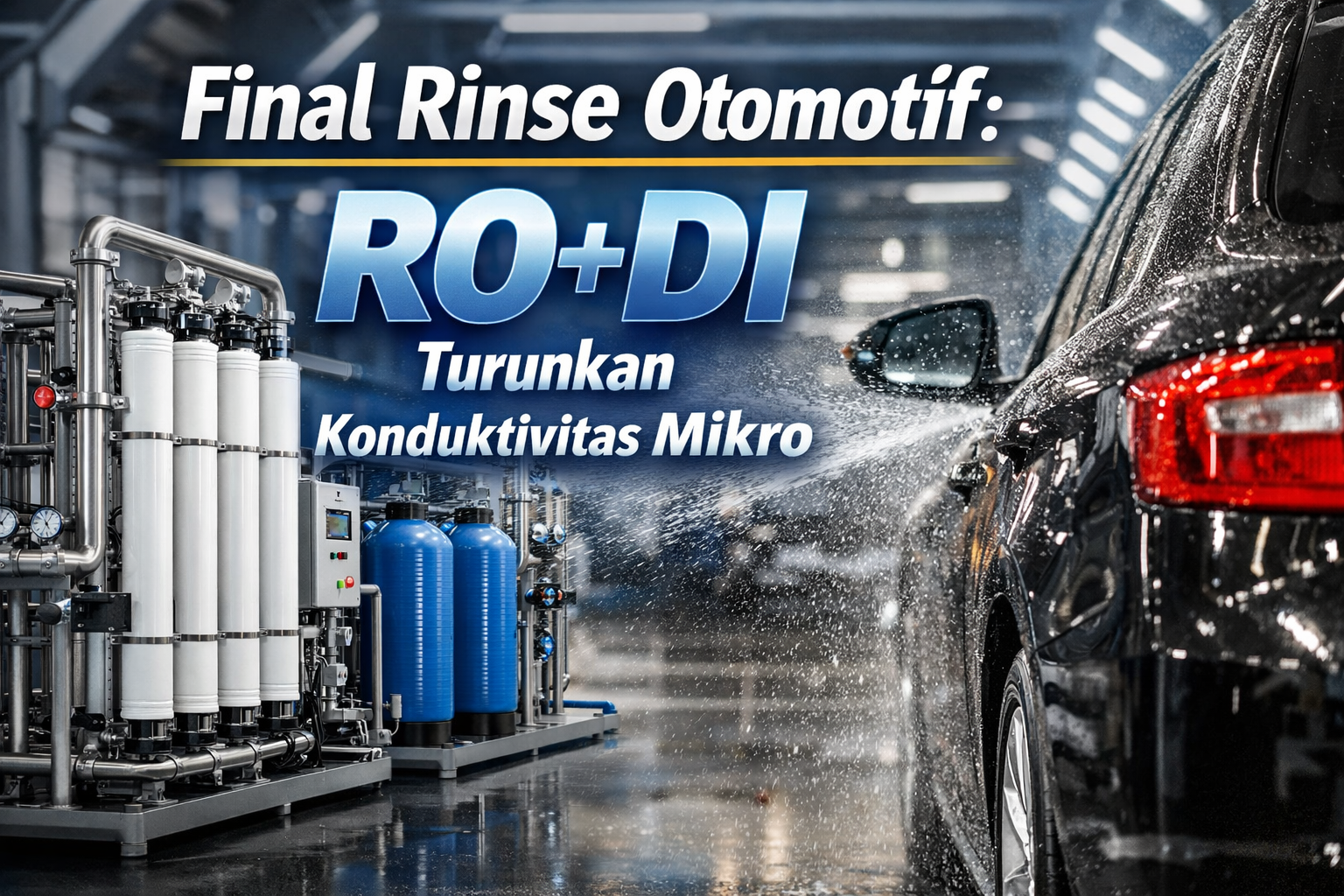
Car‑wash studies frame the contrast: standard wash volumes (~150–350 L/car) leave salt traces, while true “spot‑free” rinsing with RO/DI yields streak‑free finishes (mdpi.com; mdpi.com). On automotive lines, final‑rinse targets sit in the single‑digit μS/cm, with one e‑coating line reporting <5 μS/cm and a wheel‑pretreatment system holding <10 μS/cm (eurowater.com; eurowater.com).
The playbook is blunt: spot‑free automotive rinsing “requires the removal of hardness and sometimes all dissolved ions” (resintech.com). Only RO (≈90–99% salt removal) followed by DI (>99%) consistently gets below 10 μS/cm—often 0.5–5 μS/cm—compared to tap water at 100–1000 μS/cm (eurowater.com; resintech.com).
Staged purification and rinse architecture
A typical design runs raw water → pretreatment → RO → DI → delivery. Pretreatment—sediment capture, softening or antiscalant, and activated carbon—protects the RO membranes before polishing. Plants often add ultrafiltration as RO pretreatment when using variable surface waters.
RO membranes then strip ∼90–98% of dissolved minerals—including calcium, magnesium, chloride, and silica—producing a low‑conductivity permeate (often ~10–30 μS/cm) and a concentrated brine (watertreatmentguide.com). The RO permeate feeds ion‑exchange demineralizers (strong‑acid cation plus strong‑base anion resins) that polish nearly all remaining ions to <5–10 μS/cm, with TDS (total dissolved solids) ≲1–5 mg/L (eurowater.com; eurowater.com). Plants deploy brackish water RO when feed TDS is in the thousands.
Counter‑current rinsing—cascading water from cleaner to dirtier tanks—minimizes makeup demand while keeping RO/DI at the final rinse only. In painting lines and car washes, this “spot‑free” final rinse with demineralized (RO) water is used to achieve a shiny finish without streaks or salt deposits (mdpi.com).
RO rejection and DI polishing mechanics
RO (reverse osmosis) uses thin‑film composite membranes to reject most salts and organics; silica rejection is typically ~90–98% (watertreatmentguide.com). Silica is “one of the most problematic substances” in RO systems because dissolved silicic acid can precipitate at the membrane (almawatech.com). High‑pressure operation (10–20 bar) is common, with permeate flows set to meet rinse demand.
Optimizing RO recovery without scaling is an economic and reliability lever. Plants dose antiscalants—often phosphonate or carboxylate chemistries—upstream, typically with a dedicated dosing pump.
DI (deionized) polishing follows. A strong‑acid cation (H⁺ form) resin followed by a strong‑base anion (OH⁻ form) resin produces very low conductivity, often <1 μS/cm, with anion resin configurations tuned for silica and carbonate removal. Some systems use two‑bed or mixed‑bed units for finer purity; in either case, the equipment sits in the family of demineralizers.
Real‑world automotive flows illustrate the standard: one premium car body‑builder’s e‑coat rinse runs ~4 m³/h of DI water at <5 μS/cm (eurowater.com), while a wheel‑manufacturer reuses 5 m³/h and tops up 1 m³/h to hold <10 μS/cm (eurowater.com).
Instrumentation and water quality control
Quality‑control engineers monitor RO feed, RO permeate, and DI product with inline 4‑electrode conductivity or resistivity meters. In practice, teams aim to keep RO permeate ~0.1–0.3 mS and DI product <0.005 mS (5 μS); any upward trend is a red flag. Flow, differential pressure across RO modules, and pH are logged to catch fouling early.
Conductivity meters require regular calibration, and temperature compensation matters because conductivity shifts with temperature. Many systems hold the DI outlet in a small recirculating loop for continuous measurement; readings above a few μS/cm trigger immediate action.
Lab checks complement instruments. Silica needs special attention because conductivity often misses it until late: ISO‑style targets are <0.05–0.2 mg/L silica, measured by molybdenum‑blue colorimetry or ICP. A field check adds alkali (NaOH) to a DI sample; opalescence above ~10 μg/L flags silica breakthrough. Plants also verify hardness, sodium, and chloride removal via photometric or electrode methods.
Silica spotting and targeted troubleshooting
Pinpoint silicate spots on parts usually trace to silica in rinse water—often from exhausted or fouled anion resin or RO breakthrough. Regenerate or replace the anion bed more frequently, or specify a silica‑removal anion resin (porous styrenic gel) when needed (felitecn.com).
Upstream control matters if RO feed silica exceeds ~20 mg/L; pretreatment via coagulation/precipitation may be required. For polishing, some lines add a mixed‑bed unit to scrub residual anions before final use.
RO membrane fouling and maintenance practices
Falling permeate flow at constant pressure or rising differential pressure points to fouling—hardness scales, silica, iron, biofilms, or organics. Effective pretreatment uses softening or antiscalants and activated carbon to remove chlorine and organics; a dedicated activated carbon filter is common in paint‑line water rooms.
Silica‑specific fouling is mitigated by keeping RO feed at neutral‑to‑slightly‑acidic pH (silica is less soluble at high pH) and by periodic clean‑in‑place (CIP). Many plants run annual or semi‑annual cycles: dilute acid (citric or HCl) to dissolve scales, followed by caustic for organics. For these tasks, maintenance teams stock membrane cleaners suited to the foulant mix.
Antiscalant programs—often part of a wider chemical control plan—reduce cleaning frequency and extend membrane life, supported by membrane antiscalants. Membranes typically run 3–5 years, with flux, rejection, and recovery trends guiding replacements (almawatech.com).
Resin selection, capacity, and regeneration
DI resin issues show up as rising conductivity. When the cation bed (H⁺ form) exhausts, hardness breaks through first; when the anion bed exhausts, CO₃²⁻ or silica breakthrough raises pH and conductivity. Pure DI reads near pH ~7; a drift toward 8–9 often signals anion exhaustion.
Regeneration is offline: backwash spent resin, recharge with acid (cation) and caustic (anion). As a rule‑of‑thumb example, a 500 L resin bed with ~1.7 eq/L capacity removes roughly 8.5 kg CaCO₃ before regeneration. In practice, beds regenerate weekly or monthly depending on load; monitoring regeneration waste toward near‑neutral pH and low conductivity confirms completion.
Standard strong‑acid cation and strong‑base anion resins, including gel‑type styrenics for high exchange capacity, sit at the core of ion‑exchange resin programs. When silica is stubborn, specifying silica‑removal grades is a proven option (felitecn.com).
Pretreatment hardware and filtration choices
Rinse rooms often combine sediment and fine filtration ahead of membranes. Inline fine solids control typically uses a cartridge filter to remove 1–100 μm particles before the RO skids.
Hardness control up front prevents scale formation on both RO and DI beds; many lines install a dedicated softener when antiscalant alone is insufficient. For integrated skids across groundwater and surface sources, vendors offer complete membrane systems spanning RO, nanofiltration (NF), and ultrafiltration (UF).
Quality outcomes and water savings
Beyond defect prevention, rinse‑water loops with RO recycle cut water use. One U.S. assembly paint line using 92 million gallons/year saved about 5.0 million gallons/year by optimizing an RO‑fed phosphate rinse, meeting 25% of its 2030 water‑reduction target in year one and trimming ≈$47,000/yr in disposal costs (en-nz.ecolab.com).
Automakers are moving toward reuse and ZLD (zero liquid discharge) philosophies with RO/DI at the core (aquasgroup.com). Regulators are pushing low effluent TDS as well; in Indonesia, Government Reg. 82/2001 establishes dissolved‑solids limits that drive RO/DI and recycle investment.
Why this level of purity matters
Even a few ppm of Ca/Mg in rinse water dry into white spots. As one plating expert wrote, city‑water rinses with TDS ~1000 μS/cm will “almost always leave your substrate with total dissolved solids” (finishing.com). The RO/DI tandem reduces Ca²⁺, Mg²⁺, Na⁺, Cl⁻, HCO₃⁻, SiO₂ and more to negligible levels, leaving essentially no mineral residue.
The operational recipe is now standardized: pretreatment (sediment/antiscalant), RO, and DI to hit <10 μS/cm (eurowater.com), with continuous monitoring of conductivity, pH, and silica to stay in spec. The result: better finish quality and more sustainable water use—because spotting and chemical hazing only appear when dissolved solids are allowed to dry on surfaces (jenfab.com).