

Industry: Automotive | Process: Industrial_Wastewater_Treatment_(Oily_&_Metals)
Automotive plants generate complex effluent: oil‑water rinses and plating baths carrying metals like nickel (Ni), zinc (Zn) and chromium (Cr), plus phosphates and oils. An Indonesian study cites about 1,500 m³/day average wastewater generation for an automobile plant (researchgate.net). Batch steps, cleaning operations or spills can trigger shock loads — sudden spikes in flow and pollutant concentration — that upset downstream processes (nepis.epa.gov) (environmental-expert.com).
The mitigation playbook starts with an equalization tank (EQ tank), then layers in online sensors and automated chemical control. The aim: dampen hydraulic surges, blend concentrations to predictable levels, and react in real time to changing influent conditions so the plant consistently meets permit limits.
Variable flows and metals in automotive effluent
Automotive effluent is not steady-state; it’s a patchwork of rinse waters and baths that can swing in minutes. The U.S. EPA’s field manual notes that these swings risk operational upsets and stresses the vulnerability during peak events (nepis.epa.gov). Case evidence from e-coat lines similarly warns that combinations of the waste create variability that challenges settling and treatment (environmental-expert.com).
In Indonesia, regulatory pressure is explicit: PermenLH No.5/2014 imposes stringent discharge limits for Ni, Cr, oils and other parameters, and many factories struggle to comply (researchgate.net) (researchgate.net).
Equalization tank: flow and load buffering
An EQ tank is essentially a buffer basin with mixing. Its first job is flow equalization: store during peaks and release slowly to “dampen hydraulic surges” before treatment (nepis.epa.gov). The second is contaminant equalization: continuous mixing blends high- and low-strength streams so “the various wastewater streams are blended and homogenized into a predictable and consistent influent” (environmental-expert.com) and averages out spikes (nepis.epa.gov).
The third task is load control: throttling outlet flow or holding volume when concentrations run high (nepis.epa.gov). In practice, EQ tanks often hold several hours of flow and demand adequate mixing to prevent solids buildup and achieve these benefits (nepis.epa.gov) (nepis.epa.gov). Plants commonly pair EQ tanks with supporting equipment that keeps this hardware reliable and maintainable, such as wastewater ancillaries.
One automotive e‑coat case study reported that an EQ tank turned highly variable rinse waters (with Zn, Ni and P content) into a “consistent influent,” enabling predictable pH adjustment and flocculation (environmental-expert.com).
Online sensors and automated chemical dosing
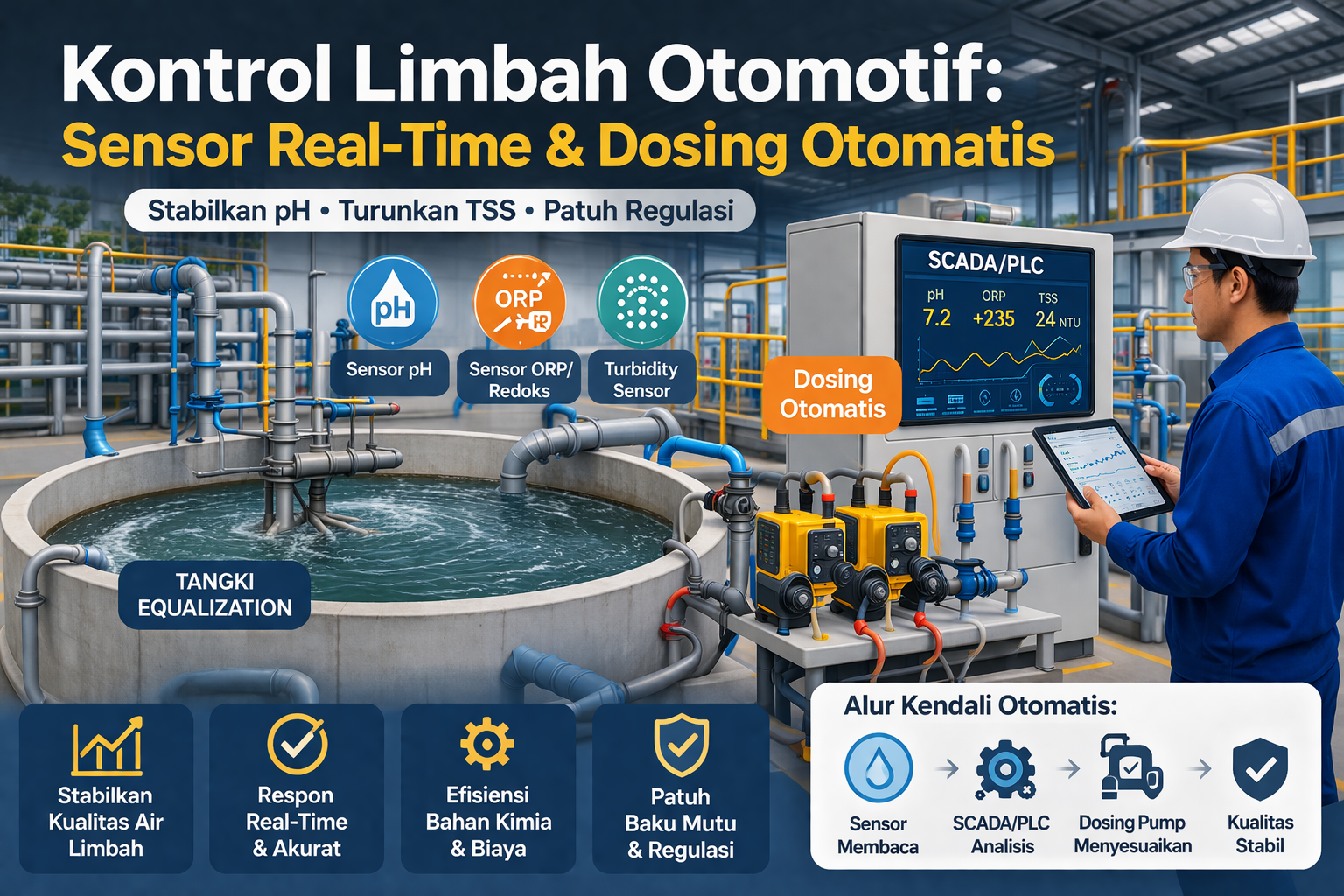
Equalization handles the worst swings; sensors and automation do the rest. Plants deploy real‑time probes for pH (acidity/alkalinity), ORP (oxidation‑reduction potential, a redox indicator) and turbidity (cloudiness from suspended solids). Engineers also use UV‑absorbance or optical oil‑in‑water meters as feedback signals (mdpi.com).
These instruments feed SCADA/PLC systems (Supervisory Control and Data Acquisition/Programmable Logic Controller) that actuate dosing pumps in real time (mdpi.com) (mdpi.com). If a pH drop is detected, the logic adds acid or caustic as needed; if turbidity rises, the system can increase coagulant or flocculant dosing to precipitate metals and particulates. Continuous pH monitoring lets the controller adjust base addition so metal hydroxides such as Ni(OH)₂ and Zn(OH)₂ form near their minimum solubility point (environmental-expert.com).
ORP signals guide oxidative stages: if the probe shows low redox potential (insufficient oxidation), the control system injects more oxidant; if turbidity suddenly spikes, coagulant dosing can be increased or feed flow throttled. Reviews note that combining online sensors with model‑based or AI controllers can automatically adjust chemical dosage, “achieving improved treatment performance with less reagent cost” (mdpi.com). Many plants now run multiplexed sensor networks and PLCs to “collect data and detect issues,” with some fully automating parameter adjustment (mdpi.com).
Measured outcomes and compliance stability
The buffering‑plus‑automation strategy delivers quantifiable gains. In one pilot study on phosphorus removal in China, a dynamic sensor‑driven dosing controller achieved 100% compliance with effluent phosphorus limits and a 67% improvement in effluent stability (mdpi.com). In automotive contexts, consistent pH control and flocculation aided by sensors have similarly supported meeting strict metal limits (environmental-expert.com), which is material in Indonesia under PermenLH No.5/2014 (researchgate.net).
Adoption correlates with improved performance: a 2016 survey found 78.2% of Indonesian industrial firms were in compliance with effluent standards after adopting better treatment and monitoring (researchgate.net). Cost signals move too. Automated dosing avoids overfeeding reagents, cutting consumption; one review notes that roughly 20% of WWTP chemical use is for nutrient removal, so optimizing dosage yields outsized impact (mdpi.com). Equalization also prevents peak events that can trigger treatment upsets, bypasses or fines. Recent reviews converge on the same point: integrating robust sensor feedback and PLC logic significantly improves compliance stability while reducing manual intervention (mdpi.com) (mdpi.com).
Source references
U.S. EPA Field Manual (1984) on metal‑finishing wastewater (nepis.epa.gov) (nepis.epa.gov); ARCOWA/PEMSEA (2018) Indonesian wastewater report (researchgate.net) (researchgate.net); KIA E‑Coat case study (Ecologix, 2008) (environmental-expert.com); Ratnaweera & Fettig (2015) Water (state‑of‑art on online sensing) (mdpi.com); Jin et al. (2025) Separations (AI dosing review) (mdpi.com) (mdpi.com); Yang et al. (2024) Water (real‑time control study) (mdpi.com).