

Industry: Automotive | Process: Industrial_Wastewater_Treatment_(Oily_&_Metals)
Automotive manufacturing effluent is a stubborn mix: oil/grease, organic solvents, and dissolved metals—Ni, Cu, Zn, Cr among them—from machining, plating, painting, and degreasing lines (ACS ES&T Water). Parts‑washing and phosphating are frequent culprits for elevated zinc or copper.
Regulators are taking note. In Indonesia, plating‑galvanizing standards (Permen LH 5/2014) allow only 1.0 mg/L Zn and 0.5 mg/L Cu (plating) (Karbonaktif). In Europe, a 2024 update to the Industrial Emissions Directive expands micropollutant limits (Chemviron). In practice, final effluent goals may demand far lower concentrations—often <0.1 mg/L for metals, and single‑digit mg/L or ppb (parts per billion) for organics.
Conventional physicochemical/biological trains—coagulation, sedimentation, biological oxidation—usually strip 80–95% of BOD (biochemical oxygen demand) and COD (chemical oxygen demand) and most suspended solids. But refractory organics and trace metals persist, which is why plants are adding polishing stages to reliably hit compliance margins.
Granular activated carbon (GAC) polishing
Mechanism and fit: GAC (granular activated carbon) adsorbs dissolved, often non‑biodegradable organics into a vast pore structure, including solvents, phenols, surfactants, TOC (total organic carbon), and residual dissolved oils (Chemviron). Plants typically place carbon contactors after secondary treatment; feed is prefiltered to <10 μm to protect the bed—an application where inline cartridge filters are commonly selected. As a media option, activated carbon beds are the workhorse for this polishing step.
Performance benchmarks: Industry sources call activated carbon “highly effective” against a wide range of organic and hydrocarbon pollutants (Chemviron). Bench and pilot studies consistently show 80–99% cuts in trace organics, often driving effluent TOC/COD into single‑digit mg/L. U.S. EPA literature reports GAC polishing can reduce COD to roughly 5–15 mg/L—dependent on feed quality, carbon dose, and contact time (EPA NEPIS). Meta‑analyses cite empty‑bed contact times (EBCT, the hydraulic residence time in a fresh carbon bed) of 10–20 minutes at 2–5 m/h, with thousands of bed‑volumes (BV) before breakthrough of pharmaceuticals/organics (ResearchGate) (ResearchGate).
Case outcomes and media life: Full‑scale GAC contactors often treat hundreds to thousands of m³/day. One municipal installation achieved >2,000 BV per contactor before reactivation, with low‑organics cases reaching >10,000 BV (ResearchGate). Studies also report 75–85% removal of refractory TOC where GAC is applied (EPA NEPIS). The media is regenerate‑friendly: spent carbon can be thermally reactivated—destroying adsorbed organics—and reused (Chemviron). In comparative terms, GAC typically costs on the order of hundreds of USD per cubic meter; reactivation reclamates ~90% of capacity. GAC beds also provide incidental physical filtration of lingering oil droplets or turbidity.
Metals caveat: While some metal co‑adsorption occurs—and some vendors list arsenic among removables (ResearchGate)—conventional GAC is not relied upon for heavy‑metal polishing. Zinc and copper adsorption by unmodified carbon is weak; GAC is best viewed as the final organic scrubber (Chemviron).
Ion‑exchange (IEX) resins for metals
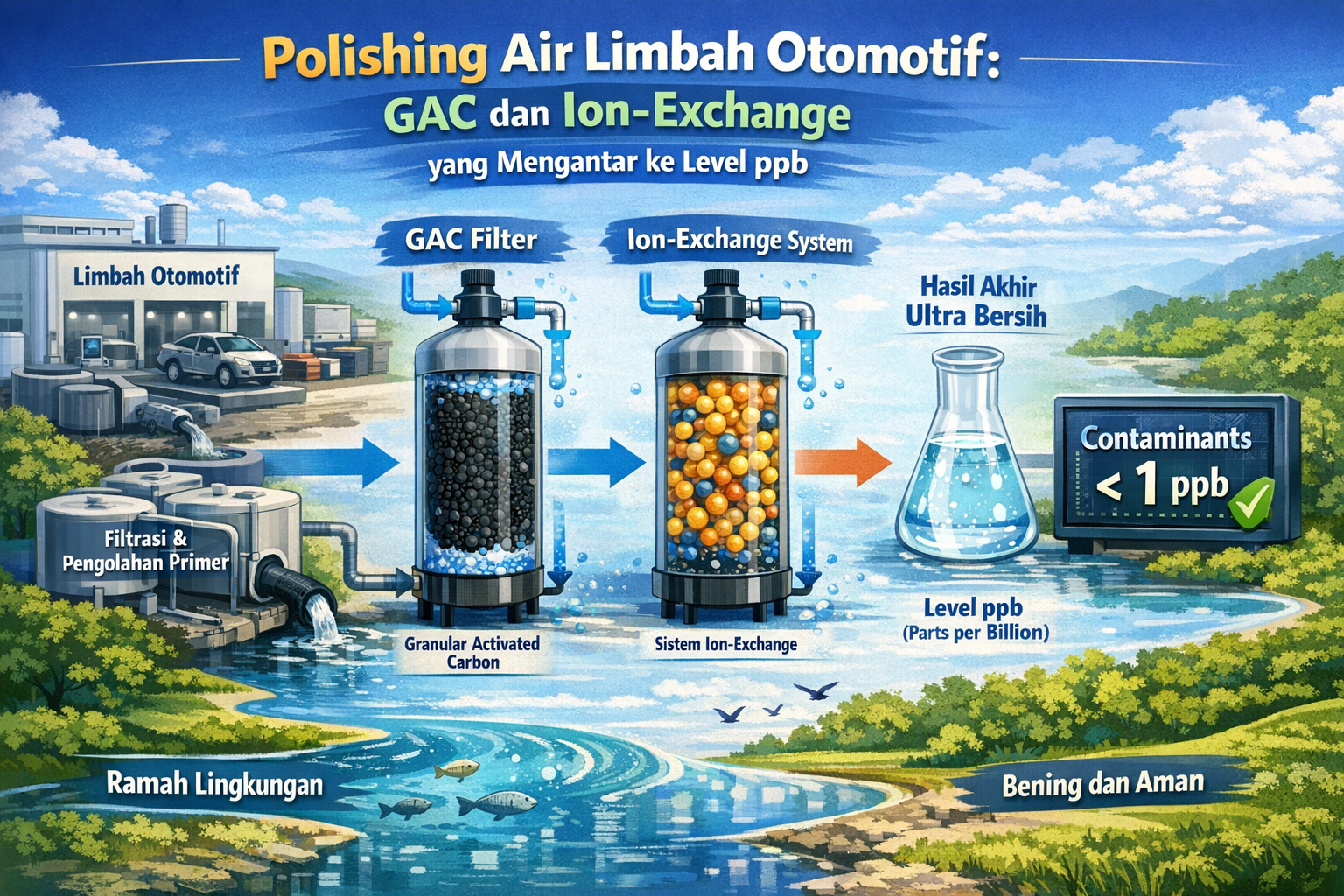
Mechanism and selectivity: Ion‑exchange (IEX) resins are polymer beads that bind ions. Strong‑acid cation or chelating resins—often iminodiacetate or polyacrylic chelating types—show high affinity for Cu²⁺, Zn²⁺, Ni²⁺, Cd²⁺ and more, exchanging these with H⁺ or Na⁺ on the bead. In polishing duty, packed columns of ion‑exchange resins are tailored to target metals that survive upstream treatment.
Capacity and effluent quality: A commercial chelating resin (Puromet MTS9300) is rated at ~50 g Cu per liter of resin (Purolite). In practice, a few cubic meters of resin can capture tens to hundreds of kilograms of metal before exhaustion, delivering extremely low effluent concentrations. In an automotive case study, adding an ion‑exchange polishing unit—fine prefiltration plus two 30 ft³ chelating vessels—drove zinc below 1 ppb (<0.001 mg/L) (Xylem). Service‑based systems (e.g., Xylem’s WWIX) routinely achieve sub‑μg/L metal levels (Xylem).
Operating envelope and regeneration: Typical polishing trains use 5–10 μm prefilters ahead of the resin—another role for cartridge filters—and operate at modest flows, about 25–75 gpm per 30 ft³ unit (Xylem). A single cycle can run for weeks to months depending on load. Regeneration (typically acid‑strip) recovers the captured metals and restores the resin; many service contracts handle off‑site regeneration to minimize on‑site residuals (Xylem).
Triggers for final polishing
- Tight limits or violations: If measured effluent values approach a large fraction of legal limits, polishing is prudent. Example: a plating line discharging Zn near 1.0 mg/L (the Indonesian limit) faces a permit tightened to 0.5 mg/L—conditions that favor an IEX step (Karbonaktif). For organics, if residual COD/TOC remains above ~10–20 mg/L, adding GAC provides margin. As a rule of thumb, add polishing whenever a critical parameter exceeds ~50–70% of its limit.
- Emerging contaminants or future rules: Anticipated standards for trace organics/metals (e.g., micropollutants) argue for preemptive GAC or IEX. The EU’s upcoming requirements are one signal (Chemviron), as is Indonesia’s tighter enforcement and prospects of Zero‑Liquid‑Discharge mandates.
- Process changes or higher loads: New metal‑finishing or coating lines can overwhelm legacy plants. Water reuse/ZLD schemes typically need advanced polishing to reach very low residuals. In one Indian automotive ZLD project, extensive polishing (UF/RO + IonExchange) was required to reclaim ~80% of wastewater (Ion Exchange Global) (Ion Exchange Global), saving ~2,900 m³/day of fresh water—but only after membranes plus resin met reuse criteria.
- Reliability and safety margin: Polishing adds resilience to shock loads from storms or batch spikes. Many plants oversize final adsorbers to ensure uninterrupted compliance. The business risk from a single exceedance (fines, possible production impacts) supports a polishing column.
Integration and sizing guidance
Retrofits typically place polishing last—downstream of the clarifier/floatation and any membrane stages. For gravity separation duty in brownfield plants, a clarifier commonly precedes polishing. Where membranes are in play, pretreatment can include ultrafiltration ahead of RO; in polishing for reuse, RO trains such as brackish‑water RO often sit upstream of media beds.
Sizing is based on peak effluent flow and expected contaminant load. Bench tests are essential: adsorption isotherms for GAC, and small‑scale column tests for IEX, to predict media life and confirm attainability of targets (SUEZ Water Handbook) (Purolite). Economically, GAC systems carry moderate capex (carbon vessels) and ongoing replacement/reactivation costs; IEX service units are often OPEX‑based. Cost–benefit analyses should weigh these against avoided non‑compliance penalties and water reuse gains.
Bottom line
GAC columns are a proven remedy for polishing residual organics and trace COD (Chemviron) (ResearchGate). Dedicated ion‑exchange—often with chelating resins—scrubs zinc, copper, and other metals to sub‑ppm and even ppb levels (Xylem) (Purolite). Facilities add these stages when residual contaminants persist or regulatory margins vanish—say, when effluent Zn/Cu hovers near notice limits or permits tighten. Data‑driven evaluation (bench tests and monitoring) is essential, but results show well‑designed GAC/IEX polishing routinely drives organics to low mg/L and metals to ppb, meeting the toughest discharge criteria (Xylem) (Chemviron).
Sources: Indonesian environmental standards (Karbonaktif); global GAC reviews and case studies (Chemviron) (ResearchGate) (EPA NEPIS); ion‑exchange performance and capacity (Purolite) (Xylem); automotive wastewater composition (ACS ES&T Water).