

Industry: Aquaculture | Process: Solid_Waste_Removal_&_Sludge_Treatment
Intensive recirculating aquaculture systems (RAS) slash freshwater demand by 90–99% compared to traditional farms (www.sciencedirect.com). By 2020, global aquaculture output reached ~122.6 Mt — about 60% higher than in the 1990s (www.sciencedirect.com) — making efficient waste treatment critical. The catch: RAS concentrates wastes, with “reject” water from sludge dewatering carrying dissolved nitrogen (N) and phosphorus (P) at levels that can stress fish or trigger eutrophication (www.sciencedirect.com).
Biology explains the split. Fish excrete ~85–90% of nitrogen as dissolved ammonia via the gills, while phosphorus is mostly bound in feces (learn.farmhub.ag). Mechanical solids removal captures most P, but leaves the side stream — sludge dewatering reject — high in soluble nitrogen, mainly as nitrate (learn.farmhub.ag) (www.sciencedirect.com). Upstream, plants often rely on primary equipment to intercept solids before dewatering; compact screens and separators in waste‑water physical separation trains are standard.
How high can that reject go? Municipal sludge digester reject water has been reported at ~1718 mg/L NH4‑N and 122 mg/L PO4‑P (COD 2240 mg/L), a useful proxy for the extreme nutrient loads possible (www.mdpi.com). Even if aquaculture side streams are lower, they often carry tens to hundreds of mg/L N and residual P. RAS designs typically limit tank nitrate to <100 mg/L NO3‑N to avoid fish stress (link.springer.com), so side‑stream removal is essential before water is recycled or discharged.
Compact biological biofilm treatment (MBBR)
Moving‑bed biofilm reactors (MBBR) grow nitrifying bacteria on plastic carriers to convert ammonia (NH4⁺) to nitrite (NO2⁻) and nitrate (NO3⁻); an anoxic or anammox stage can complete nitrogen removal (denitrification converts NO3⁻ to N2 gas; anammox removes N without added organics) (learn.farmhub.ag) (iwaponline.com). A full‑scale two‑stage system treating real reject achieved ≈3.9 kg N/m³·day with >87% efficiency, or ~0.16 kg N per m³ per hour (iwaponline.com). Even at 35 g/L NaCl, specialized carriers maintained ~92% ammonia conversion (www.researchgate.net).
By contrast, low‑tech woodchip denitrification hits only ~15 g N/m³·day (0.015 kg/m³·day) (link.springer.com), underscoring MBBR’s density advantage. In practice, engineers assume 1–4 kg N/m³·day nitrification capacity, with aeration (≥6 mg/L dissolved oxygen, DO) and biofilm carriers (e.g., Kaldnes media) required (www.sciencedirect.com) (iwaponline.com). In short, MBBR offers compact, high‑rate N removal with small sludge yield, but it does need energy for aeration and tight DO/pH control (www.sciencedirect.com) (iwaponline.com). Where compact, packaged systems are preferred, plants often specify moving‑bed bioreactors to fit tight footprints.
Chemical precipitation and phosphorus recovery
Metal salts (ferric chloride, aluminum sulfate) or magnesium dosing for struvite precipitation (MgNH4PO4) strip dissolved P to solids with >90% removal. In tests on synthetic aquaculture effluent, electrocoagulation achieved 100% total P removal but only ~30% ammonia‑N reduction (www.scielo.br). Conventional dosing at roughly “2–4 mg Fe per mg P” reaches up to ~95% PO4‑P removal and can leave <1 mg/L residual P. Struvite typically needs pH≈9.5 with Mg:P≈1:1 and co‑precipitates some NH4‑N (>90% phosphate captured under optimal conditions) (environmentalevidencejournal.biomedcentral.com). Plants generally source these as part of a coagulant program.
The trade‑offs are familiar: compact footprint and near‑complete P removal versus sludge production and reagent costs. Chemical precipitation “is often used because of its economic benefits, but it produces a large amount of sludge,” which then needs dewatering and disposal (and can bind residual coagulant) (techxplore.com).
Hybrid treatment for low‑nutrient effluent
A combined train is often optimal: nitrify/denitrify biologically, then polish phosphorus chemically, or front‑load chemical P removal to protect the biology from toxic spikes. MBBR alone does little for P (EBPR needs alternating anaerobic conditions and is rarely used in small RAS), and chemical precipitation leaves nitrate. The engineering takeaway: match MBBR for N with precipitation for P to achieve low nutrient effluent (learn.farmhub.ag) (iwaponline.com).
Loads, sizing, and oxygen demand
Loads swing with operations. A farm discharging 1000 L/h overflow might see sludge belt wash/press reject at 30–100 L/h (5–10% of flow) with, for instance, 100 mg/L NH4‑N and 5 mg/L PO4‑P — that’s 0.1–0.2 kg N/day and 0.005–0.015 kg P/day. Design for pulses: 50 L/h at 200 mg/L N equals 10 g/h or 240 g N/day. At 3 kg N/m³·day, required MBBR volume is ≈0.08 m³ (80 L); at 1 kg N/m³·day, ≅0.24 m³.
MBBR sizing example: with C(NH4)in=100 mg/L and Q=50 L/h, the load is 5 g N/h (120 g/day). At 2 kg/m³·day, V=(120 g/day)/(2000 g/m³·day)=0.06 m³ (60 L). Many designs include a safety margin — e.g., 100–200 L — for downtime. Operate at DO ≥4–6 mg/L (the review also cites ≥6 mg/L), with aeration typically ~1–2 kg O₂ per m³·day. Use 4.57 g O₂ per g NH4‑N oxidized to size blowers, often with 10–20% excess O₂ capacity.
Denitrification options and carbon supply
If nitrate must be reduced for discharge, denitrification requires ~2.9 g COD per g NO3‑N removed (using methanol or acetate). For 10 g NO3‑N/day, that’s ~29 g COD/day (~100 mL methanol). A 125 L birch‑wood woodchip reactor (1.7 d HRT) reached 96–99% NO3 removal at 1.5–2.0 g/day (link.springer.com). By comparison, a small mixed‑liquor denitrification reactor might handle 5–10 g N/m³·day; removing 10 g N/day would need roughly 1–2 m³ (if external carbon is available). Note: denitrification via external carbon — e.g., methanol — generates N₂ gas, whereas anammox can remove N without added organics.
Chemical dosing and clarification design
Sizing phosphorus removal follows the load. To remove 100% of 5 mg/L P at 50 L/h (3 g/day), dose roughly 2–3 mg Fe per mg P, or ~6–15 ppm FeCl₃ overall. Example: 3 g P × 2 mg Fe/mg P = 6 g Fe (≈15 mg Fe/L in a 400 L reagent feed). Provide 3–5 minutes of rapid mixing, then settle in a clarifier with ~30–60 minutes hydraulic retention time. Treated water (low P, high N) moves on; settled sludge (iron phosphate or struvite) is pumped to dewatering/disposal. Plants commonly integrate a clarifier sized to the side‑stream flow.
Struvite precipitation adds Mg (e.g., MgCl₂) and raises pH to ~9–9.5 (NaOH), capturing both P and ~50% of NH4 as MgNH4PO4 crystals; control is slower and more complex but yields a useful fertilizer solid (environmentalevidencejournal.biomedcentral.com).
Side‑stream integration into facility design
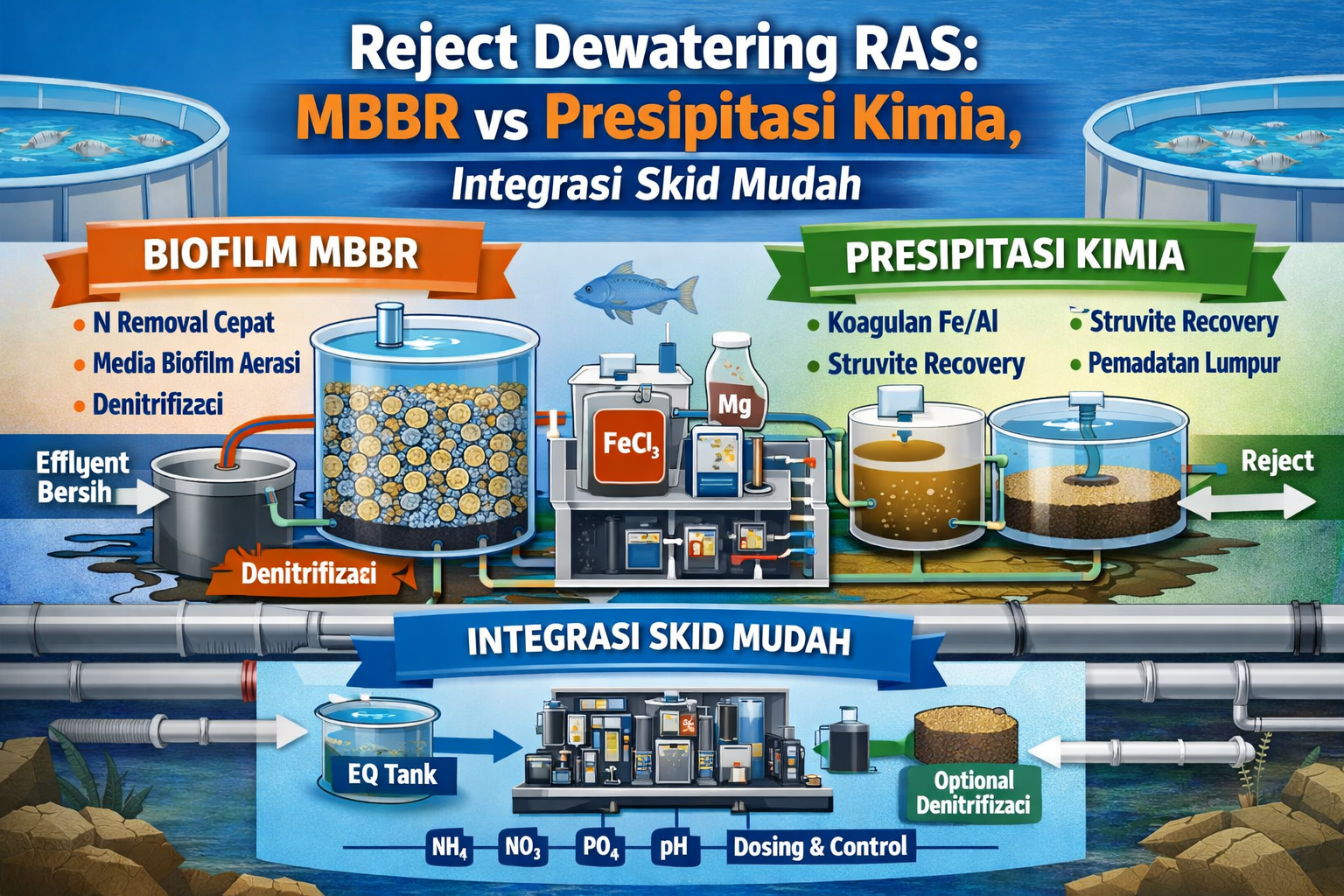
Flow routing typically directs sludge‑dewatering filtrate to an equalization (EQ) tank to smooth intermittent press/centrifuge pulses; sizing commonly covers at least one dewatering cycle volume. Many RAS facilities use a 500–1000 L EQ with mixing to prevent short‑circuiting. Dosing and pH control are handled with metered chemical feeds and in‑line pH monitoring; Fe/Al salts can depress pH (alkali may be needed), while struvite requires pH ↑9. Measuring influent PO4 allows dose‑modulation (e.g., 2–3 mg Fe per mg P). These steps are often automated through a dosing pump and PLC logic.
After chemical reaction, the side stream enters a settling unit; sludge blankets are withdrawn routinely and clarified water proceeds. The biological stage then manages nitrogen. An aerated moving‑bed bioreactor is filled 40–60% with carriers to house nitrifiers (Nitrosomonas/Nitrospira), and is operated at DO ~5–6 mg/L. For example, removing 100 g N/day at 2 kg/m³·day needs ~0.05 m³ reactor volume. Air systems are sized to supply ~4.6 g O₂ per g NH4‑N plus a 10–20% margin.
Where discharge standards demand nitrate reduction, designs add an anoxic denitrification tank (external carbon feed) or a fixed‑bed reactor such as woodchips. Volumes of ~0.5–1.0 m³ are typical to remove ~100 g NO3‑N/day at moderate rates, with gas venting for N₂. These steps are often bundled under a nutrient removal package. Instrumentation closes the loop: flow, pH, DO, and nutrient (NH4‑N, NO3‑N, PO4‑P) sensors trigger control of chemicals and aeration, with alarms for high nutrients or low DO. Layouts often place units next to sludge dewatering, provide a bypass for maintenance, and allow easy sludge access. The MBBR outlet can return to the RAS sump (improving internal water quality) or go to final discharge.
Targets, outcomes, and monitoring
Proposed standards for shrimp farm effluent suggest total nitrogen (TN) <10–20 mg/L and total phosphorus (TP) <1–5 mg/L (www.globalseafood.org) (www.globalseafood.org). Inside RAS, nitrate can often remain at ~50–100 mg/L, but environmental discharge typically demands ≤5–10 mg/L N and <1 mg/L P. Accordingly, side‑stream treatment should remove ~80–90% of both N and P. In practice, a well‑sized MBBR plus optional denitrification has removed >90% of NH4/N (off‑line), and a coagulant clarifier has removed >90% of P. One pilot reported >96% NO3‑N removal using woodchip+sand (link.springer.com), while MBBR systems have achieved ~87% TN removal (iwaponline.com). Phosphate can be driven to <1 mg/L. Facilities verify compliance via inline tanks (NH4, NO3, PO4 sensors or labs).
Bottom line for engineers
Side‑stream reject from aquaculture sludge dewatering is a small flow with a big nutrient punch. Designing around measured loads, MBBR (with anoxic/anammox as required) removes dissolved N at g–kg N/m³·day rates (iwaponline.com), while chemical precipitation (Fe/Al dosing or struvite) strips P to near zero (www.scielo.br) (techxplore.com). With equalization to buffer pulses, dosing and pH control, mixing/clarification, and compact biofilm reactors, plants can recycle virtually all water and meet reuse or discharge targets.