
Microscreen drums, gravity settlers, and inclined belt filters dominate solids removal in fish farms. Side-by-side results show how they stack up on capture by particle size, washwater use, and operating cost—and how to pick for RAS versus flow‑through.
In recirculating aquaculture systems (RAS), solids control sets the tone for water quality, energy draw, and sludge handling. The workhorse is the microscreen drum filter with 30–100 µm openings; gravity‑based radial‑flow settlers are nearly water‑free to operate; and inclined belt filters, typically paired with coagulant/flocculant chemistry, can push total suspended solids (TSS) removal toward complete. Peer‑reviewed trials detail the trade‑offs—and a pragmatic selection guide emerges for small, medium, and very large systems.
Microscreen drum filters (30–100 µm)
Drum (microscreen) filters are rotating cylinders wrapped in fine cloth (typically 30–100 µm openings) with automated spray nozzles for self‑cleaning. Under normal loading they remove on the order of 70–80% of TSS; Johnson & Chen (2006) estimated ~72% TSS removal for a microscreen (60–90 µm) (source). In practical trials a drum filter alone captured ~40–45% of the daily solids mass in a trout RAS (source).
Capture efficiency by particle size is high: drums trap most solids larger than the mesh size. In one comparison, microscreens (“propeller‑wash bead filters”) removed >85% of particles >55 µm (>85% >50–60 µm were retained) (source). Removal falls for finer silt (<20 µm) unless filters are used in series or with flocculation. Note this is typically slightly lower than a comparably‑loaded clarifier, but drums remove much smaller particles.
Backwash water use is moderate. Drum filters continuously spray jets over the screen, typically requiring only ~1–3% of total flow for cleaning, with jets firing briefly when the screen contacts a backwash arm; vendors generally specify only a few percent of system flow, and modern drums are designed for low water use. No continuous bulk flush is needed (unlike a cartridge filter).
Operational costs are moderate. A drum filter (few‑meter diameter) can run a small farm (10–50 m³/h) and costs on the order of several thousand dollars (increasing with size). Energy use is modest—a small pump plus motorized drum drive and nozzle supply. Maintenance is limited to checking sprays/nozzles and periodic cloth replacement; no chemicals are used; filter cloth life is typically months of operation. Drums are automated and low‑maintenance, making them cost‑effective for RAS.
Use cases: drum filters excel when very fine bio‑solids must be removed (e.g., larval or juvenile culture) and are widely used in RAS worldwide (source). In one Danish model trout farm, a single 40–60 µm drum reduced TSS by ~72% (source). Optional coarser mesh can spare small fry but then removal drops.
Radial‑flow settlers (gravity clarifiers)
Radial‑flow settlers are circular clarifiers with quiescent gravity settling. Water is fed tangentially into a large cylinder (often with a conical hopper bottom); solids settle and are periodically flushed. These devices remove mainly large, settleable solids, are passive (no media), and require virtually no continuous backwash.
Capture efficiency is moderate‑to‑high for coarse solids. In Johnson & Chen (2006), a prototype radial clarifier gave 82% mean TSS removal, capturing large flocs (influent mean particle diameter ~340 µm dropping to ~176 µm in the effluent) (source). Davidson & Summerfelt (2005) found a radial settler removed ~77.9% TSS (±1.6%) in a 150 m³ RAS test (source), while a swirl concentrator only removed ~37% under the same conditions (same source). In other words, radial clarifiers halve the volume of particulate matter by settling the coarsest fraction (source). They do not capture very fine (<20–30 µm) solids effectively; most very small particles stay in suspension.
Backwash water use is negligible. Solids accumulate at the hopper bottom and are removed periodically (e.g., by siphon or pump). Once optimized, only a “minimal volume of water” is needed to flush settled solids; an initial sludge purge used ~70 L, and subsequent flushes ~15 L each (over a >0.3 m³/min flow) (source).
Operational costs are low. Capital cost per unit volume is modest (essentially a concrete/fiberglass settling tank and piping). There are no moving parts or pumps (beyond possibly a low‑speed sludge pump). Energy use and maintenance are minimal. However, settlers are space‑intensive—several square meters per m³/h of flow—which can raise site cost; very large flows need multiple settlers or a very large tank. For procurement, many operators deploy a clarifier for this duty.
Johnson & Chen concluded that radial clarifiers are a “water‑efficient, low cost alternative solids collection device” in RAS (source). Settling basins in flow‑through hatcheries or raceways act on the same principle.
Inclined belt filters with flocculation
Inclined belt filters (e.g., ISIS/Hydrotech belt filter systems) use a slowly moving perforated belt with vacuum under it and spray wash bars. They were pioneered for thickening microscreen backwash/sludge but can be used on raw effluent with flocculation. In aquaculture they usually follow a flocculation tank: coagulant (alum or polymer) is added, solids flocculate, then the mixture flows over the filter belt; chemical aids are standard for high removal of fine particles. Coagulant and flocculant supply can be managed with standard consumables such as coagulants and flocculants.
Capture efficiency is very high with flocculation. Dosing 15 mg/L cationic polymer before the belt filter achieved 96% overall TSS removal (effluent <30 mg/L) (source). Adding alum plus polymer gave up to ~99% removal (source). Even without fine mesh cloth, the flocculated slurry is almost entirely trapped as filter cake; the resulting sludge may be dewatered to ~10–15% solids dry matter (source). Without flocculation, belt efficiency drops sharply on fine solids, especially for particles <50 µm.
Backwash water use is low‑to‑moderate. Cleaning relies on vacuum dewatering, mechanical scrapers, and intermittent spray bars; continuous vacuum means water largely drains out rather than needing rinsing. Only short bursts of rinse water are typically used to unclog the belt at the discharge end. No published “percent flow” is given, but conceptually belt filters tend to use only a small rinse flow (often <1% of feed flow) because mechanical scraping and vacuum handle most solids. In practice, usage is comparable to or slightly higher than a drum filter. By contrast to a radial settler’s “minimal” flush (source), a belt filter does require built‑in cleaning sprays—but these are intermittent.
Operational costs are high. Belt systems are complex machines with a long filter cloth, vacuum pumps, and a conveyor drive. They also require significant chemical dosages (coagulants are applied at grams per cubic meter); Ebeling used tens of mg/L of polymer (and alum) (source) (source). Energy use is higher than for a drum (the vacuum blower runs continuously), and capital cost is higher than a simple drum or clarifier. On the other hand, belts deliver very thick sludge (10–15% solids), which can cut hauling costs. In short: expensive but very effective.
Performance comparison: size, water, cost
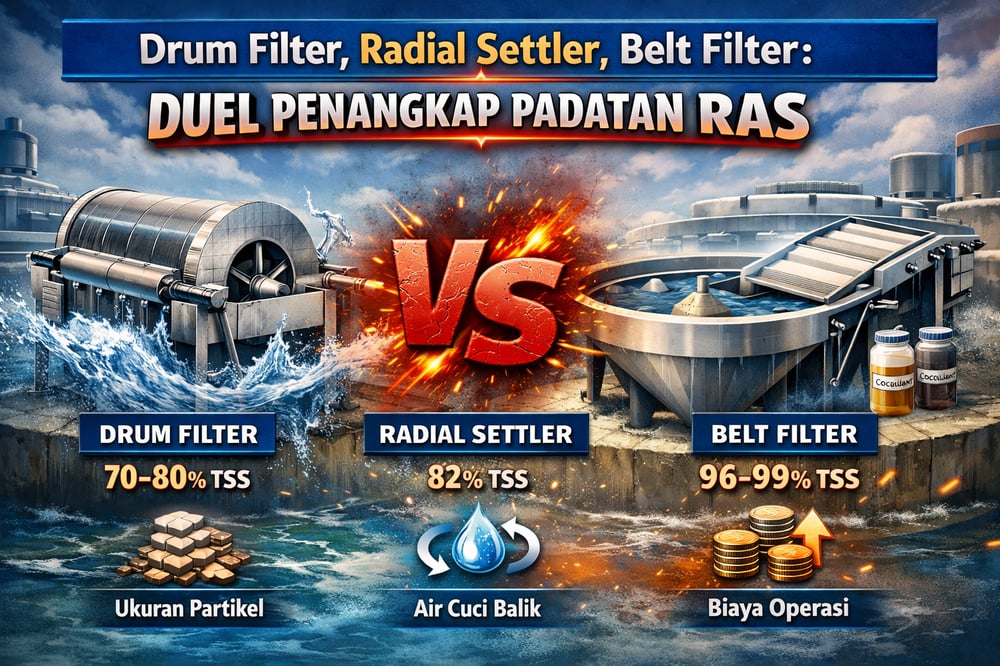
Solids capture by size: radial settlers excel on very coarse solids (hundreds of µm). Johnson & Chen found the clarifier roughly halved the typical floc size (340→176 µm) and removed 82% TSS (source). Drum filters capture a mix; for example, a microscreen caught ~85% of particles >55 µm and generally removed ~72% of TSS (source) (source). Belt filters (with floc) can capture essentially all particle sizes—achieving ~96–99% TSS removal (source) (source), including very fine (<20 µm) ones when coagulants are used. In other words, drum < radial < belt in nominal percentage (without coagulants, drum ≈ radial < belt; with coagulants, belt ≫ drum).
Water consumption: radial settlers use virtually no washwater (flush volumes ≪1% of flow) (source). Drum filters typically use only a few percent of system flow for periodic backflush sprays. Belt filters also use only light spray (plus vacuum)—often comparable to or slightly higher than drum usage. In practice, the only filter needing significant wash water is a media or cartridge filter, which is not considered here.
Operational costs: radial settlers are cheapest to run (almost no energy or chemistry), drums are moderate, and belts are costliest. Drums have built‑in automation (a pump and <1 kW motor) but no chemistry; belt filters have multi‑kW vacuum and hydraulic systems plus coagulant usage. All systems require routine maintenance (spray nozzles on drums and belts, sludge removal on clarifiers).
Selection by system type and size
Recirculating Aquaculture Systems (RAS): the standard approach is a fine microscreen (drum or disc) as the first treatment. For a small RAS (tens of m³/h), a single drum filter (mesh ~30–60 µm) usually suffices to remove ~70–80% of TSS (source), with high ease‑of‑use and a small footprint. Larger RAS (hundreds of m³/h) often use multiple drums or vertical‑disc filters in parallel. When extremely high solids or regulatory discharge limits exist, a radial settler may be added ahead of the drum to catch coarse settleables (e.g., drum + clarifier can achieve ~88% removal, source). A belt filter is seldom used as primary in RAS unless very fine polishing is needed; it is sometimes added to thicken/press the waste stream (e.g., drum backwash) for easier disposal. In practice: <50 m³/h—one drum filter; 50–500 m³/h—multiple drums (30–100 µm) ± a final disinfection; >500 m³/h—drums plus a radial clarifier to stage solids removal, and/or a polishing belt if TPSS targets are very low.
Flow‑through (pond and raceway systems): if solids removal is imposed, clarifiers are typical. A radial settler (or a rectangular settling basin) is cost‑effective: it can capture ~80% of settleable waste (source) at almost zero energy cost. Drum filters are generally not used on open systems (unless the water is being reclaimed into an RAS). If very high fine‑particle removal is required (e.g., for discharge to a sensitive water), a belt filter (with flocculant) could be employed, but this is rare due to cost. In summary: small flow‑through (<10–20 t/hour): often gravity draining to earthen baffled ponds (no filter needed); medium (>20–100 t/h): a radial/lamella clarifier is recommended; large biomass farms with limited outflow: clarifier + disinfection or microscreen can be used. Belt filters are usually only used if a farm wants to recover and compact pond sludge (coagulant dosing plus inclined belt to minimize sludge volume).
System size considerations: for small farms, simplicity and low cost dominate—a single drum filter (for RAS) or nothing (for extensive flow‑through) is common. Medium farms may justify a clarifier (to avoid saturating a single drum) or multiple drums. Very large farms require staged systems: e.g., a large circular clarifier followed by multipump drum filters. The economies of scale reward passive settlers and automated drums; belt systems are justified only by very stringent discharge rules or if sludge disposal costs are extreme.
Overall patterns
Overall, RAS managers choose fine microscreens (drums/discs) for low RGB and high removal efficiency (source) (source), accepting the small backwash flow. Flow‑through systems tend to rely on simple settling (radial clarifiers) for coarse solids, since water can be exchanged freely. Belt filters (with flocculants) are reserved for high‑end polishing or sludge‑thickening due to their high cost and chemical needs.
Sources
Peer‑reviewed engineering trials and reviews were used. Johnson & Chen (2006) report ~82% TSS removal in a radial clarifier (source); Davidson & Summerfelt (2005) similarly found ~78% for a radial settler (source). Drum filters gave ~72% (modeled) removal (source) and accounted for ~40–45% of total solids capture in a RAS study (source). Ebeling (2006) shows inclined belt filters with coagulant achieve ~96–99% TSS removal (source) (source) and concentrate solids to ~12–13% dry matter (source). Radial clarifiers “require only a minimal volume” of flushing water (source). These data guide system selection for Indonesian or international aquaculture operations.
References
Johnson & Chen 2006 (source) (source); Davidson & Summerfelt 2005 (source) (source); Ebeling 2006 (source) (source).
