

Industry: Aquaculture | Process: Grow
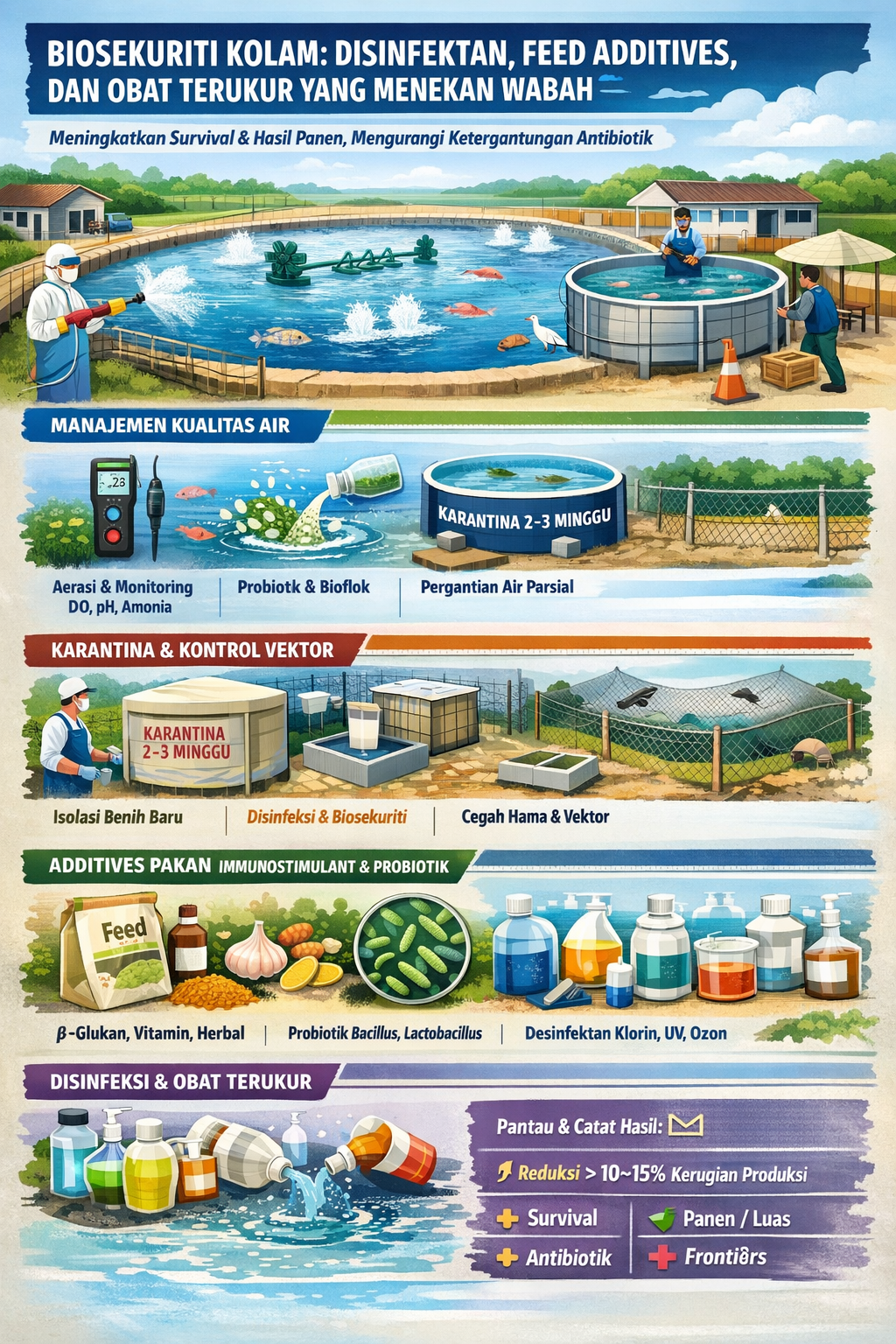
Ask operators who’ve cracked disease control in ponds, and the pattern is consistent: tighter biosecurity, higher harvests. In Indonesia, farm biosecurity correlates positively with harvest per area and harvest size (Frontiers).
Global stakes are high. Disease losses often run 10–15% of output (Frontiers; PMC), and aquaculture antibiotic consumption has climbed to about 10,300 tons in 2017, with Asia — China at ~58% — dominating use (PMC).
This guide distills an evidence-based plan for ponds: water quality management, quarantine, access control, feed immunostimulants/probiotics, water disinfectants, and approved therapeutics — all under responsible use and record-keeping, with source links embedded throughout.
Core water quality and microbiome management
Maintain dissolved oxygen (DO) above 5–6 mg/L (milligrams per liter) and monitor pH, ammonia, and nitrite routinely; stress from low O₂ or ammonia predisposes fish to infection. Good water chemistry and feeding practices “will go far toward preventing disease” (Seafood Education Academy).
Stabilize the pond microbiome with probiotics/bioremediators — for example, Bacillus and Nitrospira in biofloc or bioaugment products — to degrade sludge and improve water chemistry; dietary probiotics can also improve fish disease resistance, growth, and water quality (PMC). Regular partial water exchange and bottom drying (fallowing) between crops can “minimize the potential impact” of pathogens on production (Frontiers). In practice, farms with strict water/O₂ management and balanced feeds see significantly fewer outbreaks.
Quarantine and cohort management
Isolate incoming fry or fingerlings for 2–3 weeks in a separate system with its own water supply. Stock all-in/all-out from a single source, acclimate, observe, and sample/test for key pathogens before transfer to main ponds; quarantine “isolate[d], acclimated, observed, and…treated for specific diseases” prior to release (Seafood Education Academy). Dispose of quarantine effluent safely; dechlorinate where needed using a dechlorination agent (ppm means parts per million) to protect downstream life (dechlorination agent).
Access control and vector exclusion
Fence ponds, restrict visitors, and block wildlife, pets, and vermin. A survey of Indonesian shrimp farms found 73.3% used physical barriers (fences, nets, screens) or treated water to exclude wild crabs and fish from grow‑out ponds (Frontiers)). Likewise, install netting or scare-lines to deter birds and exclude cats/dogs — 52–61% of Indonesian farms did so (Frontiers)). At inlets, robust intake screens help keep out feral fish and debris (manual screens).
Provide disinfectant footbaths at entrances (chlorinated or iodine solution), require farm‑dedicated boots/clothing, and never borrow nets or gear. If vehicles or equipment move between sites, disinfect them on arrival (e.g., spray with ≥1% bleach or quaternary ammonium solution); one survey noted only 13% of farms disinfected vehicles — a risky gap (Frontiers)). Sanitize pumping equipment and aerators between ponds. In short, “fences, netting, and vehicle/foot dips” materially lower pathogen transfer.
Feed immunostimulants and probiotics
Immunostimulant supplements — β‑glucans, chitosan, vitamins (C, E), nucleotides, and plant extracts like garlic, turmeric, or aloe — prime innate defenses and improve mucus/antibody responses. In challenge trials, tilapia fed a novel immunostimulant at 12 g/kg logged 100% survival against Aeromonas, versus ~91.7% in controls (FeedNavigator), and immunostimulant-fed fish often show higher leukocyte counts, lysozyme activity, and disease resistance (FeedNavigator; Seafood Education Academy). Market adoption is strong: the Asia‑Pacific feed probiotics/immunostimulant segment is ≈US$1.03 billion in 2025, forecast to $1.33 billion by 2030 (Mordor Intelligence).
Probiotics (e.g., Bacillus, Lactobacillus, Enterococcus) applied via feed or water outcompete pathogens, enhance gut barrier function, and produce antibacterial compounds; many studies report improved growth and survival, with pond water quality benefits as probiotics convert ammonia and nitrite (PMC). Prebiotics and synbiotics (pre+probiotic) can amplify effects. Note: choose proven strains/formulations and rotate if resistance to one strain seems to develop.
Pond and equipment disinfection
Between cycles, drain and dry the pond for at least a few days; remove sludge and drain bottom ditches. Apply a disinfectant or lime to the pond floor and equipment; calcium hypochlorite solution at ~1,000–1,600 ppm can be sprayed on the floor and gear, left for several hours, then flushed out (StudyLib). For nets and tanks, scrub off organic matter first, then apply strong disinfectants (e.g., peracetic acid or Virkon) for 15–30 minutes before rinsing (Fish Health Ireland).
In recirculating systems, UV or ozone treatment of water is used; UV reactors avoid chemical residues and fit low-volume flows (UV systems). For hatchery or broodstock water, iodine-based iodophors (povidone-iodine) at ~100 ppm for 10 minutes are effective against many pathogens (Fish Health Ireland). Some facilities use chlorination followed by neutralization with thiosulfate; note that high-organic water reduces disinfectant efficacy — always clean first.
In large earthen ponds, only localized treatments (e.g., dipping eggs, treating broodstock) are practical. Regular partial water exchange, drying, and sanitation remain the backbone.
Targeted treatments for ectoparasites and fungi
For external parasites and surface fungi, formalin (37% solution, commonly ~12,000 ppm as supplied) can be used at ~20–50 ppm for 1–2 hours in separate dipping tanks. Potassium permanganate at 2–5 ppm is another bath option. Neutralize permanganate effluent with sodium thiosulfate; dechlorinate treated waters as needed before discharge. Formalin and permanganate are not added to pond water — only to treatment baths — and pond water should then be partially refreshed.
Hygiene infrastructure and routines
Place disinfectant footbaths (e.g., 5% sodium hypochlorite or iodophor) at all entry points; change solutions daily or when soiled. Provide clean water for washing hands and equipment; use nylon gear that can be sun‑dried. Clean boots and clothing between ponds. Accurate preparation of bath and dip concentrations benefits from controlled dosing (chemical dosing pumps). Proper farm hygiene is as important as chemical disinfection for biosecurity.
Therapeutics and responsible use
Use only government‑registered aquaculture drugs and follow labels. In Indonesia, the Ministry of Marine Affairs and Fisheries (KKP) registers aquaculture drugs/feed additives; its database lists products with license numbers (e.g., “KKP RI No. I…”) and includes vitamins, mineral premixes, immunostimulants such as AquaStem V for immunity (KKP registry; KKP registry).
Antibiotics are a last resort. Bacterial outbreaks (e.g., Aeromonas, Vibrio) should be addressed through management first; use antibiotics only when necessary and under veterinary oversight. Approved options include oxytetracycline (Terramycin/Fish‑Tetracycline) (FDA), florfenicol (Aquaflor) (FDA), and sulfadimethoxine‑ormetoprim (Romet‑30) (FDA) — each with specific regimens and withdrawal periods. Off‑label or banned antibiotics (malachite green, chloramphenicol, nitrofurans, certain fluoroquinolones) are prohibited and can trigger crop rejection. Always dose accurately, observe withdrawal, and document usage.
Antiparasitic and antifungal drugs: for internal parasites, praziquantel or levamisole may be used where registered. For fungal infections like Saprolegnia, malachite green/methylene blue were once common but are banned in many markets; hydrogen peroxide dips (40–80 mg/L for 1 hour) or formalin are safer alternatives. Sea lice in marine cages are often treated with hydrogen peroxide (750 ppm bath) or organophosphates for salmon. Choose low‑toxicity options and dose correctly to avoid collateral kills; dechlorinate treated water to protect beneficial pond fauna (dechlorination agent).
Integrated chemical use: rotate active ingredients and combine with husbandry. If bacterial loads rise, raise aeration, add an immunostimulant feed and a charged probiotic, and only use antibiotics if fish show systemic disease signs. Diagnostics (microscope, PCR) can confirm pathogens and guide therapy, reducing blanket drug use.
Monitoring, compliance, and training
Maintain logs of DO, ammonia, nitrite/pH, mortalities, treatments (type, dose, batch), and harvest yields; analyze trends and link water quality dips to disease events. In one survey, record‑keeping scored a mean ~50% — a sign that documentation needs work (Frontiers).
Regulatory compliance: follow national guidelines and market MRLs (maximum residue limits; allowable chemical residues in harvested product). Use only chemicals approved by Indonesian regulations; the KKP “Daftar Obat” lists registered aquaculture products with official license numbers (KKP registry; KKP registry).
Training and audits: train staff on footbaths, net handling, and disease signs; audit practices periodically (e.g., confirm nets are disinfected, no untreated water is recirculated) to sustain a culture of biosecurity.
Results signal and operating impact
The operational payoff is tangible. Farms with stronger biosecurity post higher harvest per area and larger harvest size (Frontiers). Proactive management can cut expected disease losses — often 10–15% of output (Frontiers; PMC) — improve survival rates, and reduce reliance on antibiotics. Combining good pond management with targeted chemical interventions supports higher stocking densities and more predictable production.
Methods and sources
Sources: peer‑reviewed reviews and industry reports on aquaculture health (Frontiers, FAO, scientific reviews) and official program data were synthesized. Indonesian sources (KKP registries, local surveys) are cited to illustrate practice or regulation. Inline references (e.g., Seafood Education Academy) link to detailed data and recommendations.