

Industry: Aquaculture | Process: Feeding_Systems
In intensive fish farming, feed is the budget boulder: industry sources put it at more than 40–50% of production costs (MDPI; an ASEAN study notes formulated feed is “responsible for over 50% of the cost” of aquaculture, SEAFDEC). That’s why even small inefficiencies matter. A pinhole in a line or a dusty elbow that breaks pellets can waste 1% or more of annual volume; at 1,000 tons per year, that’s 10 tons gone — a cost too large to ignore (Hatchery International).
The fix isn’t glamorous. It’s disciplined maintenance: daily verification, routine cleaning, methodical troubleshooting, and hardware that resists dust and corrosion. It’s also about using food-contact-safe chemicals so the cure doesn’t contaminate the feed (NSF; NSF White Book).
Daily verification and calibration protocol
Automated feeders are checked daily to confirm each unit dispenses as programmed, with no leaks, overdosing, or underfeeding (Hatchery International). Feeder clean-ups and inspections are scheduled regularly — weekly or biweekly, and more often in humid or wet weather — with system calibrations at least weekly or whenever the feed type or batch changes (Hatchery International; Hatchery International).
Loss of calibration is insidious. A knee-jerk example shows a feeder dispensing 0.85 kg when set for 1.00 kg — a 15% underfeed that over weeks can drastically reduce growth (Hatchery International; Hatchery International). Logging feed-in versus dispensed weight helps spot discrepancies early (Hatchery International).
Methodical troubleshooting workflow
The most common fault is a clog or blockage anywhere in the feed circuit — hoppers, dosing units, pipes, or nozzles (Fish Farm Feeder). Typical causes include debris or foreign objects falling into the silo, compacted or damp feed in lines, or power interruptions that let feed cake (Fish Farm Feeder).
When a problem arises, isolating the fault location comes first: verify silo feed flow, test the blower/feeder mechanism, and then inspect individual pipes and nozzles. Many modern feeders allow isolating a single line or doser while others continue, minimizing downtime (Fish Farm Feeder). Unclogging often means shutting off the system, opening the affected pipe, and clearing by hand or gently tapping with a mallet — and power must be deactivated before opening a hopper or pipeline (Hatchery International).
Planned maintenance and run philosophy
Preventative maintenance beats crisis fixes. FM Bulk Handling designs feed conveyors to run continuously — 24/7, 365 days — at slow speeds, making them virtually self-cleaning and cutting downtime (Fish Farmer Magazine). Farms plan periodic maintenance during low-demand windows (overnight where feeding is round-the-clock) and avoid waiting for a jam to occur, logging all maintenance and incidents to spot patterns such as a hose wearing out every six months at a bend.
As one industry review summarizes: “it is much better to perform maintenance…on a planned schedule than having to suddenly stop feeding at an unfavourable moment” (Hatchery International).
Cleaning and inspection to prevent clogs
Cleaning feeders and lines is critical yet often neglected. Feed dust and residues accumulate on surfaces; dry pellets abrade at corners, leaving powder, while wet or humid feed forms sticky “cement” deposits in hoppers, chutes, and nozzles (Hatchery International). Over time, this buildup can suffocate feeders and cause uneven dispensing (Hatchery International).
In practice, feeder chutes, dispensers, and surrounding areas are wiped, brushed, or blown free of dust daily. Silicone or soft‑pressure washers reach nooks; brushes or vacuums clear under walkways and along tank rims to remove fish scraps and moldy feed (Hatchery International).
Nozzles and chutes: every outlet is inspected for crusted feed each cleaning cycle. Nozzles or spinner disks are disassembled per manufacturer instructions and dust removed; even a thin layer on a nozzle throws off spray patterns. Hoppers and silos: empty at least seasonally (or between large batches) and wipe walls to remove caked feed; leftover feed rots, attracting insects and pathogens — “rotting feed…will start to stink and mould in short order” — so regular inspections matter (Hatchery International).
Feed lines and conveyors: pneumatic lines are blown out or vacuum conveyors cleaned regularly to dislodge settled dust. Blowers with dust build‑up get inlet filters cleaned or replaced. Belt/screw conveyors are inspected for spillage or wear. Even a pinhole caused by a worn pipe wall will spray feed and waste 1% or more of feed volume; for a farm feeding 1,000 tons/year, 1% breakage/dust loss is 10 tons/year wasted feed (Hatchery International).
Calibration checks double as inspections: collecting and weighing dispensed feed reveals partially blocked or worn chutes (inconsistent output). Logs of calibration deltas help: if a feeder gradually needs a 10% positive adjustment over a month, that suggests mechanical wear or a leak. Visual inspection for corrosion or wear includes brown rust on metal parts (a sign of fuel/lubricant infiltration), crackling in plastic hoses, and ensuring bolts/fittings remain tight. Equipment in contact with sea or brackish water is rinsed with fresh water after heavy sea spray exposure to delay corrosion (Hatchery International).
Equipment selection for dust and corrosion resistance
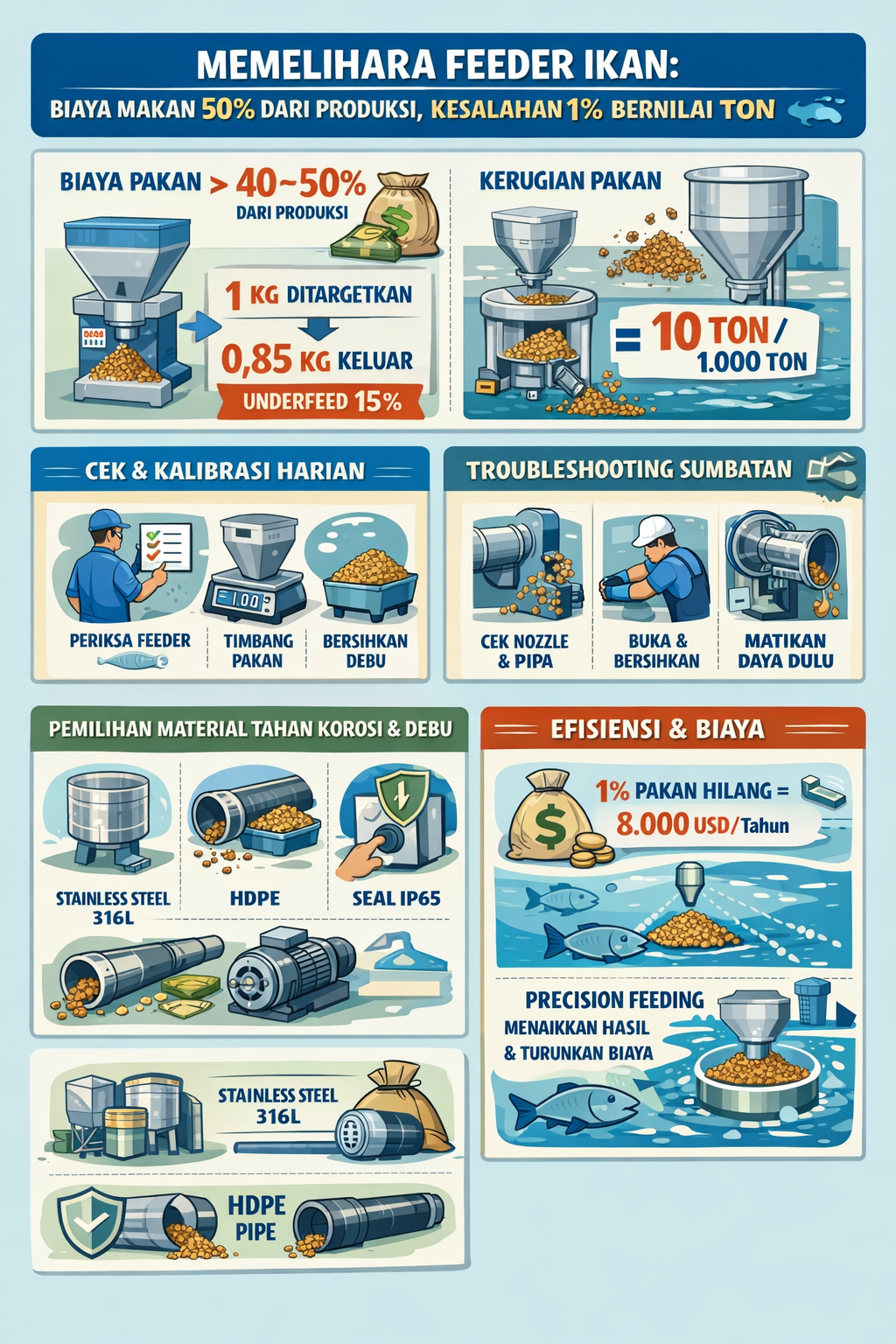
The choice of feeder technology influences dust and durability. Pneumatic (air‑blown) feeders are favored in many intensive farms because the air stream helps keep pellets intact and offers long run distances (MDPI; MDPI). Centrifugal or vibratory feeders may generate more fines due to mechanical conveyor surfaces. Features to target include self‑cleaning conveyors and slow operating speeds — FM Bulk’s machines run slowly so feed doesn’t slam into walls, reducing dust (Fish Farmer Magazine). Vibratory trays or spiral conveyors that gently rattle out clumps can cut dust; dedusting filters or cyclones on silos and blowers trap powder.
Design considerations include minimizing right‑angle turns in pipes — every 90° elbow can be a breakage point — because excessive 90° turns or fittings create backpressure and wear (Georg Fischer). Large‑radius bends and smooth‑bore pipes reduce impingement. Thick‑wall feed pipes last longer at tees and valves: thicker HDPE (high‑density polyethylene) or steel tubing outperforms thin PVC. Where metal is used, stainless steel (316L) or polypropylene/HDPE resist salt corrosion (Georg Fischer), and Fritzmayr (1994) notes HDPE piping offers decades of life in harsh aquaculture settings (Georg Fischer). For freshwater, corrosion remains a risk from ammonia and oxygen, so material choice (galvanized vs plastic) follows local water chemistry. Motors, gearboxes, and sensors should be rated at least IP65 (a dust‑ and water‑resistant enclosure rating) to survive splash zones.
In food‑contact environments, 316L stainless is a mainstay; components such as 316L stainless steel housings used in pharmaceutical and food‑grade applications illustrate the corrosion‑resistant standard expected around feeders. In salty, humid barns and on marine cages, composite materials can also help; lightweight FRP (fiber‑reinforced plastic) enclosures designed for chemical and seawater resistance, like composite cartridge housings, signal the kind of material strategy feeders benefit from in splash‑prone zones.
Corrosion mitigation protocols
In marine cages or barns, metal parts receive marine‑grade coatings (epoxy primer plus polyurethane topcoat), and zinc or aluminum anodes protect submerged components. Plain carbon steel is avoided in humid zones. Even food‑grade lubricants can wash away protective oils, so a routine anti‑corrosion spray is scheduled on idle parts (Georg Fischer).
Food‑grade lubricants and cleaning agents
Because feed is a food product, all lubricants and cleaning chemicals must be food‑safe. Only NSF H1‑approved greases or oils — or ISO 21469‑certified equivalents — are used on bearings, chains, and gearboxes. By definition, an H1 lubricant is formulated from ingredients listed in FDA 21 CFR 178.3570 and is “food grade” (colorless, odorless, very low allowable transfer into feed), and NSF notes food processors demand certified products so “incidental contact” cannot contaminate food (NSF; same source: NSF). Silicone or synthetic polyalkylene glycol (PAG) greases marked H1 are common in feed conveyors. Regular automotive grease is not acceptable near feed. Lubricant use is inspected annually, with product cans/labels checked for an NSF H1 mark.
For cleaning and sanitation, detergents and disinfectants are registered for food‑contact surfaces, ideally chosen from the NSF “White Book” of approved cleaners to ensure ingredients meet FDA standards (NSF White Book). Quaternary ammonium compounds, peracetic acid, or chlorine‑based sanitizers are often used in aquaculture. Label instructions for dilution and contact time are followed, then equipment is thoroughly rinsed to leave no toxic residue. Harsh acids or caustics that could pit stainless steel or leave film are avoided. As specialist guidance puts it, “effective food safety practices depend on…having the right cleaning processes in place” (NSF White Book). Staff are trained to clean feeders and pipes with these approved agents (with PPE such as gloves and goggles) and to document when and what was cleaned.
Key metrics and operational outcomes
Proper maintenance pays out. With feed exceeding 40–50% of production costs (MDPI; “over 50%” in ASEAN contexts, SEAFDEC), small changes matter: a 1% loss equals 10 tons for every 1,000 tons fed (Hatchery International). If feed costs $800/ton, that is $8,000 lost annually from one feeder line. Regular cleaning and choosing low‑wear equipment can cut such losses.
Market research highlights that precision feeding — only giving fish what they eat, enabled by well‑maintained automatic feeders — directly boosts yield and lowers costs by reducing waste runoff (LinkedIn). Downtime is expensive because feeders run weekends and nights; equipment built for 24/7 use with slow‑safe operation aims to keep maintenance costs minimal (Fish Farmer Magazine). Investing in robust feeders — a 10‑year lifespan goal with reliable parts is cited — and a disciplined maintenance program translates into higher fish growth, lower feed conversion ratios, and less labor spent fixing issues (Fish Farm Feeder).
The through‑line from farms and vendors is consistent: rigorous cleaning schedules, daily inspections, and certified food‑contact products are not just good practice; they yield measurable benefits — and a single clogged or mis‑calibrated line can cascade into lost growth, a higher feed bill, and health problems in fish (Hatchery International; Fish Farm Feeder; Georg Fischer; NSF).
Authoritative guides and studies were used throughout — including technical articles and industry analyses (Hatchery International; Fish Farm Feeder; Georg Fischer; NSF) — to align recommendations with proven aquaculture standards.