

Industry: Aquaculture | Process: Water_Source_&_Intake_Treatment
Humic substances, algal organics, and tannins hitchhike into aquaculture intakes, adding color and dissolved organics that absorb light, foul filters and UV units, and feed microbes. Ozone (O₃), a strong oxidant with redox potential of 2.07 V, targets electron‑rich sites such as C=C double bonds and aromatic rings (pmc.ncbi.nlm.nih.gov). In aquaculture practice, ozonation “remove[s] organic carbon…turbidity, algae, color, odor and taste” (www.researchgate.net).
One trout recirculating aquaculture system (RAS) trial — RAS being a looped system that recycles water — reported a 35% cut in suspended solids (TSS), 36% drop in chemical oxygen demand (COD), 17% reduction in dissolved organic carbon (DOC), and an 82% reduction in color in tank water after ozone treatment (www.researchgate.net). Bench tests have gone further: with sufficient dose, ozone completely eliminated UV‑absorbing color, achieving 100% absorbance removal at 400 nm (pmc.ncbi.nlm.nih.gov).
The chemistry is straightforward and synergistic. Pre‑ozonation attacks humics and other high‑molecular organics, breaking conjugated structures and aromatic rings into smaller carboxylates and aldehydes — often via reactive •OH radicals from ozone decomposition — shifting the organic carbon size distribution to lower molecular weights (pmc.ncbi.nlm.nih.gov). Downstream, granular activated carbon (GAC) — with micropores around 0.5–2 nm and very high surface area — preferentially adsorbs small, nonpolar organics; large biomolecules like proteins, polysaccharides, and humic macromolecules cannot enter micropores and tend to foul the carbon (www.researchgate.net). By fragmenting macromolecules first, ozone lets those smaller compounds “fit” into GAC, raising uptake and avoiding pore clogging (pmc.ncbi.nlm.nih.gov). In industry use, the O₃→carbon train has delivered roughly 90–95% overall color removal (spartanwatertreatment.com). For that polishing step, many operators turn to activated carbon filters to remove the oxidation byproducts and residual organics.
Ozonation and carbon adsorption mechanism
Ozone’s selectivity for electron‑rich moieties (aromatics, double bonds) underpins the observed removal of “taste, odor, and color” (pmc.ncbi.nlm.nih.gov). As humic fractions drop and low‑weight “building blocks” rise, the GAC step becomes more efficient (pmc.ncbi.nlm.nih.gov). GAC’s pore architecture explains why: it is optimized for small molecules and is prone to fouling by large dissolved organics unless preceded by oxidation (www.researchgate.net).
Filter loading and UV transmittance gains
Pre‑ozonation reduces turbidity and TSS, lightening the load on granular media and membranes; the RAS trial above logged a 35% TSS drop (www.researchgate.net). Smaller oxidized organics are less likely to foul sand or membrane filters, which lifts flows and lengthens run times. Facilities that still rely on granular beds often pair ozone with sand/silica filtration or add cartridge filters as a final barrier before disinfection.
Crucially, ozone lowers UV‑absorbing organics. As color and aromatics are destroyed, UV transmittance (UVT) rises; batch tests have shown complete removal of color absorbance at 400 nm (pmc.ncbi.nlm.nih.gov). In practice, operators have reported ~90% UVT after ozonation in freshwater RAS, aiding UV dose delivery (www.researchgate.net). Combined O₃+UV or O₃/AC+UV schemes have raised microbial kill rates versus UV alone (pubmed.ncbi.nlm.nih.gov; pmc.ncbi.nlm.nih.gov). Many intake trains pair ozone and carbon with ultraviolet disinfection, and where membranes are used, pretreating via ultrafiltration can further stabilize downstream performance.
Measured removal efficiencies (numbers)
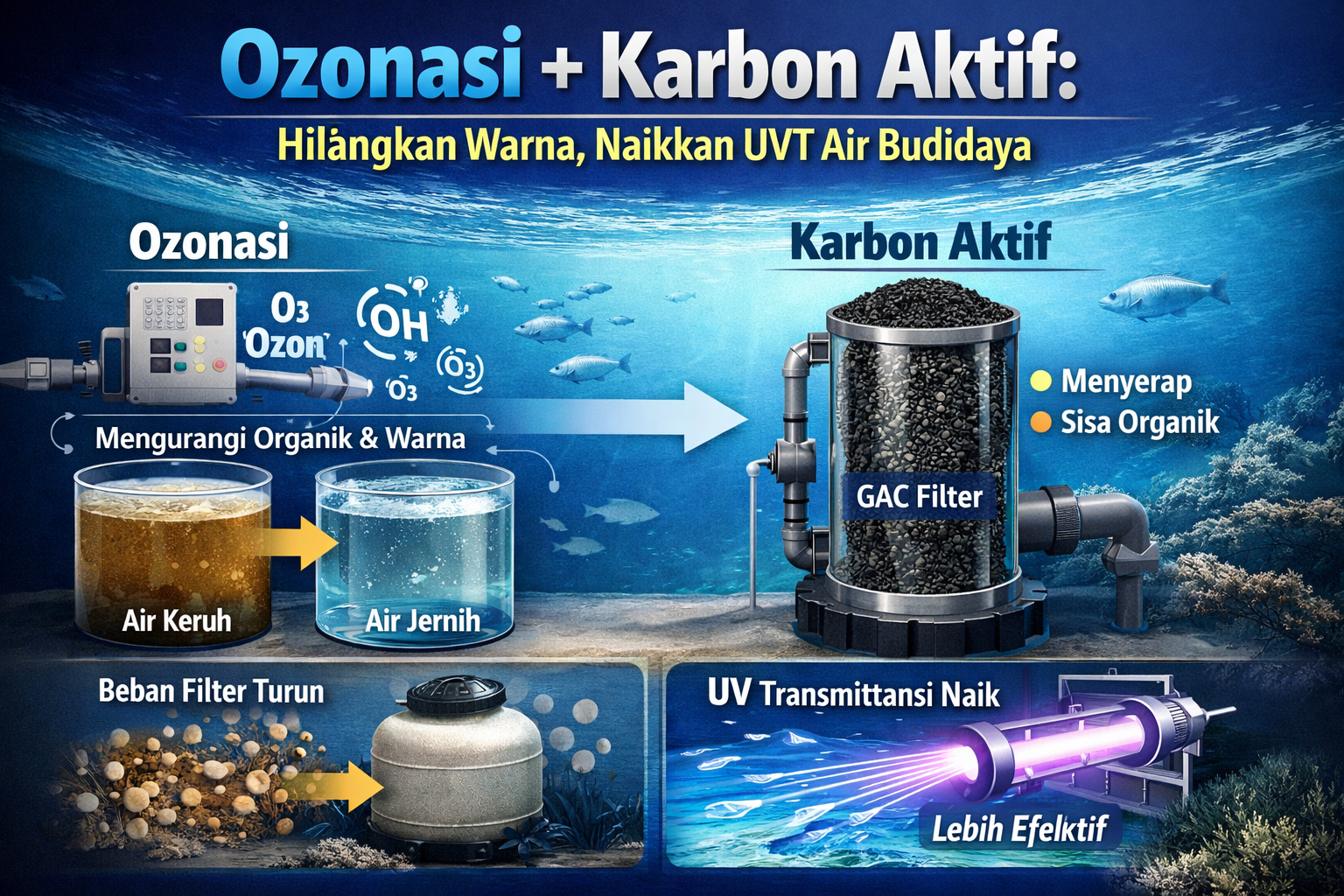
Across studies and field reports in recirculating systems, ozonation has cut organic loads and color by large margins: an 82% reduction in color intensity (apparent color units) after ozonation in one RAS study (www.researchgate.net), and ~100% removal of UV‑visible color absorbance in bench work (pmc.ncbi.nlm.nih.gov). COD, TOC, or DOC reductions with ozone have ranged from ~20% to 50%, depending on dose (www.researchgate.net; pmc.ncbi.nlm.nih.gov). By contrast, activated carbon by itself typically removes only the DOC fractions it can sorb; GAC alone often adsorbs ~50% of nuanced organics but leaves colloidal humics (www.researchgate.net). In combination, O₃ → GAC can reach >90% DOC/UV254 removal in practice.
Representative removal gains with O₃ + GAC (as reported in industry/literature):
- Color (CU): Spartan report — raw color ~140 CU to ~6 CU after O₃ at 5 mg/L with 10‑minute contact (≈95% removal) (spartanwatertreatment.com).
- DOC (mg/L): experiments report DOC drops on the order of 15–50% depending on dose (www.researchgate.net).
- TSS: about −35% with ozone in RAS (www.researchgate.net).
- Nitrate/Nitrite: ozone often oxidizes nitrite to nitrate; reported nitrite drops are ~80% (www.researchgate.net).
- Pathogens: O₃ alone can nearly sterilize; complete coliform kill and ~99% Vibrio reduction have been observed (pmc.ncbi.nlm.nih.gov; pmc.ncbi.nlm.nih.gov).
Effects on UV disinfection
Large organics and color compete for UV photons. With ozone pre‑treatment, the required UV dose for the same log‑reduction drops as UVT rises. In one RAS study, ozone followed by UV achieved total coliform destruction, whereas UV alone left residuals (pubmed.ncbi.nlm.nih.gov). Full decolorization by ozone (~100% A400 removal in batch tests) implies nearly pristine UV paths (pmc.ncbi.nlm.nih.gov). Field reports note that ozonated RAS water enables UV units to run at ~90% UVT and sustain higher kill rates at the same energy (www.researchgate.net).
Cost and operational profile
Ozone generation has both capital and operating costs. Corona‑discharge units with oxygen feed consume “tens of watts per gram ozone”; producing 1 kg O₃ typically uses ~12–13 kWh (www.chinaozonegenerator.com), translating at ~$0.10–0.15/kWh to roughly $1.2–$2 per kg O₃. Typical RAS ozone dosing is a few g/m³·d (grams per cubic meter per day), making energy costs on the order of cents per m³ of water. Equipment can run from thousands to tens of thousands of dollars installed, with compressed air/oxygen, contactors, and safety systems.
Activated carbon adds recurring cost. GAC media is roughly $1–2 per kg (www.researchgate.net) for heavy‑duty, high‑iodine‑number grades; once saturated it is replaced or thermally reactivated. Backwashing, periodic changeout (e.g., monthly), and disposal are part of the OPEX. In saline intakes, ozone can form byproducts — notably bromate from bromide — requiring monitoring; seawater RAS faces this regulated carcinogen risk (www.researchgate.net). GAC also removes residual ozone and can polish bromate slowly. Where housings are needed for higher pressures, operators may specify steel filter housings for robustness.
Production benefits and ROI
On the benefits side: clearer, lower‑DOC water supports healthier stock, higher survival and growth, and saves downstream maintenance. Less particulate and microbial load stabilizes biofilters and reduces disease risk. One trial reported ozone‑assisted skimming improved fish physiology and stabilized nitrification — feed conversion and growth rates were not disrupted by nitrite spikes (cordis.europa.eu). Lower organic load also means fewer cleanings and extended capacity, allowing more water reuse. Ozone+GAC can replace or reduce chemical disinfectants (no chlorine DBPs, no antibiotics).
A simple cost–benefit illustration: if adding ozone/carbon lifts survival or growth even modestly, returns can be meaningful. A 10–20% reduction in disease mortality on a 50‑tonne/year tilapia operation valued at ~$2/kg could add about $100k–$200k per year. Even a 5% improvement in feed conversion or survival can offset typical ozone system costs (about $5k–$20k capital, plus ~$100–$500/month OPEX for a medium system). Clearer water may also support higher stocking density or longer culture cycles, boosting yield.
Trade‑offs and system integration
There are trade‑offs. UV alone is “lower cost and easier maintenance” than ozone (www.researchgate.net), while “Ozone application…is more costly and very complex” (www.researchgate.net). But in high‑intensity RAS, the incremental cost can pencil out — sharing oxygen delivery and contact tanks can moderate the net expense of adding ozone (www.researchgate.net). Ozone‑carbon trains also set up downstream membranes and UV for success by lifting UVT and curbing fouling — a consideration for facilities that rely on UV systems and membrane pretreatment.
Bottom line
Adding an ozone–carbon stage delivers high‑end water polishing — studies report removal of >80–90% of color and “Erisman COD,” essentially eliminating UV‑254 absorbance (pmc.ncbi.nlm.nih.gov; www.researchgate.net). Those gains — higher UVT, lower filter fouling, reduced biofilter load, fewer pathogens — must be weighed against capital, energy, media, and byproduct management costs. For many recirculating aquaculture facilities, where water reuse economics dominate, the documented stability and mortality reductions outweigh the added treatment step. As a practical matter, pairing ozone with activated carbon upstream of UV disinfection has become a clarity play with measurable returns.
Sources: Peer‑reviewed studies and industry reports on RAS ozonation and GAC water treatment (www.researchgate.net; pmc.ncbi.nlm.nih.gov; pmc.ncbi.nlm.nih.gov; pmc.ncbi.nlm.nih.gov; www.researchgate.net; cordis.europa.eu; www.researchgate.net; www.researchgate.net; www.researchgate.net; www.researchgate.net).