

Advanced process control, heat integration, and next‑gen solvents are cutting reboiler duty by single‑ to double‑digit percentages — a big deal in plants where steam makes up roughly 80% of capture costs. Pilots and models show 6–7% savings from economic MPC, ~7% from heat‑integrated strippers, 10–20% from intensified flowsheets, and solvent candidates near or below 3 MJ/kgCO₂.
Industry: Fertilizer_(Ammonia_&_Urea) | Process: CO2_Removal
In amine‑based CO₂ capture — the workhorse for “blue ammonia” — steam used to regenerate solvent dominates cost. One review puts steam generation and extraction at roughly 80% of amine capture costs (MDPI). That’s why seemingly modest reductions matter: even a 5–7% cut can translate into millions in annual fuel savings for a large plant (same MDPI).
Three levers are delivering those savings: smarter controls, tighter heat recovery, and more efficient solvent chemistry. The gains are stacking up — from 6–7% reboiler energy reductions via real‑time economic MPC to ~7% lower steam with heat‑integrated strippers, 10–20% from split‑flow and multi‑effect designs, and solvent candidates pushing toward sub‑3 MJ/kgCO₂ duties (MDPI; ScienceDirect; MDPI).
Advanced process control in amine strippers
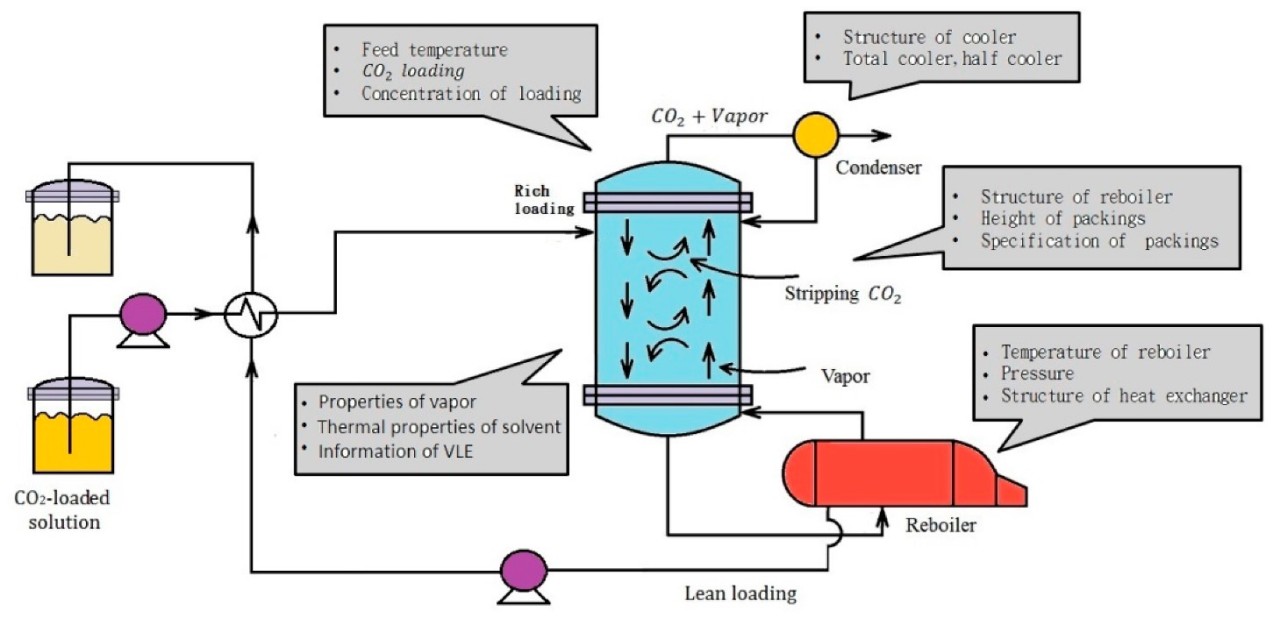
Amine‑based CO₂ strippers (regenerators that heat a CO₂‑rich solvent to release CO₂ and recycle “lean” solvent) are nonlinear, multivariable systems. Economic model predictive control (EMPC — an optimizer that uses a dynamic model and economic cost, such as fuel cost) has cut reboiler energy by ≈6–7% versus conventional control (MDPI). Decardi‑Nelson et al. reported up to 7% energy improvement over standard MPC, while maintaining capture efficiency (MDPI).
Hybrid strategies — decentralized loops for stability plus MPC for optimization — have kept capture ≥90% while holding stripper steam to ≤3.1 MJ per kg CO₂ (about 3.1 GJ/tCO₂) (MDPI). In practice, well‑tuned controllers adjust lean/rich solvent flow and reboiler heat duty in concert to minimize steam for a given CO₂ load, mitigate disturbances (e.g., fluctuating flue‑gas flow), and maintain high capture yield with minimal overshoot (MDPI; MDPI).
Unlike simple PI loops, MPC/EMPC continuously optimizes targets like reboiler pressure, lean loading (how much CO₂ the “lean” solvent still carries), and temperature under constraints — effectively “learning” optimal trajectories and shaving steam demand a few percent without sacrificing purity (MDPI; MDPI). The approach maps directly to solvent systems used in CO₂ capture, including regenerable amines such as those supplied for CO₂/H₂S service (amine solvent).
The economic payoff is straightforward: steam generation and extraction account for roughly 80% of amine capture costs, so even a 5–7% reduction can cut millions in annual fuel expense for a large plant (MDPI).
Heat integration and process intensification
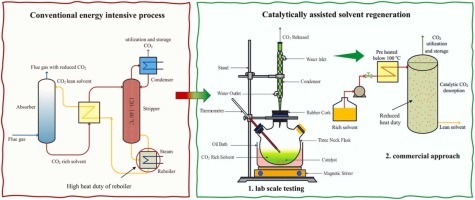
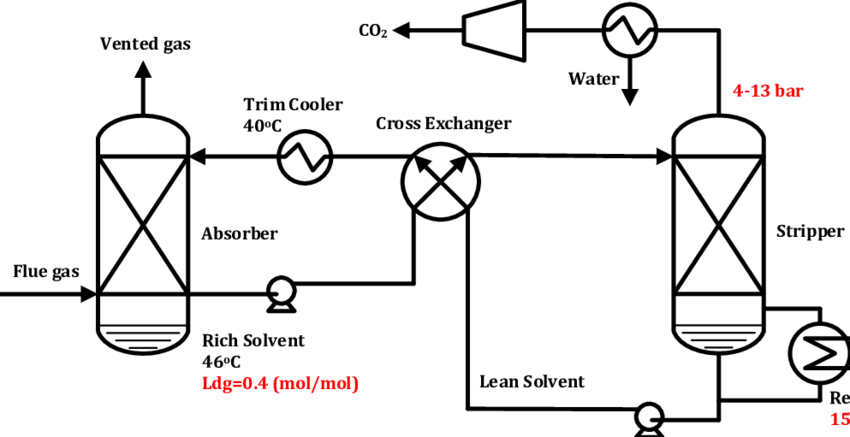
Heat integration uses internal or waste heat to regenerate solvent more efficiently. A heat‑integrated stripper (HIS — a column fitted with internal heat exchangers and/or intercooling) in a 30% MEA absorber pilot consumed ~7% less steam than a conventional configuration (ScienceDirect). Built‑in exchangers preheated the incoming rich solvent and moderated the temperature profile, boosting CO₂ desorption without extra heat input (ScienceDirect; same ScienceDirect).
Beyond HIS, multi‑effect or split‑flow stripper configurations — including absorber inter‑cooling, rich/lean split, and vapor recompression — have cut total reboiler duty by 10–20% in pilot and simulation (MDPI). Osagie et al. report that combining rich‑solvent bypass, absorber inter‑coolers and flash recovery can improve exergetic efficiency (a measure of useful energy conversion) from ~56% to ~74%, corresponding to roughly ≤20% lower steam use (MDPI; same MDPI).
The pilot cited above concluded that “heat integration positively influences the temperature profile … leading to increased CO₂ capture without additional heat input” (ScienceDirect). In stackable terms, achieving a 7–15% reduction in steam duty can translate to multi‑MW of heating saved on a large plant, reinforcing advanced integration as a key lever for capturing more CO₂ per tonne of steam (MDPI).
More efficient solvents and lower regeneration heat
Solvent chemistry dictates how much heat is required to drive off CO₂. Conventional 30 wt% MEA (monoethanolamine) has a high heat of absorption of ≈84.5 kJ/mol CO₂ — corresponding to roughly 3.5–4.0 GJ/tCO₂ (≈3.5–4.0 MJ/kgCO₂) (De Gruyter). By contrast, amino‑acid salts and tailored blends show far lower enthalpies: potassium‑lysinate solutions have CO₂ absorption heats of 55–70 kJ/mol, and K‑sarcosinate absorbs CO₂ at ~66.7 kJ/mol — translating to roughly 20–30% lower regeneration heat per mole CO₂ (De Gruyter; same De Gruyter; same De Gruyter).
At the cutting edge, a ternary amine blend (DEEA + piperazine + 4‑methylpiperidine) reported ≈2.14 GJ/tCO₂ (≈2.14 MJ/kg) steam duty — only ~60% of a baseline MEA case, cutting regeneration energy by roughly one‑third (ScienceDirect). A U.S. pilot of an ION Engineering amine system showed ~50% reduction in stripper heat duty versus a conventional MEA case, with a measured gross reboiler duty of 3.24 MJ/kgCO₂ (ResearchGate; ResearchGate). In that reference, 3.24 MJ/kg is roughly half of the ~6.5 MJ/kg implied for MEA (same ResearchGate).
Emerging solvent families — including sterically hindered amines, amino‑acid salts, ionic liquids (salts that are liquid near ambient) and deep eutectic solvents (DES; designer hydrogen‑bonded mixtures) — increasingly target <3 MJ/kgCO₂ duties, versus ~3.5–4 MJ/kg for MEA (De Gruyter). Recent literature notes certain DES systems require “low energy for solvent regeneration” due to mild physical/chemical CO₂ interactions (ScienceDirect). Most of these solvents remain at pilot scale, but any reduction is valuable because steam (LP or MP) dominates capture cost — a reality for any amine service, including commercial solutions for CO₂ removal (amine solvent; same cost share: MDPI).
Indonesia’s fertilizer decarbonization context
Industry accounts for ~14% of Indonesia’s national GHG emissions, and the country’s NDC calls for a 3.95 MtCO₂e reduction from the fertilizer industry by 2030 (UNIDO Indonesia; same source for the 3.95 MtCO₂e target: UNIDO Indonesia). State producers plan “blue ammonia” with CCS and “green ammonia” via electrolysis (UNIDO Indonesia; Petromindo).
PT Pupuk Indonesia aims to deploy ~660 ktpa of blue ammonia by 2030, storing ~26.8 MtCO₂ over 25 years (storage site described as a depleted reservoir) (Petromindo). On the ground, pilots at existing plants (e.g., PUSRI’s 2B urea unit) have implemented energy‑efficient measures, saving several thousand tonnes CO₂e per year, and four fertilizer sites using cleaner production practices have cut ~328,000 tCO₂‑eq/yr (2018 baseline) and saved ~US$47 million in costs (UNIDO Indonesia; same savings/cuts: UNIDO Indonesia).
Policy momentum is rising. Indonesia enacted Presidential Regulation 14/2024 in early 2024, establishing a nationwide CCS framework and explicitly encouraging deployment (including in chemicals) to reach net‑zero by 2060 (Herbert Smith Freehills; same Herbert Smith Freehills). The law created two CCS regimes (working‑area schemes and dedicated carbon‑permit areas) analogous to oil/gas rules, with supporting rules like MEMR Reg. 2/2023 already governing CCS in upstream petroleum (Ashurst). Officials have signaled that complementary regulations for other industries will follow; in 2023, a regulator said Indonesia aims to finalize a broad industrial CCS law “this year,” offering project certainty (Jakarta Post).
For ammonia and urea producers, that policy arc meets technical readiness. With EMPC‑tuned strippers, heat‑integrated columns, intensified flowsheets, and solvent upgrades, plants can pull levers that are already showing 6–7%, ~7%, and 10–20% steam cuts — with frontier solvents pointing to ≈2.14 GJ/tCO₂ and 3.24 MJ/kgCO₂ cases (MDPI; ScienceDirect; MDPI; ScienceDirect; ResearchGate).