
Iron ammonia catalysts hate carbon oxides. The final methanation step converts CO and CO₂ to inert methane, routinely taking both to under 5 ppm and preserving years‑long runs.
In the ammonia synthesis loop, the difference between smooth output and a costly shutdown can be just a few parts per million (ppm, parts per million by volume) of CO or CO₂. Iron–potassium (promoted magnetite) ammonia catalysts are extremely sensitive to trace “oxygenates” (H₂O, O₂, CO, CO₂): even a few ppm of CO or CO₂ adsorbs strongly on the Fe surface, blocking active sites and forming iron carbonyl/carbide species that irreversibly deactivate the catalyst (cheresources.com) (slideshare.net).
Industry practice is to hold residual COx (carbon oxides CO and CO₂) at single‑digit ppm – typically <5–10 ppm total – in the synthesis feed. In one case a leak raising CO/CO₂ to ~40–50 ppm caused measurable loss of ammonia conversion and higher loop pressure (cheresources.com). Above ~10 ppm carbon oxides, “active iron forms carbonyls and carbonates with these two,” leading to rapid activity loss (cheresources.com). In practice even this threshold is conservative: successful plants target <5 ppm COx. After amine/physical CO₂ scrubbing, trace COx “must be removed” by methanation so that final levels are under ~5 ppm (slideshare.net) (slideshare.net). In many plants this CO₂ scrubbing is delivered by amine solvent trains, such as CO₂/H₂S removal amine solvent systems. This virtually eliminates catalyst poisoning: a well‑operated methanator routinely yields <5 ppmv CO and CO₂ in the syngas (slideshare.net).
Trace COx and iron catalyst poisoning
The poisoning impact is severe: blocked sites cut both activity and selectivity, forcing higher operating temperature or pressure to maintain ammonia output. A contaminated converter shows reduced ΔT (change in temperature, a proxy for conversion) and rising off‑gas pressure. In practice, plants have seen that tight control of syngas chemistry (including COx) can extend run lengths dramatically. One report noted that closed‑loop control of key feed ratios and “methane slippage” (methane content leaving the reactor) improved run time (and equipment life) by ∼20% (azom.com). Analogously, preventing CO poisoning by methanation preserves catalyst capacity and avoids costly shutdowns.
Methanation reactions and heat management
Because CO and CO₂ are such poisons, the final syngas stage in ammonia plants is a methanator: it hydrogenates the oxides to methane (CH₄), which is inert in the ammonia loop. The key reactions are: CO + 3 H₂ → CH₄ + H₂O (ΔH ≈ –206 kJ/mol) and CO₂ + 4 H₂ → CH₄ + 2 H₂O (ΔH ≈ –165 kJ/mol) (slideshare.net) (slideshare.net). Catalysts are typically Ni‑based (Ni on alumina or kieselguhr support) – often procured pre‑reduced for ammonia service.
Typical methanator inlet conditions are ~270–300 °C and high pressure (~20–30 bar) (chemengexpert.com) (slideshare.net). Because the reactions are highly exothermic, the reactor is staged with inter‑stage cooling. In practice a multibed adiabatic reactor (operated without internal heat exchange) or 2–3 fixed beds with heat exchangers is used. Heat release is dramatic: roughly +60 °C rise per 1 vol% CO converted and +74 °C per 1 vol% CO₂ (slideshare.net). For example, one methanator design calculated that 1% CO feed would raise the gas temperature ≈60 °C. To manage this, outlet temperatures can reach ~320–350 °C even if the inlet is only ~280 °C, necessitating interstage coolers or quench gas.
Pre‑methanator feed and product specifications
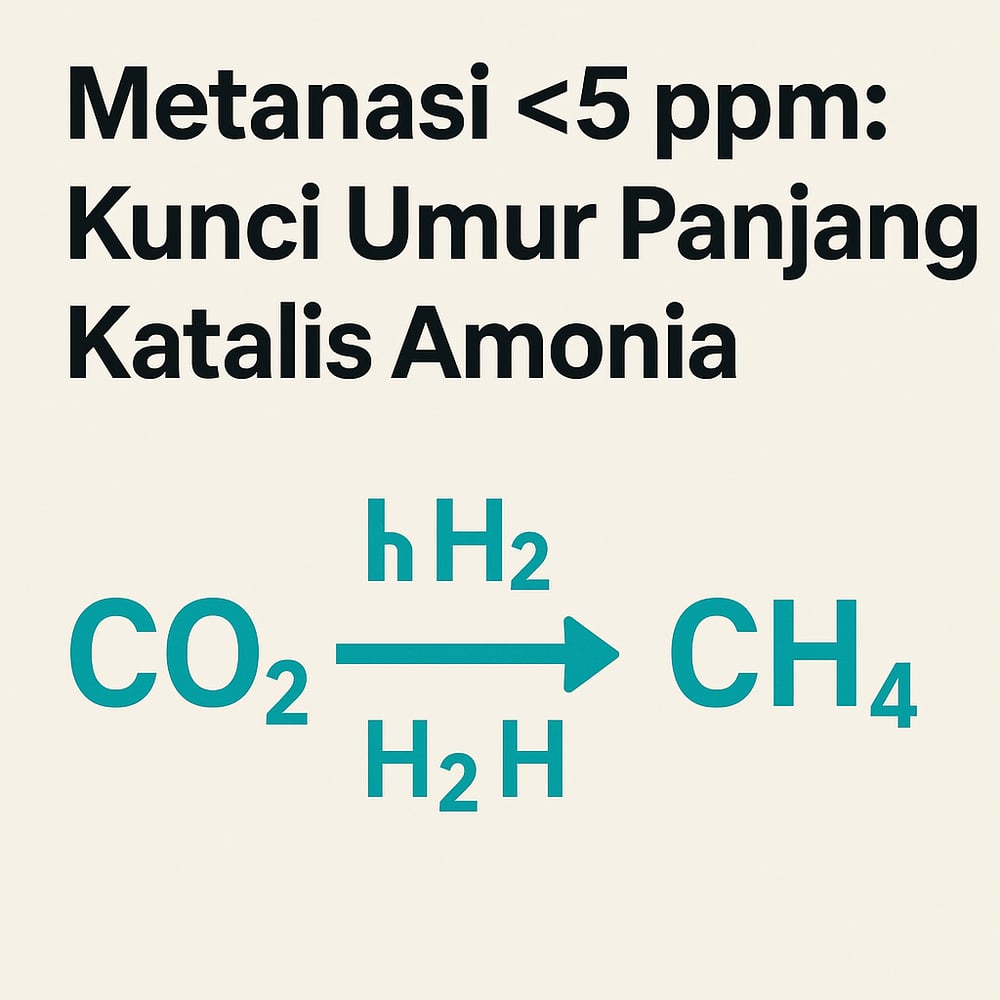
The methanator feed is the hydrogen‑rich gas coming off the CO₂ absorber (and any pressure‑swing or purge gas booster). Typical pre‑methanator composition might be on the order of 0.1–0.5 vol% CO and 0.1–0.3 vol% CO₂ in the H₂ stream (slideshare.net) (slideshare.net). The catalyst terminally cleans this to negligible levels: effluent CO₂ is driven to <5 ppmv and CO equally low, with a corresponding slight methane increase (e.g., CH₄ slip rising from ~0.3% to ~0.8%) (slideshare.net). In that example flow sheet, inlet 0.3% CO₂ and 0.1% CO went to <5 ppm.
Controls, instrumentation, and limits
Operational parameters are tightly monitored. Typical DCS (distributed control system) control monitors inlet/outlet CO and CO₂ (often by rapid gas analyzers) and bed temperatures. A rising exit CO indicates catalyst aging or channeling; a high ΔT implies over‑rich COx or hotspots. The methanator vessel often carries multiple thermowells and may be packed with temperature guns to guard against runaway tubes. Designers will limit the allowable CO/CO₂ feed to the methanator (often <0.5 vol%), since higher CO₂ dramatically increases the heat duty (∼74 °C per percent as above). Pressure drop across the bed is kept low to avoid bypass.
Performance outcomes and economics
With a properly designed methanator, residual CO and CO₂ in the ammonia loop become essentially zero. Typical methanator performance figures are: COx >99.99% conversion, leaving <5 ppmv in recycle gas (slideshare.net) (slideshare.net). This protects the iron catalyst, extending converter campaigns. In practice, long lifetimes are routinely achieved; methanation catalysts such as “VSG‑N101” have been proven in service with “long lifetimes” and outlet COx consistently <5 ppm (slideshare.net). Absent methanation, even small CO leaks would erode activity in weeks – requiring higher temperature operation or catalyst replacement.
Quantitatively, the business impact is clear. An undisturbed catalyst run (years‑long campaigns) produces millions of tonnes of NH₃; poisoning can force a shutdown and catalyst exchange at ~$0.5–1M (for a large plant). By contrast, the methanator’s additional operating cost (fuel/hydrogen) is modest. Methanation actually recovers waste hydrogen (converting CO₂ to CH₄ uses H₂) and produces low‑Btu fuel gas for reformer burners. In one analysis, careful control of methane slip and syngas purity yielded ~20% longer run times (azom.com) – by analogy, ensuring COx <5 ppm through methanation can similarly preserve converter life and uptime.
Design parameters and operating window
In summary, the final methanation step is critical to ammonia‑urea plant reliability. It prevents catalyst poisoning by sweeping CO and CO₂ to inert methane, enabling stable loop operation. Design carefully balances reaction heat (multi‑stage cooling at ~280–300 °C, 20–30 bar with Ni catalysts) to fully remove COx without overheating. The outcome is measurable: syngas leaving the methanator contains essentially zero CO/CO₂ (pushing converter life to its design limits), directly improving yield and reducing downtime (slideshare.net) (azom.com).
Sources: Industrial practice and peer‑reviewed data on ammonia synthesis loop design (slideshare.net) (slideshare.net) (chemengexpert.com) (cheresources.com) (cheresources.com) (azom.com) (analyzed above) underscore that trace CO/CO₂ must be curtailed (<5–10 ppm) by methanation. These references detail catalyst sensitivities, methanator reaction parameters, and observed impacts on catalyst performance.
