

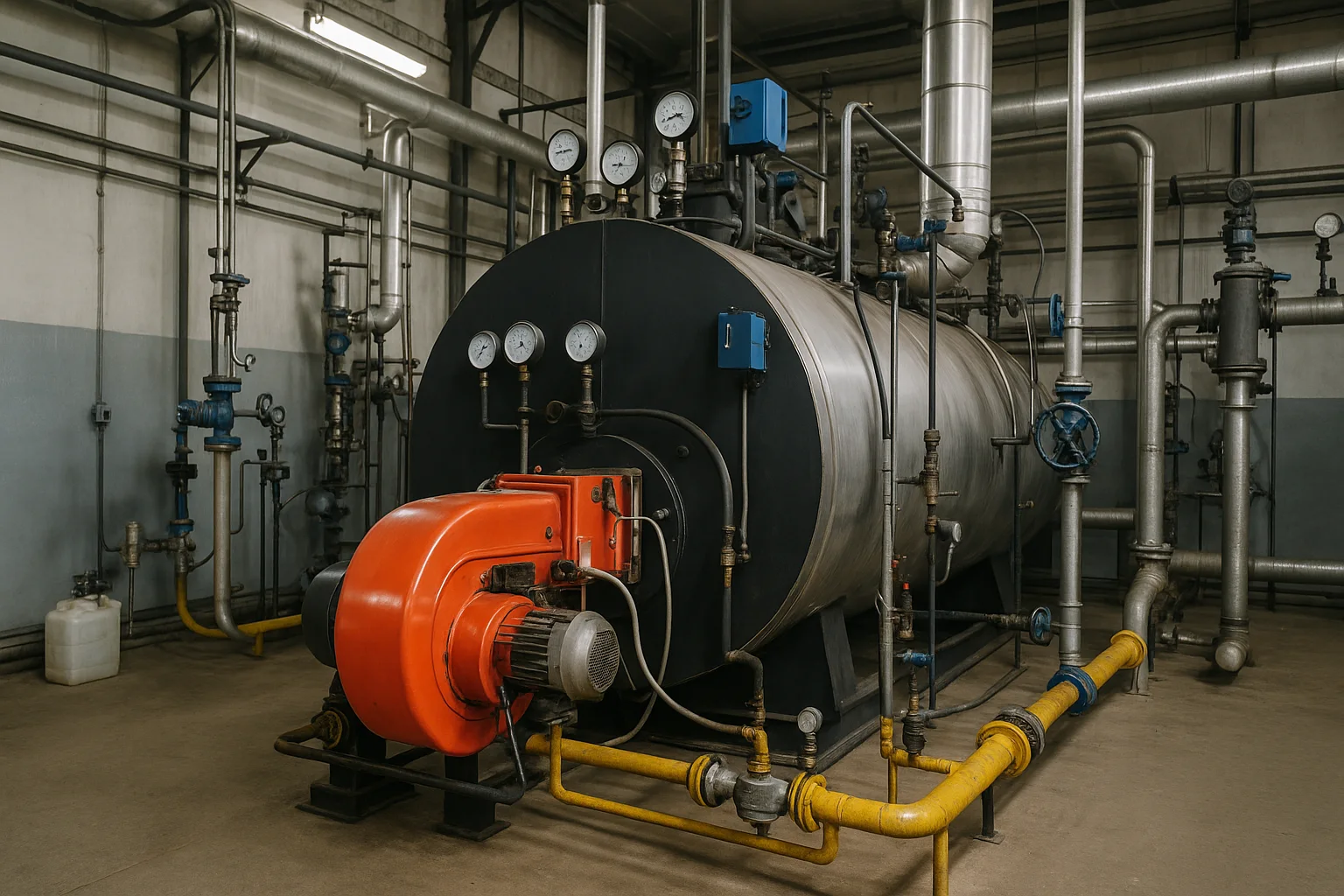
Boiler water treatment at this coconut processing plant in the Riau Islands stabilized residual phosphate, reduced mineral scale and cleaning frequency, and lowered alkalinity-booster use. PT Beta Pramesti Asia applied Hydro 1020, Hydro 590, and Hydro 310 to an 80–100 ton/hour turbine boiler operating continuously.
Updated: 3 August 2026.
Case Study Overview
| Category | Details |
|---|---|
| Industry | Coconut Processing Industry |
| Location | Riau Islands, Indonesia |
| Boiler Type | Turbine boiler system |
| Boiler Capacity | 80–100 tons/hour |
| Operating Schedule | 24 hours a day, 7 days a week |
| Key Products | Hydro 1020, Hydro 590, and Hydro 310 |
| Main Objectives | Stabilize phosphate residuals, control scale, reduce cleaning frequency, and optimize alkalinity booster consumption |
What changed in the boiler treatment program?
The plant did not address phosphate fluctuation by increasing one chemical dose. It recalibrated Hydro 1020, Hydro 590, and Hydro 310 feed, combined phosphate control with deposit dispersion and alkalinity management, and then adjusted the program from actual boiler-water trends. This matters to buyers because an 80–100 ton/hour turbine boiler operating continuously needs products, injection points, monitoring, and acceptance limits that work as one system. A facility evaluating a comparable boiler water treatment chemical program should submit feedwater, boiler-water, condensate, blowdown, and dose history; boiler scale-control chemistry and chemical dosing equipment can then be checked against those data. The U.S. Department of Energy boiler guidance similarly treats water-chemistry review, blowdown, and condensate maintenance as connected operating controls. Here, stable phosphate, lower deposits, longer cleaning intervals, and lower alkalinity-booster use were achieved without reducing boiler capacity.
Challenge
Before optimization, the coconut processing plant experienced persistent instability in its boiler water chemistry. Residual phosphate levels fluctuated outside the desired operating range, while mineral deposits accumulated rapidly on internal boiler surfaces.
These conditions increased the frequency of internal cleaning and required excessive consumption of alkalinity boosters. As a result, the facility faced higher treatment and maintenance costs, greater operational downtime, reduced equipment reliability, and increased risk of failing to meet industrial boiler safety and performance requirements.
Because the turbine boiler serves as the facility’s main power source, any interruption could directly affect continuous production. The technical team therefore needed a treatment strategy that could maintain stable water chemistry under demanding 24/7 operating conditions.
About the Customer
The customer is one of the largest coconut processing plants in the Riau Islands. Its production facility operates continuously and relies on an 80–100 tons/hour turbine boiler system as the primary source of power for plant operations.
The reliability of the boiler is critical to maintaining production continuity, controlling operating costs, and protecting high-value equipment from scale and corrosion.

The Solution
The plant’s technical team selected an integrated Hydro boiler treatment program consisting of Hydro 1020, Hydro 590, and Hydro 310.
The treatment strategy was designed to support three critical areas of boiler water management:
- Precise phosphate control to inhibit mineral scale formation.
- Deposit dispersion to minimize the accumulation of suspended solids and internal deposits.
- Alkalinity and corrosion management to maintain the required operating balance and protect boiler components.
Implementation included recalibrating chemical dosing, optimizing alkalinity booster consumption, and maintaining the required phosphate and P/M ratio targets. The program was supported by routine technical monitoring and dosing adjustments based on actual boiler water conditions.
This integrated approach allowed the plant to improve treatment consistency without compromising boiler capacity or production continuity.
The Results
Within several weeks of implementing the Hydro treatment protocol, the plant achieved significant improvements in boiler operation and water chemistry.
Residual phosphate levels became stable within the targeted technical range, providing more consistent protection against mineral scale and corrosion. Internal deposit formation decreased, which significantly extended the interval between boiler cleaning activities.
The optimized dosing strategy also reduced alkalinity booster consumption. This improvement lowered chemical procurement costs while helping the plant maintain the required boiler water parameters.
The main operational results included:
- Stable residual phosphate levels within the target range.
- Significantly reduced mineral scale formation.
- Longer intervals between internal boiler cleaning.
- Lower alkalinity booster consumption.
- Reduced maintenance-related downtime.
- Improved boiler efficiency and operational stability.
- Extended equipment service life.
- Stable boiler capacity of 80–100 tons/hour.
- Lower overall boiler water treatment costs.
Through more accurate dosing and continuous monitoring, the plant achieved a more reliable and cost-efficient boiler treatment program suitable for demanding 24/7 industrial operation.
Customer Testimonial
“Before implementing the Hydro Boiler Treatment Program, we frequently struggled with unstable phosphate residuals, rapid mineral deposition, and excessively high alkalinity booster consumption. These problems increased our operational costs and caused frequent downtime.
After applying Hydro 1020, Hydro 590, and Hydro 310 with a more precise dosing strategy, phosphate residuals became stable, internal cleaning frequency dropped significantly, and chemical consumption decreased without compromising system performance.
Our boiler efficiency and overall operational stability have improved. The program has reduced costs while providing better reliability and long-term protection for our boiler system. We highly recommend this solution for facilities operating large-scale industrial boilers.”
Key Products
Hydro 1020
Hydro 1020 supports the boiler water treatment program by helping control water chemistry and protect the system from operating conditions that can contribute to scale, deposits, and performance loss.
Hydro 590
Hydro 590 is applied as part of the integrated treatment strategy to improve deposit control and maintain cleaner internal boiler surfaces under continuous operation.
Hydro 310
Hydro 310 supports alkalinity and corrosion management, helping maintain boiler water conditions within the required operating range while protecting critical system components.
Conclusion
The integrated Hydro boiler treatment program successfully addressed unstable phosphate residuals, rapid scale formation, frequent boiler cleaning, and excessive alkalinity booster consumption at the coconut processing plant.
By combining Hydro 1020, Hydro 590, and Hydro 310 with precise dosing and continuous technical monitoring, the facility improved boiler reliability, reduced operating costs, and maintained stable production at a capacity of 80–100 tons/hour.
For industrial facilities experiencing scale, corrosion, unstable boiler water chemistry, or excessive chemical consumption, a properly designed and monitored treatment program can deliver measurable improvements in reliability, efficiency, and total operating cost.
Learn more about Beta Pramesti Asia boiler water treatment solutions