

Article
Nickel pits fill fast. The fix is tougher pumps and smarter water plants
Industry: Nickel_Mining | Process: Extraction
Tropical laterite nickel mines face relentless inflow. In places like Sulawesi, open pits flood quickly under ~2,000–3,000 mm per year rainfall and shallow groundwater, compromising access and wall stability (info.burnsmcd.com) (apnews.com).
One miner’s scale shows what is at stake. PT Vale Indonesia sends all runoff and seepage to treatment before discharge, about 7.56×10^6 m³/year, or roughly ≈107 m³ per tonne Ni (vale.com). However, local monitoring has found rivers near Sulawesi mines turning murky. Some samples also contained hazardous Ni, Pb and Cd (apnews.com).
Designers need to size for both volume and quality. In heavy rain, one Sulawesi pit was modeled at a peak runoff of ~9,230 m³/h (≈2.6 m³/s) (journal.itny.ac.id). That flow carries fines. Modeling showed an inflow TSS (total suspended solids) near ~8 mg/L entering a sediment pond, and a properly sized clarifier removed ~78% TSS (journal.itny.ac.id). In the field, however, loads can be far higher. A Pomalaa tributary measured ~190 mg/L TSS, above the 100 mg/L processing limit, while dissolved nickel was much lower (~0.01–0.04 mg/L) (researchgate.net) (researchgate.net). So suspended solids drive the risk. Metals are usually minor, but they are regulated.
Regulatory discharge requirements
Indonesia’s Ministry of Environment sets strict effluent limits for nickel mines: pH 6–9; TSS ≤200 mg/L for mining or 100 mg/L for processing; Ni ≤0.5 mg/L; and low Cu, Co, Cr, Pb, among others — per Permen LHK 09/2006 (nikel.co.id) (vale.com). Non-compliance risks fines or shutdowns (nikel.co.id).
Dirty‑water pumps and abrasion resistance
Dewatering systems must move large, gritty flows. Clear-water pumps (turbine or clean-water centrifugal) are efficient but intolerant to grit (info.burnsmcd.com). Nickel pits generally require “dirty-water” systems designed for fluctuating inflows and solids (info.burnsmcd.com).
Rugged submersible or vertical pumps with hardened internals are standard. Weir Minerals’ Warman SSB-A (a slurry/sludge submersible) is built for abrasive duty, handling up to ~60% solids by volume using high-chrome Ultrachrome A05 wear parts (casing, impeller, wearplates), enabling continuous muddy service without clogging (miningweekly.com) (miningweekly.com).
Mobility, piping, and redundancy
As mine plans shift, skid-mounted pump sets enable quick repositioning and adaptability (info.burnsmcd.com). HDPE discharge lines are favored for impact resistance and smooth bores to reduce abrasion (info.burnsmcd.com).
Automation is central to handling peak events. This includes level-probe auto-start and overload/run-dry protections. Redundancy also matters: multiple sump pumps plus spares. Designers also allow for rare surges (“100‑year storms”) with oversized sumps or controlled pour-over. Trash racks at sumps limit debris.
Stages of lift and floating stations
Shallow sumps usually use submersible pumps. Deeper drawdown can move to vertical turbine pumps or surface centrifugal pumps. If the inflow is very high, floating pump stations on pontoons keep the intakes at the water level. One Brazilian iron-ore pit used vertical/axial pumps on a pontoon platform (mining-technology.com). As pits get deeper, the inflow usually rises. Then perimeter wells or wellpoint arrays are needed to lower the groundwater first (mining-technology.com).
Costs vary widely, from tens to hundreds of USD per cubic yard drained. The cost depends on depth and geology. However, the cost of a pump failure is higher, because it means lost access and a safety risk (info.burnsmcd.com).
Coarse pretreatment and screening
All pumped water goes through treatment before discharge. Coarse pretreatment starts with trash screens and grit removal to protect the equipment downstream. Quiescent zones or air scouring can drop out coarse sands. In many plants, engineered primary systems such as automatic screens or the broader waste-water physical separation step remove debris larger than a few millimeters.
Primary clarification and detention time
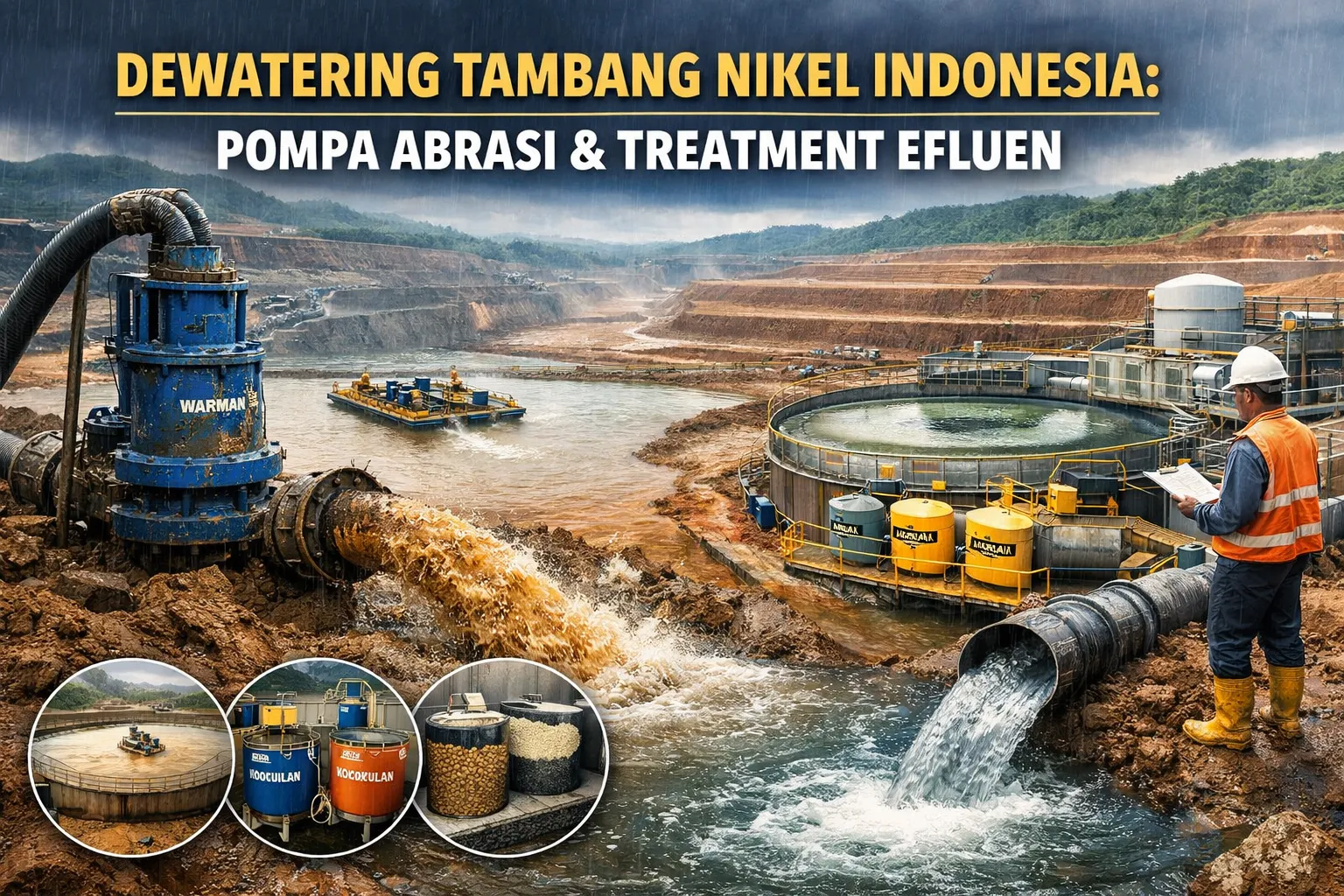
Settling basins or clarifiers take over next. With flocculant addition, gravity separation removes fine solids; mining operations often use long HRT (hydraulic retention time) of 24–48 hours to settle most TSS (journal.itny.ac.id) (mdpi.com). At one nickel site, modeling showed ~78% TSS removal for an ~8 mg/L load in a properly sized pond (journal.itny.ac.id).
Compact units such as a clarifier or a lamella settler can achieve similar separation with less footprint. The settled sludge is dredged from time to time.
Chemical coagulation and flocculation
Coagulants such as ferric chloride or alum and polymer flocculants speed up aggregation and settling. They can also begin precipitating some metals (mdpi.com). A dosing pump usually handles the controlled dosing to keep the target dose and pH.
Many mines prefer liquid coagulants like PAC (polyaluminum chloride) for turbidity control. They pair them with high-molecular-weight flocculants to boost clarifier efficiency by 30–50% (flocculant performance per product description).
pH neutralization and metal precipitation
If the inflow is acidic (pH <6), we add a neutralization reactor. A limestone (CaCO₃) or lime [Ca(OH)₂] system raises the pH and precipitates metals. The CSIR-designed South African nickel leachate plant used a fluidized-bed limestone neutralizer with ~60 g/L slurry. It precipitated metals and generated gypsum at the same time (researchgate.net). Simpler plants dose caustic lime to pH ~8–9 to drop Fe and other metals as hydroxides. Biological oxidation (Fe²⁺→Fe³⁺ by bacteria) can come before neutralization to improve Fe removal (researchgate.net).
Secondary clarification and polishing filters
Post-neutralization, a secondary clarifier settles metal hydroxide sludges (e.g., Fe(OH)₃, Al(OH)₃) and gypsum; this step can remove 90%+ of dissolved metals. In the CSIR nickel plant, gypsum crystallization was integrated due to high sulphate (researchgate.net).
Final polishing usually uses dual-media filters, for instance sand filters to capture 5–10 µm particles followed by anthracite media to improve turbidity removal. It also uses activated carbon if organics or residual reagents are present. An equalization basin stabilizes effluent TSS and pH before discharge. In some cases, constructed wetlands or vegetated clarifiers provide gentle polishing of trace species. Studies note limited Ni uptake by wetlands, but they can trap residual solids and oxidize metals (observation per paper).
Sludge handling and upkeep
Clarified sludges are thickened and dewatered (for example, vacuum filters or filter presses) for disposal in tailings or landfills. Some experimentation exists on reuse in cements or backfill (note per paper). Sludge volumes can reach 1–10% of influent volume. Therefore the sludge needs secure storage and scheduled dredging and hauling.
Operators plan maintenance cycles for ponds and basins. One study highlighted de‑silt intervals with a maximum of every 10 months (journal.itny.ac.id). Supporting skids, valves and controls are usually packaged as water treatment ancillaries to standardize upkeep.
Treatment performance and example sizing
Well-designed sedimentation removes >50–80% of TSS; with coagulants/flocculants, several-hundred mg/L TSS can be reduced to ≪50 mg/L (journal.itny.ac.id) (mdpi.com). Heavy metals precipitate effectively via pH control; laboratory studies report >90% removal by conventional precipitation (mdpi.com).
Illustrative sizing: at 10,000 m³/d and 200 mg/L TSS, a 2‑day pond holds ~20,000 m³ with area ~6,000 m² (3.3 m depth). If 80% of solids settle, effluent TSS is ≈40 mg/L. A polishing step or dual clarifiers can take it below 10 mg/L. If Ni were 1 mg/L, raising pH to ~10 precipitates ~90–95% as Ni(OH)₂. That gives <0.1 mg/L in effluent (mdpi.com). These numbers are indicative. Actual design must follow site tests.
Compliance, monitoring, and reuse
Effluents must meet the pH, TSS, and metal limits noted above before discharge (nikel.co.id). PT Vale reports continuous monitoring of effluents into Lake Matano, targeting compliance with Ministry standards (vale.com), while Indonesia’s regulators have intensified enforcement, including fines and permit reviews for non‑compliance (reuters.com).
Untreated mine waters commonly breach TSS limits during storms — the Pomalaa case recorded ~190 mg/L versus 100 mg/L — while metals like Ni were far below limits (~0.01–0.04 mg/L versus 0.5 mg/L), reinforcing a focus on solids removal and pH control (researchgate.net) (researchgate.net) (nikel.co.id).
Investment in dewatering and treatment avoids shutdowns and enables reuse. Vale’s reduction in water-use intensity to ≈107 m³ per tonne Ni reflects recycling after treatment (vale.com). International experience shows modern paste or thickened tailings systems can deliver decanted water at TSS <20 mg/L. With careful design, nickel mines can meet and outperform benchmarks (mdpi.com).
Planning considerations for mine designers
Best practice aligns on several points: quantify water loads via hydrogeology and rainfall; combine wellpoints/bores with robust sump pumping and HDPE discharge lines sized for seasonal peaks (info.burnsmcd.com) (mining-technology.com); implement coarse removal before treatment; build multi‑stage treatment sized for peak flow (e.g., 2‑day retention, chemical dosing for flocculation); neutralize and precipitate metals via pH control, as demonstrated in the CSIR nickel project (researchgate.net); and automate monitoring to keep discharge within permit limits.
Peer‑reviewed reviews corroborate the approach: gravity settling plus chemical coagulation addresses fine solids effectively, and heavy metals are readily removed as hydroxides under proper pH control (mdpi.com) (mdpi.com).
Technical anchors that pay off
Two pillars underpin reliable discharge compliance: wear‑resistant pumps and piping for abrasive slurry (miningweekly.com) (info.burnsmcd.com); and a comprehensive treatment regime — from flocculation and sedimentation to filtration — to polish effluent (mdpi.com).
To standardize these steps, operators usually use modular units like a tube settler to raise capacity. They also upgrade filter trains with strong housings and consumables so the plant keeps working. The aim is simple. Meet Indonesia’s standards (Permen LHK 09/2006, TSS ≤200/100 mg/L, Ni ≤0.5 mg/L, pH 6–9) before release (nikel.co.id).