

Article
The Fab’s Other Cleanroom: Inside the Chemistry of Chip-Wastewater
Semiconductor manufacturing is using more water. Use could double by 2035. It also leaves behind some of industry’s most variable and toxic wastewater. Fabs are building centralized treatment plants to handle it. These plants neutralize acids, precipitate metals and fluoride, polish ions and filter to near‑zero discharge.
Industry: Semiconductor | Process: Wafer_Fabrication
A modern multi‑fab campus can drink like a small city. Intel’s Ocotillo site withdraws about 53,000 m³/day (14 MGD; MGD, million gallons per day) semiengineering.com. A single advanced fab “use[s] millions – or even tens of millions – of gallons of water per day” samcotech.com. Industry forecasts say semiconductor water use will double by 2035, reflecting a skyrocketing market; TSMC alone used ~101×10^6 m³ in 2023 idtechex.com.
As demand rises, fabs generate proportionally more wastewater. In Korea, semiconductor processes produced ~177,937 m³/day by 2019, or ~19.3% of all industrial effluent researchgate.net. Much of this is happening in water‑stressed regions like Taiwan and the U.S. Southwest, which is driving aggressive reuse and ultra‑stringent treatment goals idtechex.com semiengineering.com.
Variable, toxic wastewater chemistry
Fab wastewater blends streams from photolithography, etch, deposition, CMP (chemical mechanical planarization), and cleaning. Each stream has a different chemistry. Typical constituents include strong acids (HF, HCl, H₂SO₄, HNO₃, H₃PO₄), alkalines (for example NH₄OH), metal salts (Cu, Zn, Ni, Fe, Al, Co, etc.), chelating agents (for example PBTC, cyanide), peroxide/ozone, organics (photoresist solvents like IPA), silica, and suspended particles samcotech.com researchgate.net.
One study found scrub wastewater with pH ≈2.2, F ≈460 mg/L, sulfate >15,000 mg/L, NH₄‑N ≈11 mg/L, total P ≈2.5 mg/L, SiO₂ ≈10 mg/L, and Fe ≈22 mg/L researchgate.net researchgate.net. Sim et al. note that several acidic chemicals lead to acidic wastewater that contains harmful substances. If this water is discharged without control, it can impose a significant environmental burden researchgate.net.
Global regulators set very low effluent limits. “Government regulations set limits on containment levels that are environmentally safe to discharge” semiengineering.com. In Indonesia, an operating permit (Technical Approval) needs compliance with Ministry of Environment and Forestry numeric effluent standards (pH, BOD, COD, heavy metals, etc.). Until they are updated, the current MoEF Reg.5/2014 standards apply enviliance.com enviliance.com. To meet typical Class I discharge limits, fabs usually target TSS < 30 mg/L, BOD₅ < 20 mg/L, Cu/Zn/Pb/Ni well below 0.1–0.2 mg/L, and F⁻ at a few mg/L.
Centralized treatment train architecture
A centralized plant that is flexible usually uses a train with several stages. (1) Equalization (flow/pH buffering). (2) pH neutralization. (3) Chemical precipitation/coagulation. (4) Ion exchange polishing. (5) Filtration with membranes/carbon. Real-time sensors and DCS controls adjust chemical dosing as influent chemistry shifts. Modular parallel reactors with spare capacity keep uptime high.
Good design practice is to reduce peak flows via equalization basins by ~40–60%, easing downstream load porvoo.com.cn. Fabs usually segregate streams (for example, very contaminated etch vs. cleaner rinse) so the central plant sees a more uniform mixture. However, the central system still must handle worst‑case blends semiengineering.com.
Figure: Centralized fab wastewater is treated via a multi‑stage plant. Key steps (pH neutralization, precipitation, exchange, filtration) are applied in series to handle the broad contaminant mix and variable loads.
Equalization and pH neutralization
An initial equalization tank with mixing evens out pH and flow swings. Automatic pH controls add alkaline (for example NaOH or flakes) to very acidic blends, or acid (for example H₂SO₄) to very alkaline streams. The target is near‑neutral conditions before downstream steps. A dosing pump usually delivers accurate dosing to keep the setpoints stable.
Lime (Ca(OH)₂) is the workhorse for HF-rich etch effluent. Raising pH from ~2 to neutral or alkaline forms CaF₂. One study achieved 99% fluoride removal at a Ca:F molar ratio ≈1.6 researchgate.net. pH control also sets up metal removal. Many metal hydroxides (Cu, Zn, Ni, etc.) become insoluble around pH 8–10 intechopen.com. In practice, simultaneous precipitation can remove >95% of metals. For example, a pH ~10.3 lime treatment yielded ~99% removal of several heavy cations in 15 minutes intechopen.com. Plants use two-stage precipitation (lower/high pH) for mixed metals if needed.
Chemical precipitation and solids separation
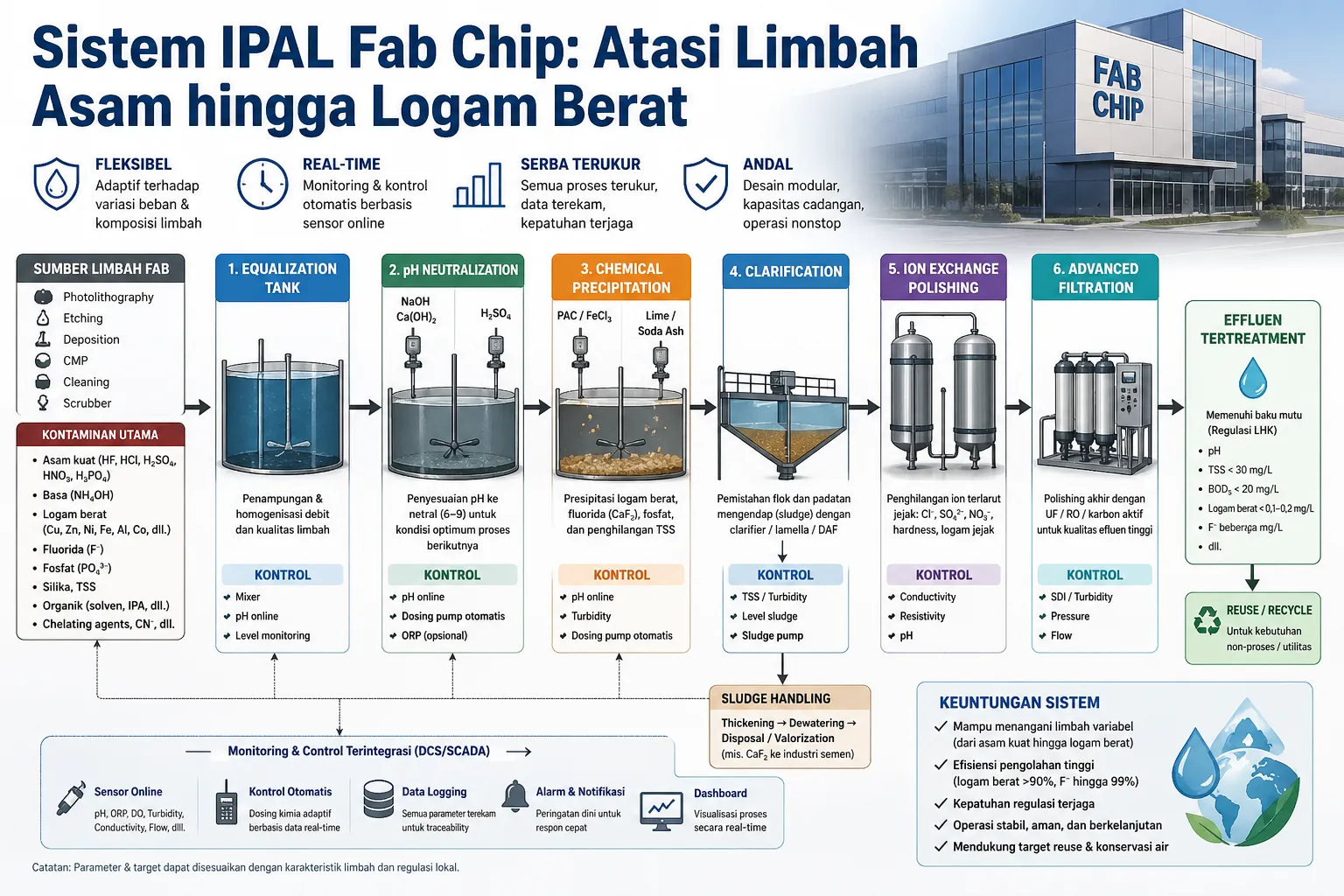
After neutralization, precipitation/coag tanks add coagulants such as FeCl₃ or PAC to floc colloids and oxidize/remove organics. For industrial wastewater duty, plants usually deploy PAC for industrial treatment to improve floc strength. Additional lime or soda ash drives out residual metals and hardness as insoluble salts by raising pH into the range of minimal metal hydroxide solubilities.
Heavy metals (Cu²⁺, Zn²⁺, Ni²⁺, Fe³⁺, etc.) drop sharply above pH ≈8. Reaching pH ~10–11 can remove 90–99% of these metals intechopen.com intechopen.com. Fe/Al coagulants remove phosphates. Fluoride is precipitated as calcium fluoride with Ca(OH)₂ at Ca:F ~1.5–2, which gives near‑complete (99%) removal. The CaF₂ byproduct can be recovered (cement manufacture), and resin can polish the residual soluble F researchgate.net.
Silica and arsenic (if present) can be co-precipitated at high pH or filtered. Silicic acid usually stays dissolved and may need separate UF/adsorption. Overall, chemical precipitation removes about 80–95% of TSS and more than 90% of regulated metals. Sludge settles in compact clarifiers. A lamella settler reduces the footprint. A DAF unit speeds up separation when detention time is short.
Embedded image: A settling tank (clarifier) after precipitation, where flocculated metal hydroxides and calcium fluoride separate as sludge. (In practice, a lamella clarifier or DAF unit is often used for speed and compactness.) pixabay.com
Ion exchange polishing
Clarified effluent still carries residual ions. These are usually sub‑mg/L levels of Cu/Zn, hardness (Ca/Mg), nitrates, sulfate and chloride. They must be reduced for tight discharge or reuse. An ion exchange system with strong‑acid cation and strong‑base anion resins, usually arranged as a mixed bed, can polish to ultra‑trace levels for sensitive loops.
For recycled rinse water or final polishing, fabs usually use a mixed-bed ion exchanger. In discharge duty, IX can remove >90–95% of remaining hardness, silica, phosphates, and heavy ions, usually down to <0.1 mg/L. One plant reported cutting chloride and metal ions from tens of mg/L to single‑digit µg/L (ppb). Resins are regenerated with acid (cation) and caustic (anion). The regenerant waste is neutralized and precipitated or recycled. IX has a higher operating cost. However, it is invaluable for meeting “zero discharge” constraints for onsite reuse loops samcotech.com.
Advanced filtration and adsorption
Membrane and adsorbent polishing removes the last particulates and organics. UF (ultrafiltration) modules, usually installed as a dedicated ultrafiltration pretreatment line, strip colloids and nano‑flocs and reduce turbidity to near zero. Activated carbon beds adsorb trace organics (for example, residual solvents, TOC). A dedicated activated carbon system also offers incidental adsorption of some metals such as Ni.
For high‑grade reuse, RO (reverse osmosis) can remove >95% of dissolved salts (Na⁺, Cl⁻, SO₄²⁻) and any last contaminants, producing demineralized permeate. Fabs usually install a brackish-water RO for feeds with moderate TDS (total dissolved solids). RO reject (concentrate) is sent back to IX or to evaporation crystallizers. Modern fabs even pilot electrodialysis or membrane distillation. However, a conservative design usually pairs RO with IX (RO+IX). U.S. water regulators for new fabs (for example, Phoenix) are already requiring RO pretreatment before sewer discharge semiengineering.com.
The combined effects are strong. MF/UF can remove about 99% of particulates and bacteria porvoo.com.cn, RO/IX more than 98% of ions, carbon about 90% of methanol/IPA, and oxidation (if used) more than 90% for organics. Final effluent usually shows TDS in the low hundreds mg/L, metals in µg/L, and negligible BOD/COD. Integrated membrane blocks are usually specified as complete membrane systems for industrial duty.
Performance metrics and outcomes
A benchmark centralized plant can remove more than 95% of target metals and organics. In one trial, optimized precipitation and IX brought all tested metals from 10–50 ppm down to sub‑0.1 ppm intechopen.com. Another facility raised internal water reuse from about 30% to about 65% by upgrading the train. This avoided about $30 million of new water system capital investment semiengineering.com.
Compliance is built in. Typical outcomes show pH ~6.5–9, BOD/COD near zero, TSS < 30 mg/L, and metal/discharge ions below legal limits. Many fabs target near‑zero discharge, reusing recovered water as scrub makeup or coolant, with only a small bleed. Byproducts help offset cost. The CaF₂ precipitate and, after treatment, ammonium sulfate can be sold or used (cement, fertilizer) samcotech.com.
Operations, monitoring, and standards
The operating targets are explicit. pH is regulated to about 7.0±0.5. Fluoride stays below 2 mg/L (target below 1 ppm) after treatment. Heavy metals stay below 0.1 ppm each. TSS stays below 30 mg/L. Plants use continuous monitors for pH, conductivity and specific metals (for example Cu/Zn analyzers). They also run periodic ICP‑MS and TOC testing to check performance. Many fabs add online UV/TOC and metal probes to adjust dosing as conditions change.
Meeting Indonesian MoEF standards — including the current Reg.5/2014 limits pending updates — is routine with this approach enviliance.com enviliance.com. Instrumentation, metering, and controls are typically packaged as supporting ancillaries to integrate seamlessly with the treatment train.
Sources and further reading
Core data and design guidance are drawn from recent industry and research publications on semiconductor fab wastewater treatment sciencedirect.com researchgate.net researchgate.net semiengineering.com, as well as case examples and regulatory summaries enviliance.com semiengineering.com idtechex.com. Additional references include detailed precipitation and IX performance notes researchgate.net intechopen.com and reuse practices samcotech.com samcotech.com. Clarification and membrane performance benchmarks are noted here porvoo.com.cn porvoo.com.cn.