

Article
Textile mills are drowning in rinse water These three fixes are moving the needle
Industry: Textile | Process: Fiber_Spinning_&_Weaving
Weaving uses a lot of water for textile manufacturing. Millions of liters of water are used to size warp yarns (a temporary film applied to protect yarns during weaving) and remove that size (“desizing”) after weaving. Typical textile wet-processing uses about 50–240 L of water per kilogram of product link.springer.com, and dyeing and finishing alone can need about 100–200 L/kg www.mdpi.com. In practice, preparatory steps like sizing and desizing usually dominate loom-stage water use.
Desizing in particular not only uses significant rinse water — typically 2.5–25 L per kg of fabric www.degruyter.com — but also generates very polluted effluent: about 50% of textile water pollution is attributed to desizing alone www.degruyter.com. These “desize” baths are low‑volume but high‑impact effluents, with high biochemical oxygen demand (BOD, a measure of biodegradable load) and size polymers. One example: cotton desizing wastewater may contain ~1.14 kg/m³ PVA (polyvinyl alcohol) along with starch byproducts link.springer.com agris.fao.org. These facts underscore opportunities: sizing chemistry and washwater reuse.
Water‑efficient warp sizing choices
Conventional warp sizes such as starch, PVA and CMC (carboxymethyl cellulose) strengthen yarns. However, they differ sharply in how they affect water. PVA-based sizes give excellent abrasion resistance. However, they need strong rinses to remove and produce effluent with high COD (chemical oxygen demand). Natural starch sizes biodegrade easily. However, they are usually brittle or unstable.
Recent developments show greener formulas that cut both water and energy use and the effluent load. An “all-starch eco-size” used only corn starch plus additives (no PVA/PAA). It is a raw-starch size with lower viscosity and stable flow. It gave 5–12% higher loom efficiency than conventional mixed sizes and 17–61% lower size chemical cost bioresources.cnr.ncsu.edu. Its desizing wastewater was readily biodegradable (BOD₅/COD ≈0.65) bioresources.cnr.ncsu.edu. By contrast, typical PVA-based size wastes have very low BOD/COD and are hard to treat.
Beyond starch, polyacrylic and bio‑polymers (for example, modified soy or feather proteins) are under development, though not yet mainstream. Some mills are exploring film‑forming or “size‑free” weaving by pretreating yarns in organic solvents or hot oil. Foam‑based applicators use very little water. They have worked in finishing and could be adapted for sizing in special cases. In practice, “water‑efficient sizing” means getting the most adhesion per mass of size (lower add‑on) and choosing chemicals that need gentler removal. Industry reports note that mills which adopt new low‑liquor processes or recycle size see water savings usually above 50%.
For planning, a change from mixed PVA/starch size to a starch-only size can give multi-percent loom productivity gains. It also lowers effluent acidity and COD markedly bioresources.cnr.ncsu.edu. If you plan to reuse water through membranes, pair this chemistry with ultrafiltration. The separation downstream becomes easier, so the water savings grow.
Membrane recovery from desizing rinse
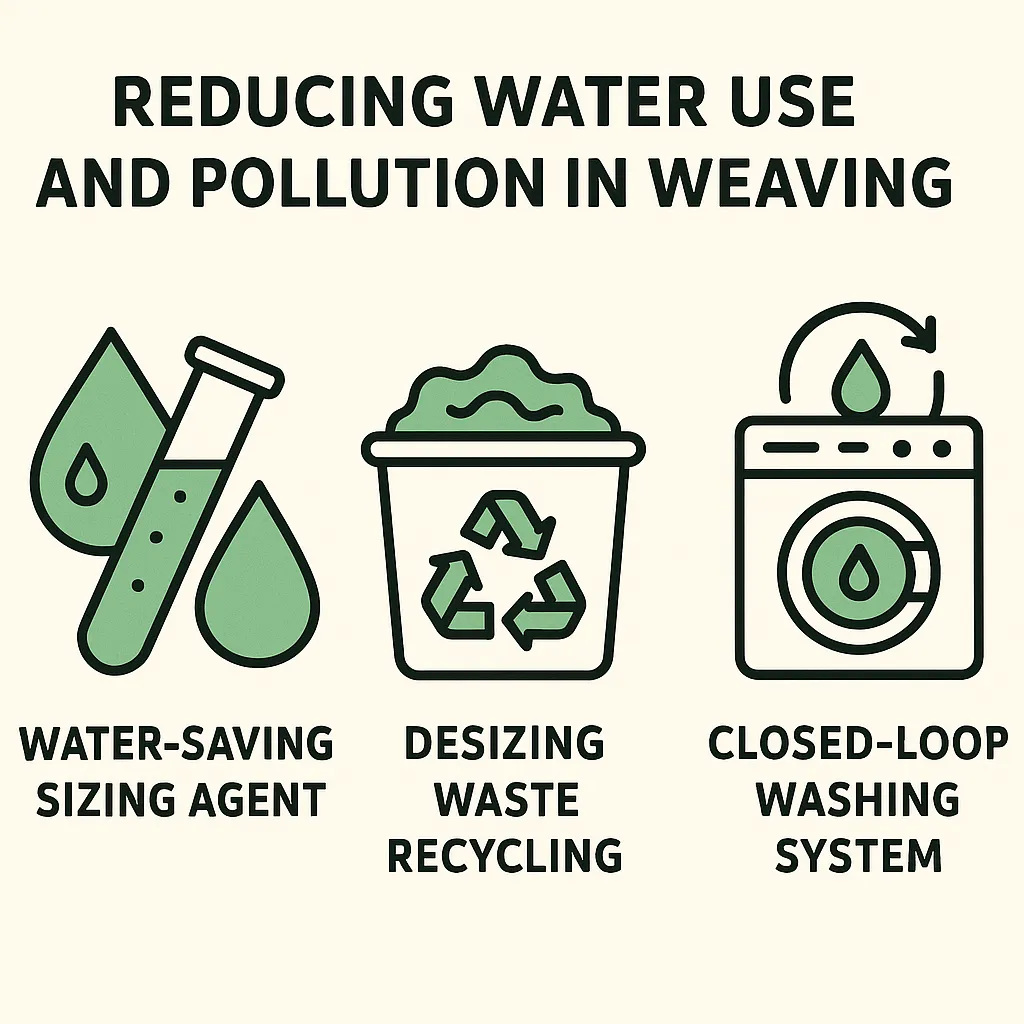
Effective reuse of desizing washwater is important. If the size polymers can be separated and recovered, the rinse water becomes reusable. For synthetic PVA sizes, ultrafiltration (UF, a pressure-driven membrane process) and related membrane processes look promising.
Recent experiments report nearly 100% PVA recovery from alkaline desizing liquor using UF membranes www.researchgate.net. One new ceramic UF membrane (MWCO ~16 kDa, where MWCO is the “molecular weight cut‑off”) kept ~100% of the PVA and gave 67 L·m⁻²·h⁻¹ flux (flux is membrane flow per area) at 80 °C and pH 13 www.researchgate.net. Another study used SnO₂/ZnO‑enhanced PVDF membranes with a cellulose nanofiber coating. It reached 98% PVA rejection with stable flux agris.fao.org. These high rejections show that post‑desizing water can be clarified and reused. The recovered PVA may go back into size formulations. The permeate, free of most polymer, can serve as makeup water.
For earthy sizes (starch, CMC), mills combine enzymatic hydrolysis (amylase) with biological treatment or membrane filtration to separate organic solids. The result is lower BOD effluent and reuse of much of the rinse water. Where biology is integrated, a compact step such as a membrane bioreactor can pair efficiently with UF or RO. Some pilot plants use coagulation/settling and low-pressure membranes to recover up to 80–90% of rinse water for in-plant cycles. In this configuration, a clarifier upstream of UF supports stable reuse.
Oxidation (ozone, UV/H₂O₂) can break down the remaining organics, but it uses a lot of energy. An improved process using UV‑C irradiation for PVA desizing claimed 67% less water use by cutting rinse steps. It also claimed about 68–83% less energy and time than conventional hot‑water desizing www.researchgate.net. In practice, a two‑stage wash is common. First, membranes capture the heavily contaminated rinse and the filtrate is reused. Then ozone or reverse osmosis polishes the water. Such schemes usually yield 70–90% water reuse. In RO service, mills usually deploy brackish-water RO as the polishing step.
Economics compare favorably when water is scarce or costly. One case study of a UF–RO reuse system reported ~US$0.44/m³ treatment operating cost www.mdpi.com. Overall, desizing effluent recycling can cut fresh‑water consumption by large fractions (often halving it) while isolating the size chemicals for proper handling or reuse www.rmix.it agris.fao.org. Where enzymes are part of the train, a precise feed system such as a dosing pump helps maintain consistent amylase activity without overdosing.
Closed‑loop washing architectures in mills
Beyond sizing and desizing, mills increasingly use closed-loop wash systems to recycle water across wet processes (scouring, mercerizing, etc.). These systems cascade rinse baths and treat a circulating stream continuously, so no effluent is discharged. This is a Zero Liquid Discharge (ZLD) configuration. Typical designs combine ultrafiltration, nano/RO, evaporation, or crystallization of concentrates www.rmix.it www.rmix.it.
One closed‑circuit pattern routes rinse effluent through filters in series: sand, activated carbon, UF, RO. The clean permeate is pumped back as forward rinse water or fresh makeup. In practice that means a sand stage, usually with a sand/silica filter. Then adsorptive polishing with activated carbon. Then pressure membranes such as ultrafiltration and, if needed, nanofiltration. Industry summaries say “closed‑loop purification systems… allow treatment and reuse of wastewater, significantly reducing consumption of fresh water” www.rmix.it.
Highlights include membrane trains that recover 90–98% of water, advanced oxidation to break down stubborn chemicals, and vacuum evaporators to recover pure water from brines www.rmix.it www.rmix.it. Trials of such systems in textile plants report 80–90% or more reduction in fresh‑water use. The EU‑funded “Waste2Fresh” project exemplifies this trend, aiming for near‑100% water reuse (multiple cycles without fresh makeup) by integrating catalytic degradation and selective separations sustainablebrands.com sustainablebrands.com.
Even simpler counterflow washers (where the cleanest rinse does the final rinse on new fabric) can cut process water by half relative to single‑bath rinsing. Investment costs are not small (membranes, energy for RO/evaporation). However, payback depends on the freshwater price and the effluent discharge fees. A 2019 reuse plant treating denim wastewater reported permeate meeting reuse quality at ~0.44 USD/m³ www.mdpi.com. That cost can be offset if fresh water costs €0.5–1.0/m³. In water‑scarce regions, or where regulation is tightening (for instance Indonesia is moving toward stricter wastewater standards), closed‑loop systems become strongly favorable.
In sum, business cases show that mills which reuse water cut fresh water purchases by over 70%, energy use for heating water by ~50%, and chemical use by 30–50%. They do this with UF/RO, AOPs (oxidation processes), or steam evaporation www.researchgate.net www.rmix.it. Some mills design these trains end to end. For them, modular membrane systems help standardize UF/NF/RO blocks across rinse loops and desize recovery alike.