

Article
Textile finishing’s water reckoning: from 250 L/kg to closed loops
Textile wet finishing can consume 100–250 liters per kilogram of fabric, but mills are cutting that to under 20 L/kg with low‑liquor machines, foam finishing, and membrane‑based recycling — and the economics increasingly work.
Industry: Textile | Process: Finishing
Wet finishing — bleaching, dyeing, washing, padding — is a water story with outsized numbers: typical dyeing/finishing uses 100–250 liters per kg of fabric (sarkengg.in) (mdpi.com). A Bangladesh survey clocked roughly 164 L/kg, with about 119 L/kg discharged as wastewater (sarkengg.in), while field studies report ~120–140 L/kg for cotton fabric dyeing (mdpi.com). That translates to roughly 120–140 m³ per metric ton. Even in mature industries, facilities often use tens of cubic meters per ton of fabric. By contrast, state‑of‑art European plants achieve ≤20 L/kg through extensive re‑circulation (sarkengg.in).
Regulators are tightening the screws. Indonesia’s Green Industry standard caps finishing water at roughly 120–150 m³/ton (~120–150 L/kg) and requires minimum reuse rates of 20% of process water (fr.scribd.com) (fr.scribd.com). Earlier regulations set a 120 m³/ton cap and only 1% recycle, but have been superseded by the stricter 2022 standards (id.scribd.com). In practice many Indonesian mills exceed 200 L/kg, which is why conservation is a front‑burner issue. Global benchmarks underscore the spread: Bangladesh mills average ~164 L/kg (sarkengg.in), India ~200–250 L/kg (sarkengg.in), Turkey 60–120 L/kg for cotton (sarkengg.in), while leading facilities in Germany and Italy target <20–30 L/kg with closed loops (sarkengg.in).
Low‑liquor‑ratio wet‑processing equipment
A basic step is low-liquor-ratio (LLR) machines. These machines reduce the “liquor ratio” (kg water per kg fabric) used in dyeing and finishing. Traditional batch dyeing ran at about 1:10 (10 kg water per kg fabric). Modern jets, winches, pads, beams and package dyeing machines run closer to 1:3–1:5. This usually cuts water use by 50–80% compared with old machines (sarkengg.in). Benninger’s new FabricMaster jet-dyeing unit is cited for “unmatched low water consumption”. Continuous pad-steam or pad-dry lines also use very little liquor (sarkengg.in).
EU BAT studies report that moving from a 1:10 to ~1:4 liquor ratio roughly doubles bath exhaustion and halves water and chemical use (studylib.net) (studylib.net). LLR applicators in finishing — foam pads, short‑range dyeing jets, exhaust winches — cut rinse volumes, and modern machines maintain near‑design liquor ratios even at low loads, avoiding a consumption spike for small batches (studylib.net) (studylib.net). Indonesia’s caps (~140–150 L/kg) effectively drive LLR adoption or heavy reuse to comply (fr.scribd.com), and in combination with counter‑current rinsing, top facilities have pushed overall water use below 20 L/kg (sarkengg.in).
Counter‑current rinsing practice
Counter‑current rinsing — fabric passes sequential tanks while fresh water flows opposite to fabric movement — reuses each rinse stage three to four times, sharply reducing make‑up water (sarkengg.in). Combined with LLR systems, industry reports indicate modern machinery alone can halve or better fresh water consumption (sarkengg.in).
Closed‑loop water recycling trains
Recycling closes the loop. Most strategies combine physical and biological treatment with reuse of spent baths and rinses. After discharge, the liquor is filtered, usually by ultrafiltration (UF, a membrane step that removes fine solids and macromolecules) or by membrane bioreactors. It then goes to reverse osmosis for high-quality recovery (pmc.ncbi.nlm.nih.gov). Membrane bioreactors (MBR, which combine biological degradation with micro and ultra-filtration) usually remove more than 90% of organics and total suspended solids (TSS). In one pilot, an MBBR–MBR train reached about 93% chemical oxygen demand (COD) removal and 99% TSS removal, with 85% color removal. The treated water met textile standards and was reused in later dyeing without color defects (pmc.ncbi.nlm.nih.gov).
For the moving‑bed step, MBBR (suspended biofilm carriers) has been validated in the same pilot. Reverse osmosis (RO) then polishes the permeate. Mills usually select brackish‑water RO when total dissolved solids are moderate. Oxidation rounds out the options. Studies on cotton reactive‑dye pad washes show that ozonation or UV–ozone removes about 95% of color and lets the mill recycle 100% of the rinse water. This cuts fresh make‑up by about 40% (researchgate.net). In UV–ozone systems, ultraviolet reactors provide the UV dose. In practice, mills use UV systems as low‑operating‑cost modules in the train. Reuse quality has held up under color checks. Fabrics re‑dyed with recycled effluent showed ΔE <1 (a small color difference metric) against virgin water (researchgate.net).
In practice, mills combine these steps in closed loops. Backwash and condensate (from steam lines) are reused internally. Without reuse, finishing rinse water usually goes straight to drain. High-efficiency mills and CETP (Common Effluent Treatment Plant) clusters, for example India’s Tirupur, are now approaching zero liquid discharge (ZLD, a design that eliminates liquid effluent). Recent reviews report ZLD reclaiming 95-98% of incoming water (link.springer.com) (link.springer.com). For larger integrated lines, standardized membrane systems help scale reuse across industrial or municipal conditions.
Policy is aligned: Indonesia’s Permenperin 40/2022 requires ≥20% of process water to be recycled (fr.scribd.com). Even a modest 20–40% recycling sharply cuts fresh intake and effluent volume; materially, reusing 1 m³ of treated water directly offsets that volume of fresh water and wastewater load.
Foam finishing and pad alternatives
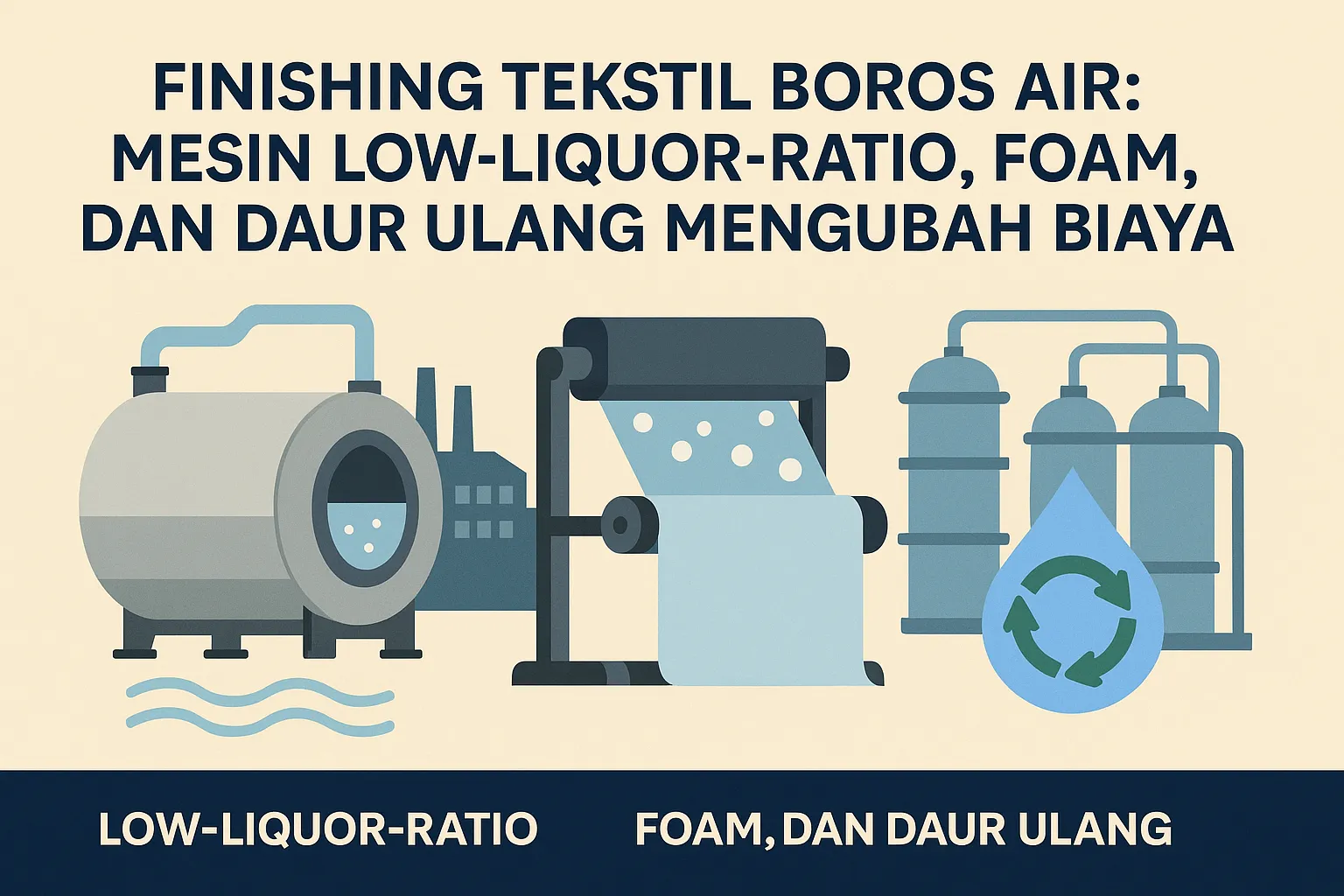
Foam finishing applies chemicals in an air–liquid foam instead of by immersion. A dye or finish is mixed into a stable foam and padded on. As the foam collapses, it leaves the chemical behind with very little water. Reports indicate that foam dyeing and finishing can use about 10% of the water of conventional methods. Overall savings range from 50–90% depending on the process (sarkengg.in). One cotton study showed a reduction of about 84.6% in chemical usage (and the corresponding water) with an optimized foam pad versus standard pad application (researchgate.net).
Commercial use covers hydrophobic (waterproofing) finishes, softeners, some reactive dyes, wrinkle‑free finishes and fleeces. It is less common on very heavy machinery fabrics. However, it works very well for garment knits and wovens. Converting pad baths to foam can greatly reduce the rinse load of a finishing mill. A pilot review noted productivity gains alongside chemical cost reductions of about 85% (researchgate.net).
Cost–benefit and payback dynamics
Water reuse is capital‑intensive — treatment trains, pumps, membranes — but savings stack up. A Spain case study of a combined MBBR–MBR system (capex €0.46M) saved on fresh water (€0.56/m³) and on discharge fees (~€0.86/m³), turning net present value positive in about two years with an internal rate of return around 18% (pmc.ncbi.nlm.nih.gov) (pmc.ncbi.nlm.nih.gov) (pmc.ncbi.nlm.nih.gov) (pmc.ncbi.nlm.nih.gov). Recycling let the plant avoid buying ≈70% of its previous water demand (the remainder lost in blowdown) (pmc.ncbi.nlm.nih.gov).
Even in Asia, where water rates vary, the business case usually clears if water costs $0.5–$1.00/m³ or higher. For example, a mill using 1000 m³/day that recycles 500 m³/day saves about $500/day (~$180k/year) when fresh water ($0.50/m³) and avoided discharge ($0.50/m³) are both counted. Against that, a modest MF/UF (microfiltration/ultrafiltration) + RO system might run $200–300k capex with ~$50k/year O&M in chemicals and energy. That implies a few‑year payback. In the cited MBR case the payback was ~2 years, and partial reuse systems (for example rinse loops only) usually show 3–5 year paybacks (researchgate.net) (pmc.ncbi.nlm.nih.gov). Compliance benefits add lift. Meeting Indonesian reuse thresholds may need an MBR if counter‑current rinsing alone cannot reach 20% (fr.scribd.com). In the Spain case high effluent quality lowered discharge taxes, improving ROI (pmc.ncbi.nlm.nih.gov). Even where discharge fees are low, smaller fresh purchases and sewage volumes deliver direct savings. Evaluations consistently show modern recycling systems recover costs in a few years, with IRRs ~15–20% in case studies (pmc.ncbi.nlm.nih.gov) (pmc.ncbi.nlm.nih.gov).
Sources and technical references
Peer‑reviewed studies, industry reports, and government standards underpin the data cited: including a 2025 review of textile water reuse (link.springer.com) (link.springer.com); Indonesian Ministry of Industry regulations (fr.scribd.com) (fr.scribd.com); dyehouse recycling case studies (pmc.ncbi.nlm.nih.gov) (researchgate.net); technology profiles and benchmarks (sarkengg.in) (researchgate.net); and EU BAT notes (studylib.net) (studylib.net).