

Article
Pulp mills are racing to strip the brown from their water. Three fixes dominate — and the price tag ranges from $0.20 to $2 per cubic meter.
Industry: Pulp_and_Paper | Process: Wastewater_Treatment
Pulp mill effluent is brown. The color comes from lignin and related organics such as chlorolignins and tannins. Mills face growing pressure to decolorize for reuse or discharge. Color is usually measured in Pt‑Co (platinum‑cobalt) or ADMI units (both are standard color scales used in water testing). Three physico‑chemical strategies dominate: coagulation/flocculation (C/F), activated carbon adsorption, and membrane filtration. Coagulation can remove about 90–96% of color, activated carbon about 95–97%, and membranes (UF/NF/RO) about 90+%. Cost estimates range from about $0.2–2 USD per m³, depending on process and region (www.mdpi.com) (www.mdpi.com).
Colored organics and measurement
Most of the color comes from high‑molecular‑weight lignin fragments and related chromophores. Large lignins (about 1,000–8,000 molecular weight) are quite easy to remove with coagulation or size‑exclusion steps (nepis.epa.gov). Mills that target reuse quality usually pair primary solids removal with targeted color treatment. Primary operations can include screens and sedimentation, and these sit upstream of the chemical or membrane units. To control solids before chemistry, facilities usually use compact clarification steps. A lamella approach is one option when space is tight, and it sits in the same treatment train as a conventional clarifier.
Chemical coagulation/flocculation mechanisms
C/F destabilizes colloids and precipitates high‑molecular‑weight organics so they can settle. Flocculation then aggregates the destabilized particles. In practice this step works well against colloidal lignin polymers and tannins.
The results are good in controlled trials. An alum dose of 1.2 g/L at pH≈6 gave 96% colour reduction in primary‑treated pulp mill effluent (www.mdpi.com). Lime (Ca(OH)₂) at ~1.4 g/L, pH≈11, removed ~91.6% (www.mdpi.com). MgSO₄ (3.4 g/L) removed ~89% (www.mdpi.com). Turbidity and TSS also went down (>90% in these trials, same sources).
The optimum pH matters. Alum worked best near pH≈6. Lime and MgSO₄ needed alkaline conditions (roughly pH 9–11) (www.mdpi.com) (www.mdpi.com). Doses usually fall in the 1–3 g/L range. Primary sedimentation goes ahead of C/F to remove large suspended solids.
Chemical metering is standardized. Mills usually pair coagulant addition with a dedicated dosing pump to hold pH and doses at their setpoints without operator drift.
Costs and residuals matter. One study estimated a full-scale physicochemical scheme (settling + coagulation + adsorption) at about $2.09/m³ of wastewater (www.mdpi.com). Adding coagulant makes sludge. In one test with 1.2 g/L alum it reached about 0.16 L per m³ (www.mdpi.com), and that sludge needs handling downstream. Coagulants are quite cheap per kg ($0.2–0.5 USD/kg for alum). However, the doses needed make the OPEX significant. In one hybrid study, an integrated coagulation–adsorption process cost about 6.78 Baht (~$0.20)/m³ (ph02.tci-thaijo.org). Some color programs add floc aids. For these, mills add flocculants after the coagulants to improve settling.
Bottom line: C/F is well-proven and scalable. It removes bulk color from colloidal lignins and suspended organics. However, residual color usually comes from smaller dissolved chromophores that pass through. It is frequently paired with a polishing step. Where footprint is tight, compact settlers can support C/F. Lamella plates are one option within conventional primary trains, alongside wastewater physical separation hardware.
Activated carbon adsorption performance
Activated carbon (AC) removes dissolved organics by adsorption. This includes hydrophobic aromatics, dyes and small lignin fragments. The carbon can be granular or powdered. In bench-scale tests, color and lignin removal reach 94–97% at moderate AC doses. One study used powdered AC made from plastic waste. It reported 96.5% color and 94.3% lignin removal at 7 h contact, 1.25 g/100 mL, pH 8 (link.springer.com). Another study reached 97% color removal with 2 g/L AC in 1 h (www.icontrolpollution.com). Typical isotherms follow Langmuir–Freundlich behavior. Equilibrium comes in about 1–7 hours, depending on agitation and dose (same sources).
The operating windows are wide. AC doses are usually 1–5 g/L (1000–5000 mg/L) with contact times of 1–4 h. Much of the removal can occur in the first hour (www.icontrolpollution.com). AC is usually used after C/F to target residual, dissolved color, or as a standalone step for concentrated streams. For polishing duty, mills source media such as activated carbon designed for organics and color removal.
Cost and handling matter. AC is expensive, about $0.5–2.0 per kg, and it must be regenerated or replaced. A large mill might use kilograms per m³ of effluent, for example 5 kg/m³ at optimum conditions in one estimate (www.mdpi.com). Spent carbon disposal or thermal reactivation adds cost. In one analysis, coagulation plus activated carbon gave an OPEX of about $2.31/m³ (www.mdpi.com). Some tropical studies report lower costs (≈$0.2/m³). This most likely reflects lower labor and chemical prices and simpler designs (ph02.tci-thaijo.org).
Scope and limits: AC is versatile and works well. However, it does not reduce TSS or inorganic load, and performance drops as the carbon saturates. On streams with very high color (for example ~20,000 Pt‑Co from bleach filtrate), AC alone can need large volumes (nepis.epa.gov). AC pairs well with upstream C/F. The C/F removes particulates and large lignins, so the AC can focus on smaller chromophores.
Membrane filtration: UF, NF, and RO
Membranes separate by size and charge. Ultrafiltration (UF, nominal molecular‑weight cutoff ~1–100 kDa), nanofiltration (NF, ~200–1000 Da), and reverse osmosis (RO, which retains virtually all dissolved organics) all target color bodies physically. A 1980 EPA pilot on kraft bleach effluent reported UF would reduce overall color by ~91%, and that UF retained 97–99% of color chromophores on a concentrate basis (nepis.epa.gov). Modern NF/RO systems are tighter. They usually achieve >95% removal of COD and color in bench tests (>90% COD/color with NF on papermill effluent, same source). Permeate is usually very clear and suitable for reuse.
Operations need discipline. Pulp waters foul. High suspended solids or colloids can quickly blind membranes. Therefore pretreatment (screening, settling, C/F) is standard ahead of membranes. Typical operating pressures are UF ~2–5 bar, NF ~10–30 bar and RO 25–60 bar. Energy can run ~0.5–2 kWh per m³. UF mainly removes high‑MW lignin fragments (about 4,000–8,000 MW) (nepis.epa.gov).
Membrane costs are front‑loaded. Plants can cost millions of USD. Membrane replacements every ~3–5 years add to OPEX, and energy is significant. Membranes are usually reserved for polishing or reuse loops. Comparative studies suggest membranes become attractive versus advanced oxidation when very high quality reuse or zero‑liquid‑discharge is needed. There is no universal cost‑per‑m³. Operational data indicate several $ per m³ including amortized capital (same source). By contrast, single‑stage UF used decades ago was judged “attractive vis‑à‑vis alternative technologies” (nepis.epa.gov).
Hardware choices follow that range. As pretreatment, mills use screening before membranes. For continuous debris control, an automatic screen reduces carryover to downstream units. For pressure‑driven separation, engineers specify ultrafiltration to remove colloids. They step up to nanofiltration for small chromophores, and use brackish water RO when near‑zero color is needed. Integrated packages such as membrane systems fit polishing or reuse plans. Fouling from oils, pitch and biocides is a real constraint. Continuous cleaning or CIP is common. Membranes do not remove free oil or inert solids, and concentrate management is needed.
Comparative performance and economics
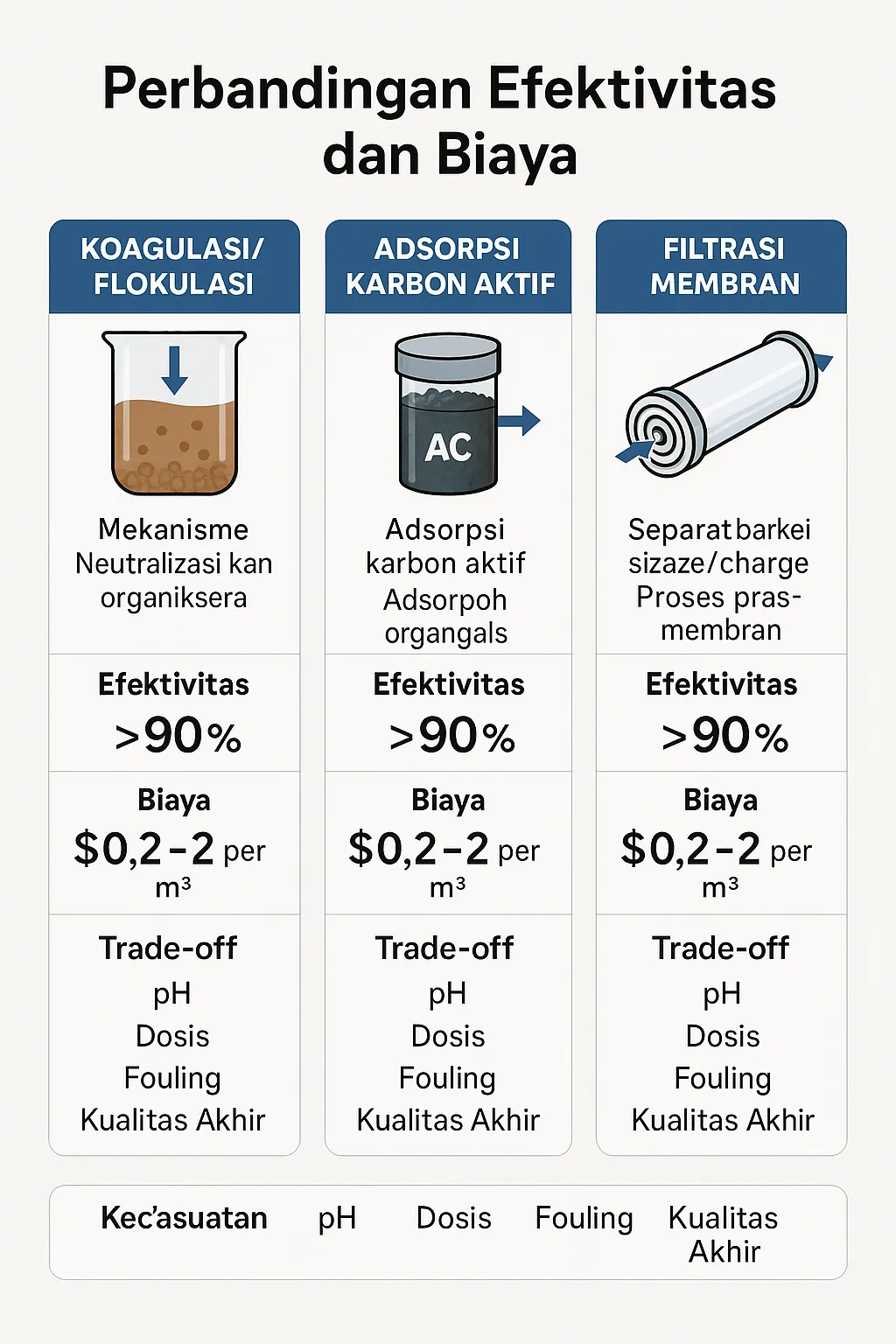
Removal efficacy: C/F can remove the bulk of colloidal color, usually more than 90% (www.mdpi.com) (www.mdpi.com). However, it usually leaves some dissolved color. AC and membranes address residual chromophores. Combined C/F + AC can give essentially colorless water, for example <37 Pt‑Co units, “no visible color” (www.mdpi.com). In multiple trials, a sequence of settling + alum coagulation (1.2 g/L) + granular AC gave final color below 50 Pt‑Co (same source). UF/NF can remove >90% of color on their own. However, they need careful pretreatment to avoid fouling.
Costs and economics: Coag/AC processes put most of the cost in chemicals and sludge handling. Reported chemical costs cluster around ~$2–2.3/m³ for coagulation plus adsorption (www.mdpi.com). In a Thailand pilot, a downstream coag+AC step was estimated at ~$0.20/m³ (ph02.tci-thaijo.org). Membranes carry high fixed costs. Typical municipal RO plants cost several $ per m³ in developing‑world settings. For a pulp mill, one analysis suggests tertiary AC polishing alone cost ~$1–1.5/m³ (www.mdpi.com).
Suitability by compound type:
- High‑MW lignin/tannin: coagulation works well and settles them, AC also adsorbs them, and UF removes them (nepis.epa.gov).
- Low‑MW chromophores/dyes: coagulation works less well, AC is good, NF/RO are best.
- Inorganic colorants/iron: not typical in pulp effluent. If they are present, coagulation (for example with PACl) can precipitate metals. AC has little effect on metals.
Regulatory context: most standards focus on COD, BOD and TSS rather than explicit color limits. For example, Indonesia’s discharge limits specify COD/TSS but not color (www.mdpi.com). However, mills that aim for reuse or aesthetic discharge usually target <100 Pt‑Co. Low color usually comes with a lower organic load.
Data‑backed outcomes and design math
In one pilot, alum coagulation (1.2 g/L) cut effluent color 96% (www.mdpi.com). Another bench test showed 97% color removal with activated carbon (2 g/L) in 1 h (www.icontrolpollution.com). An EPA report found a UF system negated ~91% of bleach‑plant color, with 97–99% retention of chromophores on a concentrate basis (nepis.epa.gov).
Chemical costs for these processes usually range from $0.2 to $2/m³ (www.mdpi.com) (ph02.tci-thaijo.org). Take a large mill that discharges 10,000 m³/d with an initial color of 5,000 Pt‑Co. Coagulation alone may reach 95% removal (to ~250 Pt‑Co) at roughly ($2/m³)×10,000 m³/d = $20,000/day in chemicals (www.mdpi.com). An AC polishing step (another ~$1–2/m³) or NF would cost more. However, a target of 80% color reduction could use a lower coagulant dose at a fraction of that cost.
Design implications and product fit
All three options significantly reduce color, but each fits a different place in the train. C/F is the lowest‑complexity, lowest‑barrier step (removal ~90–95% under optimal conditions; www.mdpi.com) (www.mdpi.com) and is often followed by AC for residual color. Membranes can deliver virtually colorless permeate for reuse but with capex, energy, fouling, and concentrate management to plan for. Many mills combine methods — e.g., settling + C/F + AC (and sometimes biological polishing) — to balance cost and effluent targets (www.mdpi.com) (nepis.epa.gov).
The choice is ultimately about targets. If near‑complete decolorization is needed, for example reuse as boiler feed or meeting strict aesthetic limits, the extra OPEX for AC or NF/RO can be justified. If only regulatory compliance on COD is mandatory, simpler coagulation (or biological treatment) may be enough. In coag trains, link the chemistry to a steady coagulants supply program and keep the pretreatment hydraulics stable. Then both color removal and costs stay stable.