

Article
Textile mills are drowning in salt. Here’s the data behind the fix — from halophiles to RO and ZLD
Industry: Textile | Process: Wastewater_Treatment
Textile dyeing and finishing effluents are not just colored. They also carry a lot of salt. Published data put total dissolved solids (TDS, a measure of dissolved salts and minerals) in typical textile effluent at 1–10 g/L (redalyc.org). Lin et al. report dye baths up to 6% NaCl (60 g/L) or 5.6% Na₂SO₄ (mdpi.com). That is a hypersaline hit by municipal standards. In a pilot case in China, membrane separation was flagged as necessary because diluted effluent still carried ~6 wt% NaCl (mdpi.com).
One complication: salinity itself is rarely regulated in Indonesian effluent standards. The rules focus on organic and toxic loads. However, mills still have to manage salt-loaded wastewater in practice (researchgate.net).
Salinity levels and sources (dyehouse TDS)
Reactive dyeing of cellulosic fabrics adds NaCl or Na₂SO₄ to neutralize fiber charge — typically 20–100 g of salt per kg fabric — driving wastewater salinity to the 1–10 g/L range, and at times to percent-level values (redalyc.org; mdpi.com). One industry was estimated to discharge ~0.2 million tonnes of salt per year (redalyc.org).
Pretreatment to remove solids and fats is needed before any further step. Primary systems such as a clarifier or packaged wastewater physical separation reduce grit and load ahead of biology or membranes.
Biological treatment under salt stress (SBR and activated sludge)
High salt impairs conventional biology. In sequencing-batch reactors (SBRs, time-sequenced activated sludge), COD removal (chemical oxygen demand, a proxy for oxidizable organics) fell by ~20% once influent TDS reached 3,000 mg/L. At 6,000 mg/L, COD removal dropped further (to ~75% of baseline) and phosphate uptake collapsed (researchgate.net). Mirbolooki et al. (2017) found that with 1 g/L TDS and moderate dye, COD removal was ~81%. At 5 g/L it fell to ~59%. At 10 g/L it plummeted to ~15%, with biomass wash-out above 5 g/L (redalyc.org).
Nitrification sometimes endures — >97% even at 6,000 mg/L in one SBR study — but phosphate removal failed above ~1.5 g/L (researchgate.net), and other studies show 0.5–5% salt cuts nitrifier kinetics by >20% (redalyc.org). The mechanisms are well known: osmotic stress on microbes and impaired oxygen transfer. In practice, traditional aerobic systems perform well only up to ~1–3 g/L TDS and degrade rapidly beyond that (researchgate.net; redalyc.org). Facilities running batch-mode biology can benchmark these limits against a sequence batch reactor.
Salt-tolerant bioprocess options (halophiles, AGS, MBR/MBBR)
When full desalination is not feasible, halotolerant or halophilic (salt-loving) consortia can carry the organic load. One mixed culture from Tibetan salt-fields fully decolorized 600 mg/L of azo dyes (Congo Red, Direct Black G, Amaranth, Methyl Red, Methyl Orange) in 8–24 hours under anoxic conditions. It tolerated 0–80 g/L NaCl, and decolorization stayed fast even at 60+ g/L (pmc.ncbi.nlm.nih.gov).
Aerobic granular sludge (AGS) seeded with halophiles kept stable 0.8–1 mm granules and high EPS production (extracellular polymeric substances, the biofilm glue) at 40–85 g/L salt. Conventional sludge granules collapsed beyond about 20–40 g/L. At 85 g/L NaCl the halophile reactor still produced EPS and held about 100 mg Na⁺/g biomass (against 125 mg/g for ordinary sludge). Therefore its osmotic regulation was better (liebertpub.com).
Biofilm systems such as moving bed bioreactors (MBBR) and membrane bioreactors (MBR, biology paired with ultrafiltration) can deliver good COD removal up to a few g/L salt, though large-scale data for saline MBRs in textiles remain scarce (researchgate.net; liebertpub.com). The takeaway: halophilic reactors can handle ~50–80 g/L NaCl, whereas conventional sludge must stay under ~3–5 g/L (liebertpub.com; pmc.ncbi.nlm.nih.gov).
Membrane desalination trains (UF/NF/RO/ED)
To remove salts outright, reverse osmosis (RO) and related membranes do the heavy lifting. One hybrid reached 99.95% salt removal after ultrafiltration (UF, a fine physical sieve that usually pretreats RO). The ultrafiltration step at 5,000 Da MWCO first concentrated the dyes (from about 998 to 7,953 mg/L) and let nearly all NaCl/Na₂SO₄ pass (>99.42%). Then high-pressure RO or bipolar-membrane electrodialysis (BMED) removed the salts. The result was essentially complete desalination with dye recovery (pubs.acs.org). In continuous full-scale practice, RO can usually achieve 90–98% salt rejection with recovery ratios up to 70–80%.
Pretreatment is not optional. RO is sensitive to fouling by organics and color. Flotation, coagulation and UF/NF are standard. NF is nanofiltration, a tighter membrane that targets multivalent ions and larger organics. Mills usually combine a DAF unit and coagulants upstream of ultrafiltration. Where hardness or larger organics make RO harder, nano‑filtration can reduce the load.
Hardware scale and energy are significant. A Chinese reuse plant (50,250 m³/d) needed 5,280 RO membranes ($500 each) and 1,224 UF membranes ($2,167 each). That implies about $1.41M in membrane inventory and about $1.41M/year in replacement costs (mdpi.com). Typical RO energy use at 25–40 bar is about 3–6 kWh/m³. For feeds in the 1–10 g/L TDS band, brackish-water skids such as brackish-water RO cover the core range. However, percent-level salinity pushes designs toward higher-pressure trains, including sea-water RO configurations.
Concentrate management is still the hard part. At 70–80% recovery, 20–30% of the inflow becomes brine at 5–10× the feed salt concentration. Hybrid NF/RO trains usually reach about 75–80% recovery (researchgate.net). After that, oxidation, electrodialysis (ED), thermal evaporation or crystallization handle the rest (researchgate.net). Electrodialysis stacks, especially BMED, can split salts into acids and bases. Lin et al. removed the dye with TUF (tight ultrafiltration, a fine-pore UF) and then converted Na₂SO₄ into H₂SO₄ and NaOH while making ultrapure water. This turns “waste” salt into chemicals and comes close to ZLD (pubs.acs.org). System integrators usually put such steps together in modular membrane systems.
ZLD strategies and economics (closed-loop reuse)
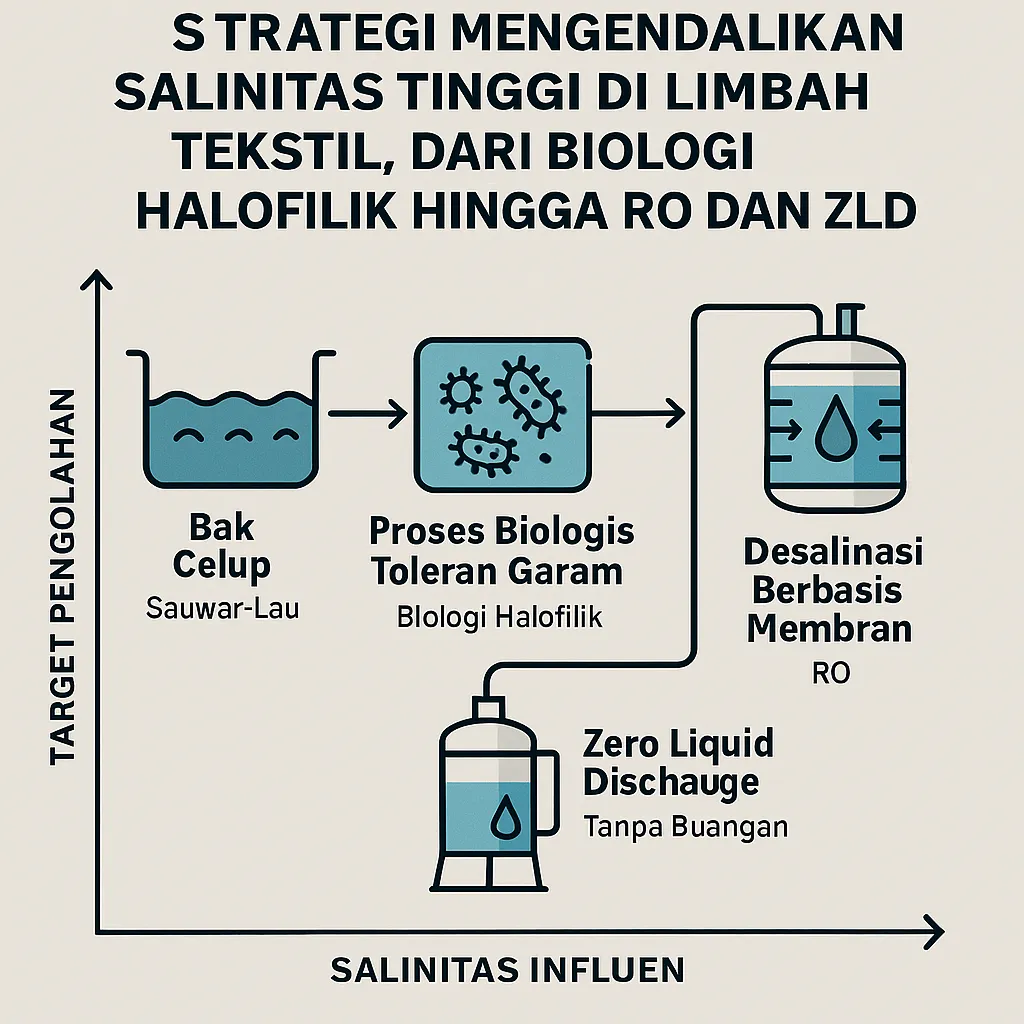
ZLD (zero liquid discharge) means no wastewater is discharged. All water is recovered or evaporated, and only salts and solids leave the gate. A typical ZLD train has four steps. First, pretreatment by flocculation and sedimentation. Second, biological treatment or equalization for BOD/COD (biological oxygen demand/chemical oxygen demand). Third, a membrane cascade (MF/UF → RO/NF) that reclaims about 70–90% of the water. Fourth, brine concentration with thermal evaporators or ED/crystallizers to handle the last 10–30%. The end result is nearly 100% water reuse. Reviews single out the textile and desalination sectors as ZLD-successful (sciencedirect.com).
The advantages are clear: no effluent discharge, a much smaller freshwater draw (usually more than 90%), and possible recovery of dyestuffs (via UF), precipitated salts, or acids and bases (via BMED). The challenges are equally clear: energy and capital. Jahan et al. (2022) note that OPEX and CAPEX are far greater than with traditional methods, and that many ZLD schemes are proven only at pilot or small scale (mdpi.com).
Practical examples in Asia include a Chinese design at 75,000 m³/d (UF/RO followed by crystallizers) that targets >95% water recovery. An Indian ZLD system (50 KLD lab sale) claims full reuse. With careful integration, for example absorbent heat exchangers for brine evaporation or hybrid ED, net water recovery can approach 98–99%. One TUF–BMED pilot turned a concentrated 8% Na₂SO₄ stream into pure water and H₂SO₄/NaOH, which is a near-ZLD outcome (pubs.acs.org).
Across designs, reported outcomes cluster around >90% water reuse, >95% salt recovery, and very low liquid waste. Some membrane-ZLD designs target a 100% closed loop (excluding small blowdowns). A review notes that textile companies “can achieve an almost full recovery and reuse of wastewater using RO and other membrane techniques.” However, system energy may double compared to conventional treatment (sciencedirect.com).
Design implications and the bottom line
Typical textile salinity — 1–10 g/L — is one to two orders of magnitude higher than domestic wastewater, and conventional plants suffer. Salt stresses slow bacterial metabolism, reduce sludge activity, and can collapse granular flocs. Halotolerant biology can shoulder much of the organic load up to ~5–10 g/L salt (redalyc.org; liebertpub.com), while membranes can strip salt entirely and produce reuse-quality water — with a concentrated brine to manage (pubs.acs.org; sciencedirect.com). The ultimate play, ZLD, closes the loop via combinations of these technologies. Data from research and field pilots show water recoveries above 90–95% are achievable, at the expense of higher energy and power draw (sciencedirect.com; mdpi.com).
Sources and notes
Peer‑reviewed studies, industry case reports and reviews underpin these figures. Examples include an SBR study quantifying COD removal vs. TDS (researchgate.net); a granular reactor paper demonstrating organism survival at 85 g/L salt (liebertpub.com); advanced membrane research documenting 99.95% desalination of textile dye water (pubs.acs.org); global reviews of textile ZLD emphasizing high recovery but energy/cost barriers (sciencedirect.com; mdpi.com). For regulatory context in Indonesia, see (researchgate.net); for salinity loads and dye-bath salt additions, see (redalyc.org; mdpi.com). A large Chinese plant’s membrane counts and costs are documented here (mdpi.com). Hybrid NF/RO concentrate handling options, including oxidation, are reviewed here (researchgate.net).