

Article
Textile finishers are sitting on a heat mine. Here’s how mills are reclaiming it — and slashing energy use.
Up to ≈40% of a stenter dryer’s input energy blows out the stack as humid exhaust. Finishing lines typically pull 0.3–0.5 kWh per kg of fabric — and much of that is recoverable, or avoidable, through wastewater heat recovery, low‑temperature finishing, and smarter drying.
Industry: Textile | Process: Finishing_&_Coating
Finishing and coating are still among the steps in textiles that use the most energy. This covers bleaching and scouring, drying, curing and functional finishes. One analysis found that about 40% of a stenter dryer’s input energy is wasted in humid exhaust air (researchgate.net). In practice, typical finishing machines (stenters, dryers, curing ovens) need about 0.3–0.5 kWh per kg of fabric. Therefore efficiency upgrades pay off unusually well.
Below is a data-based look at three levers. The first is capturing heat from hot wastewater and exhaust to preheat incoming streams. The second is low-temperature finishing. The third is optimizing the drying line. Definitions on first mention: stenter (a tenter-frame dryer that stretches and dries fabric), CPB (cold-pad-batch, chemicals padded at room temperature then held to react), COP (coefficient of performance, a heat-pump efficiency ratio), and TOE (tonne of oil equivalent, an energy unit).
Waste‑heat recovery from effluent and exhaust
Modern lines now route dirty exhaust and hot wash/rinse water through heat exchangers or heat pumps. The heat goes back into process air or fresh water. Air-to-air and air-to-water exchangers on drying lines can raise inlet air temperature by tens of °C. Therefore the dryer has more capacity and needs less fuel (kohantextilejournal.com). Brückner’s ECO-HEAT uses plate/tube exchangers to warm fresh drying air from exhaust. A second-stage COP system then heats water for reuse (kohantextilejournal.com).
The impact is large. One case study reported that a waste-heat recovery boiler (2.7 t/h) driven by on-site generator exhaust saved about 15,094 MWh per year (about US$141,000) (researchgate.net). A heat exchanger on a stenter to preheat inlet air saved about 10% of the stenter’s energy use (researchgate.net). A shell-and-tube exchanger on dyebath effluent gave about 5,716 MWh/yr (about US$47,100) by preheating fresh water (researchgate.net). That is about 0.35–0.5 kWh saved per kg of finished fabric.
Other projects show the same order of magnitude. An EU wash-water heat-pump project (1988–90) reported annual savings of 5,880 MWh (≈870 TOE). It used an industrial heat pump and exchangers on textile rinse water (cordis.europa.eu). A model of a heat-pump + storage system found it could cut dyeing energy by 0.3–0.4 kWh per kg of fabric, about US$513,000 annually (mdpi.com).
In stenter dryers, one analysis found the exhaust contained about 884 kW of energy. Recovering it onto inlet air gave 7% savings, or 21% if used to heat water/steam (researchgate.net). Research by Cinar & Ceylan showed a stenter fitted with exhaust heat recovery used 13.6% less fuel (researchgate.net). Across plants, waste-heat boilers, economizers and condensate recovery together usually trim 5–15% of plant energy demand (researchgate.net) (researchgate.net).
Summary: heat recovery usually reclaims about 5,000–15,000 MWh/year. Payback takes months to a few years. The figures above work out to about 10–50 kWh saved per kg of material (or per ton of processing), depending on scale. In Indonesia, the EnaTex project showed that combining such measures with low-liquor finishing could save up to 40% of energy in finishing-related processes (fona.de) (fona.de).
Where wastewater heat is tapped to preheat incoming fresh water upstream of finishing operations, plants usually align the loop with standard water‑treatment assets such as supporting equipment and membrane pretreatment like ultrafiltration where appropriate.
Low‑temperature and alternative finishing
Conventional padding and high-temperature curing can be replaced or supported by low-temperature steps. Examples are cold-pad-batch (CPB), plasma or ultrasound treatments, enzyme-based finishes, and high-solids/UV-curable coatings. These methods run near ambient temperature or need very little heat.
CPB pads reactive or finishing chemicals and lets them fix at room temperature over hours, avoiding high‑heat curing. Industry guidance reports that cold‑batch pretreatment can reduce energy use by ~20–30%, and China’s textile guidance notes that replacing a continuous 95 °C bleaching step by a 40–75 °C low‑temperature process “大幅降低能耗” (drastically lowers energy), with cotton CPB pretreatment saving ≈30% versus conventional high‑temp processing (shanghaiinvest.com) (shanghaiinvest.com).
Biochemical agents (e.g., enzymes for softening or anti‑pilling) often work at 30–50 °C. Patented processes report that replacing chemical finishes with white‑rot enzymes or cold‑compatible catalysts can cut heating demand by 30–45%. One low‑temperature cotton finishing patent states “低温工艺降低能耗45.8%” (a 45.8% energy reduction) versus the standard process; a biochemical variant still saved ~36% (patents.google.com) (patents.google.com).
Ultrasound integrated into pad baths or jet systems accelerates finishing reactions, allowing less heat. An equipment report cites up to 50% reduction in energy consumption and ~30% less chemicals/water versus ordinary padding (textile-network.com). The Indonesian EnaTex project highlighted ultrasound as a key energy‑saving innovation (fona.de) (fona.de).
Dry alternatives matter too. Cold plasma can give effects such as water repellency and antimicrobial coating in seconds at room temperature. Therefore no curing ovens are needed. High-solid or UV-curable coatings usually need less than 80 °C of thermal input. Traditional waterborne finishes need 100–150 °C. Switching to 100%‑solid or UV coatings can cut drying energy by about 25–50% (estimates from coating industry sources).
In practice, these methods combine. EnaTex combined a “minimum application” technique — applying finishes only on one fabric side with minimal liquors — with ultrasonics, concluding up to 40% of finishing energy could be cut (fona.de) (fona.de). Studies also report that modern lines implementing cold pad and enzyme steps routinely consume ~0.3–0.4 kWh/kg rather than ~0.6–0.7 kWh/kg (mdpi.com).
Summary: low‑temperature options can halve or more the heat input required. Published examples include ~30% savings from CPB (shanghaiinvest.com), up to 50% from ultrasound enhancement (textile-network.com), and up to ~46% from lab‑scale low‑temp processes (patents.google.com). In Indonesia, recent guidance (the 2024 “Green Low‑Carbon Technology Guide” for printing/dyeing) highlights 40–75 °C bleaching versus 95 °C conventional, noting “大幅降低能耗” (shanghaiinvest.com).
As plants tighten chemical application and lower liquor ratios, accurate metering becomes a control point next to the thermal steps. It is common to specify dosing pumps for that job.
Drying line optimization and control
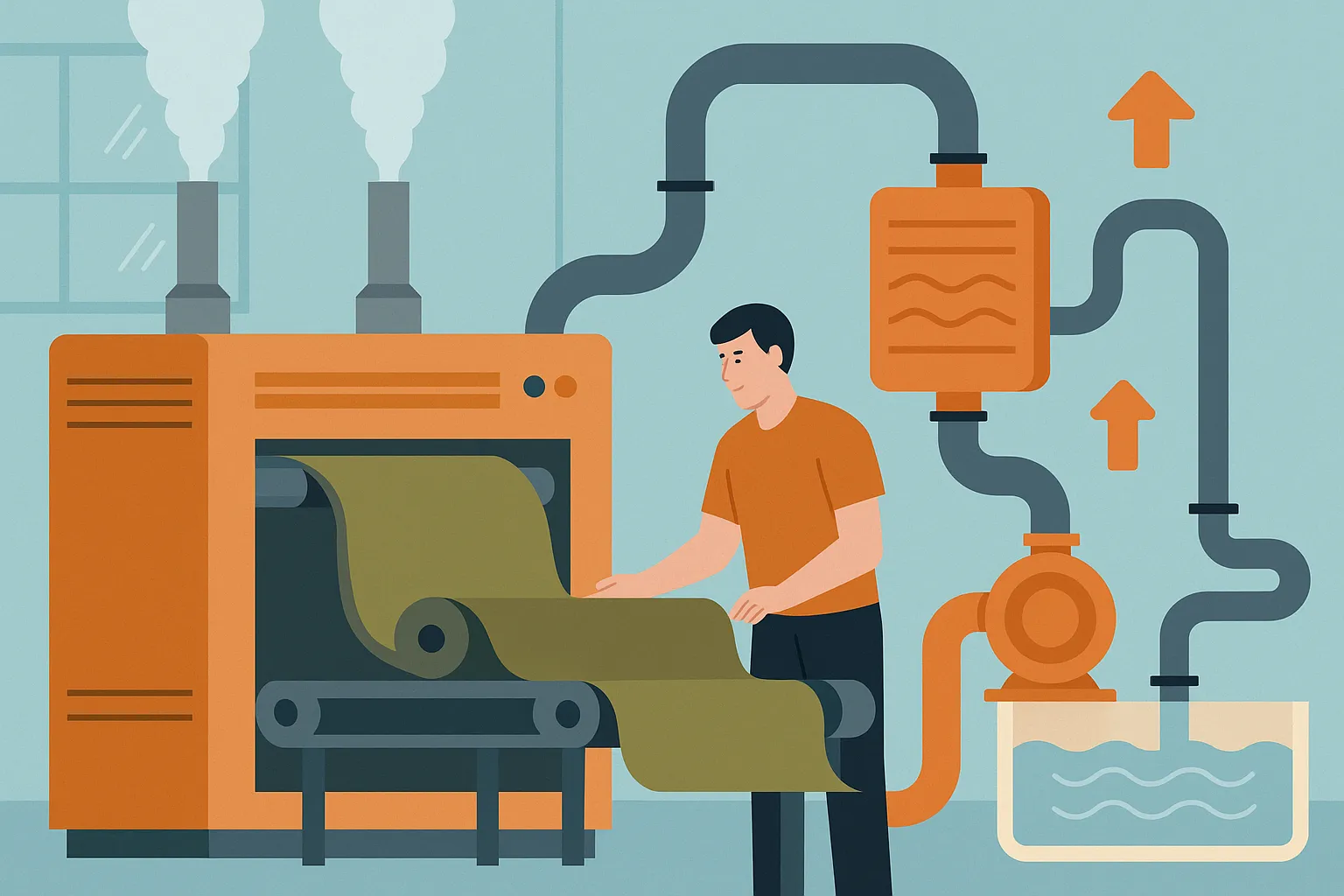
Dryers (stenters, oscillators, IR dryers, curing tunnels) are usually the largest energy consumer. Upgrades center on heat integration, airflow control, insulation, and smarter control schemes. A study of a 10‑chamber stenter found that with the best settings (max air recirculation, supported by insulated chambers), energy use dropped by ≈10% versus baseline (researchgate.net), mitigating the ≈40% exhaust loss noted earlier (researchgate.net). A related parametric study concluded that “fabric speed, operating temperature, and recirculation ratio need to be kept as max as possible without altering quality,” yielding ~15–20% savings (researchgate.net).
Exhaust heat recovery comes on top of that. The same stenter analysis measured about 884 kW in humid exhaust. Using it to preheat inlet air cut heat demand by 7%. Using it to heat water or steam cut heat demand by 21% (researchgate.net). In practice, controlled stenters with exhaust heat recovery show fuel savings of about 10–14% (researchgate.net) (researchgate.net).
Controls and sensing are the other lever. Moisture or temperature sensors can end drying as soon as the fabric reaches its target moisture, instead of running fixed cycles. This can cut process time by 10–30%. Profiling machine speed to match load prevents over-drying. Data analytics are emerging to optimize drying, and benchmarks suggest about 10% extra savings are possible. Industrial reports, though outside peer-reviewed literature, indicate gains of 5–10% from such control upgrades.
An exhaust air cleaning upgrade can dovetail with heat recovery. Integrated systems (e.g., Brückner ECO‑AIR) strip oils/chemicals and reduce exhaust heat loss, and can also reduce overall energy cost by pre‑cooling and filtering exhaust to recover heat (kohantextilejournal.com) (kohantextilejournal.com).
Summary: tuning stenter speed/flow delivers ~10% savings (researchgate.net), with another ~7–14% via exhaust heat recovery (researchgate.net) (researchgate.net). In combination with the waste‑heat systems above, drying energy use can be cut by 20–30% or more.
What the combined roadmap delivers
Taken together, wastewater and exhaust heat recovery to preheat incoming utility streams “atomizes” tens of GWh per plant per year (researchgate.net) (cordis.europa.eu). Low‑temperature and dry‑chemistry finishing eliminates boiler heat demand by ~30–50% (textile-network.com) (shanghaiinvest.com). Smarter drying adds double‑digit savings (researchgate.net) (researchgate.net).
Case evidence underscores the ROI: one mill recovered ≈15,094 MWh/yr (US$141k) via waste‑heat boilers (researchgate.net), and an industrial heat‑pump project delivered ~5,880 MWh/yr (cordis.europa.eu). In Indonesia, regulatory trends (new Green Industry Standards and low‑carbon technology guidance) reinforce these approaches; EnaTex’s combined measures achieved up to 40% energy cuts in finishing contexts (fona.de) (fona.de).
For mills that combine thermal upgrades with water-system housekeeping, the vendors include standard clarifications and filtration. See also water‑treatment ancillaries as part of project scope planning.
Sources: peer‑reviewed analyses, technology pilots, and industrial technical notes underpin all data points above: researchgate.net; cordis.europa.eu; mdpi.com; textile-network.com; shanghaiinvest.com; researchgate.net; researchgate.net; kohantextilejournal.com; kohantextilejournal.com; fona.de; fona.de; patents.google.com.