

Article
Textile mills are drowning in salt. Here’s the playbook to treat it—and when to go ZLD
Industry: Textile | Process: Highly_Colored_Effluent_Treatment
Dyehouse effluent has a lot of salt. This is not a fault in the process. Reactive dyes need large doses of NaCl/Na₂SO₄ (30–60 g/L) to fix. Therefore the wastewater leaves with 1–10 g/L total dissolved solids (TDS), which is about 0.1–1% salinity (Elsevier). Sampling in the field has found 12.6 g/kg (~1.26%) salt. That is about one third of seawater salinity (IWA Publishing).
The colour and the organics are also very high. COD is in the hundreds of mg/L and colour goes up to 652 Pt‑Co mg/L (IWA Publishing). There are surfactants and sulfates too. Then the treatment problem becomes clear. Indonesian regulations (PermenLH 5/2014 and amendments) set strict limits on COD, BOD, colour, heavy metals and more. However, they do not set salt levels. In practice you need to manage salinity for two reasons. High-salt discharges can fail general effluent tests, so the downstream biology must stay stable. Salinity control also makes water reuse possible.
Reactive dyeing salt loads and impacts
Biology is the first casualty when salinity rises. Above ~5–8 g/L, most sludge bacteria are stressed and treatment performance drops (Elsevier). In one lab study, COD removal fell from ~80.7% at low salt to 59.4% at 5,000 mg/L, then to only 14.9% at 10,000 mg/L (Elsevier). Dye removal also dipped (~60% at 5,000 mg/L TDS) and collapsed near 10,000 mg/L (Elsevier, Elsevier).
Those figures set the limits. Conventional activated sludge must be adapted. If it is not, it risks missing the BOD/COD targets at textile dyehouse salinities.
Salt‑tolerant biological operation
Two things change the outcome: the organisms and how you run the plant. Halophilic and halotolerant microbes, and acclimation, can extend performance. For example, adding Halobacter halobium to activated sludge gave effective COD removal in 1–5% NaCl wastewater (ResearchGate). A Salinivibrio strain decolorized high-strength dyes in saline media (up to 3 g/L dye) with >80% efficacy (PMC). Mixed consortia, through gradual acclimation or bioaugmentation, can tolerate up to about 5 g/L, and in special cases up to 10 g/L. However, performance drops steeply as salinity approaches 1% (about 10,000 mg/L) (Elsevier).
On configuration, sequencing batch reactors (SBRs) are commonly chosen for saline effluents and are well‑suited to variable loads (Elsevier). An SBR treating real dye effluent (~1–1.3% salinity) achieved ~70% color removal (IWA Publishing), but COD and sulfate removal required an external carbon source—molasses—to reach 87% sulfate reduction versus 23% untreated (IWA Publishing). High salinity can push sludge to rely on cosubstrate (ethanol/methanol/molasses) for stability (IWA Publishing).
Operations usually run anaerobic and aerobic steps in sequence. The anaerobic step breaks azo bonds. The aerobic step degrades amines. Plants that want this flexibility usually choose a sequencing batch reactor and pair it with biological digestion support. For stable dosing of external carbon, a metered dosing pump is standard practice. Performance summary: with acclimation and selection, biological reactors can handle moderate salinity (up to ≈5 g/L) and give ~60% COD/dye removal at 5,000 mg/L TDS. However, at ~10,000 mg/L (~1%) performance falls to <20% removal (Elsevier, Elsevier). Biology does not remove salts. It is a load‑reduction stage before physical desalination.
Membrane desalination for salt removal
Reverse osmosis (RO) is the main industrial method to remove dissolved salts. Typical salt rejection is >95–99%, especially with ultrafiltration (UF) pretreatment (MDPI). In practice, RO comes after sedimentation, UF, granular activated carbon (GAC) and similar barriers that control fouling. One textile case combined ozone + nanofiltration (NF) + RO + ion‑exchange to treat RO brine. It reached 77% water recovery and 66% NaCl recovery (ResearchGate). The plant converted 115,000 m³/yr of effluent to reused water and 680 t NaCl. That saved about $176k in water and $37k in salt, and it supports a zero liquid discharge objective (ResearchGate).
RO’s downside is brine: 5–10% of influent volume, carrying all the salts and residual dyes/organics. This reject often reaches ~50,000 mg/L TDS (EP‑BD), demanding further treatment. Plants typically protect membranes with pretreatment like a clarifier and GAC—commercially, activated carbon—and upstream solids control. UF and NF are standard steps: an industrial UF–NF installation in Italy’s Prato textile district removed >98% hardness (PMC), producing permeate with hardness <9°f (less than 160 mg/L as CaCO₃) and Cl⁻ <500 mg/L (PMC); bench tests of spiral‑wound NF showed ~96–98% hardness and ~79–86% chloride removal from brackish water (PMC), with typical NF/RO rejection rates of ~85–98% for hardness and chlorides reported (PMC, PMC).
For textile effluents in the brackish range, mills use ultrafiltration as pretreatment, nano‑filtration for divalents and dyes, and RO sized for feeds up to about 10,000 mg/L TDS via brackish‑water RO. Where needed, ion‑exchange polishes the ion removal. Electrodialysis (ED) can also desalinate by moving ions through membranes. RO and ED are cited as the only practical desalination methods for textile effluent (MDPI). However, ED alone is rarely used at full scale in this sector. Membranes foul, so plants pair pretreatment with periodic membrane cleaning and dose antiscalants to manage scaling. A brine management step is always needed.
Zero liquid discharge architectures
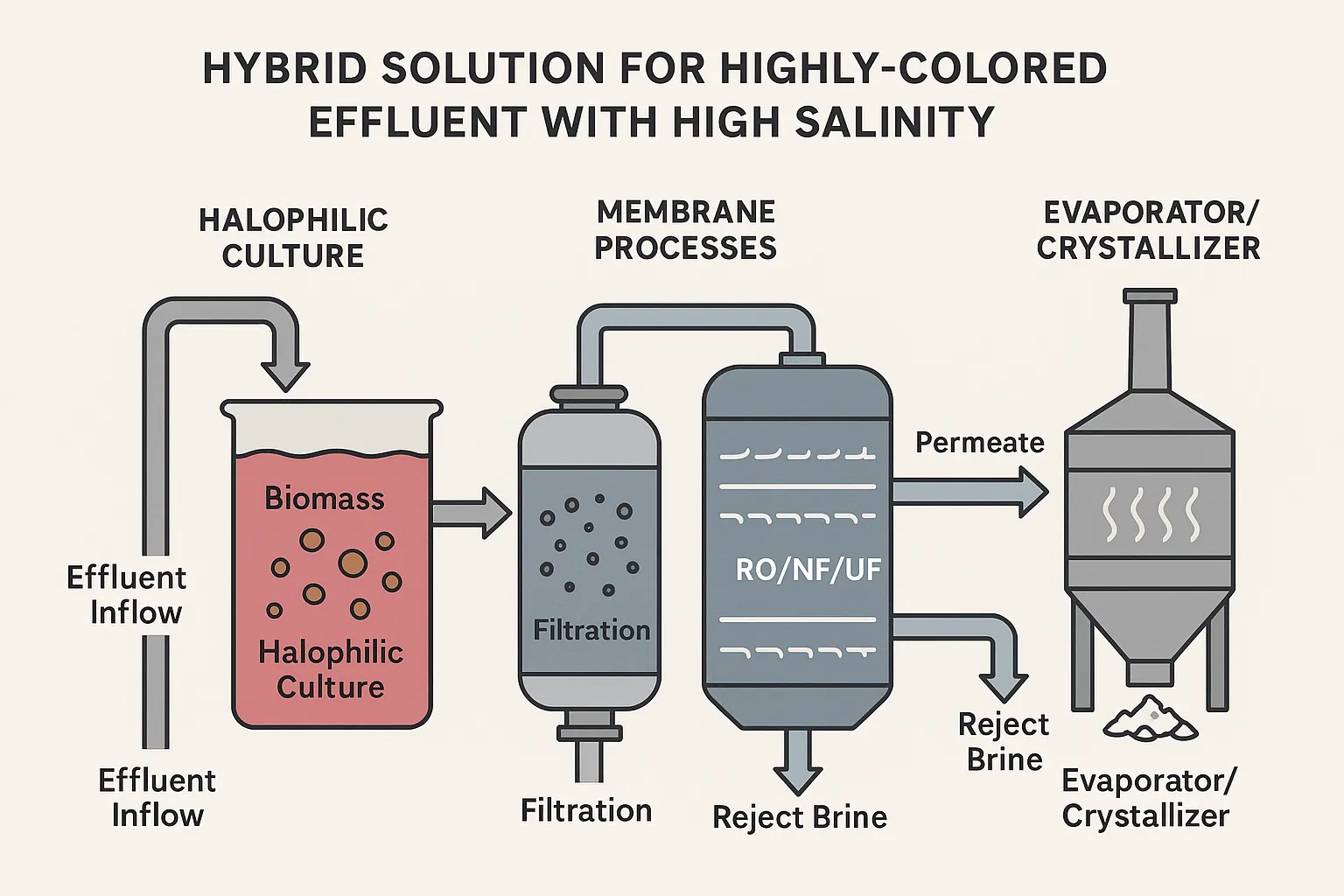
Zero liquid discharge (ZLD) means no liquid effluent. Only solids leave the site, such as sludge or salt crystals. In practice, ZLD stacks membranes with thermal concentration. A typical train is coarse filtration/clarification → UF/GAC → RO → (optionally ED) → thermal concentration. RO brine goes to evaporators/crystallizers, either multi‑effect units or mechanical vapor recompression. If land is available, it can also go to solar evaporation ponds. Electrodialysis or membrane distillation can work as intermediate concentration steps before thermal evaporation.
The payoffs are compelling. One study reported ~77% of influent volume and ~66% of NaCl recovered for reuse (ResearchGate). In Indonesia, industry seminars report water‑recycling systems achieving >80% reuse of plant water (JPNN). A brine‑recovery scheme projected 115,000 m³ water and 680 t salt per year reused, saving ~$213,000 annually (ResearchGate).
The hurdles are equally real. A typical ZLD textile plant uses ~35% more energy (and carbon emissions) than a conventional plant, largely due to thermal brine treatment (ResearchGate). RO rejects (~10% of volume) can reach ~50,000 mg/L TDS, making disposal energy‑hungry (EP‑BD). In India, regulators require ZLD for dyeing units >25 m³/day (Fibre2Fashion), but industry cautions that without cheap energy or careful design, ZLD can be economically burdensome.
These trade-offs lead many plants to hybrids. They recover salt or water in steps, for example partial rinse reuse or cascade RO, to shrink the load before any full ZLD. In Indonesia, vendors are exploring systems that recycle more than 80% of textile effluent internally (JPNN). Good deployments put salt-tolerant bioreactors before desalination, then stage membranes and evaporation. Plants usually anchor such trains with integrated membrane systems and adapt pretreatment to the waste matrix.
Design and decision factors
Three rules of thumb emerge from recent data. First, membranes are the only practical way to remove the bulk of dissolved salts (RO/ED), targeting 95–99% removal (MDPI). Second, salt‑tolerant biology can still cut organics and color by ~50–80% at moderate salinity, enabling cleaner feeds to membranes (IWA Publishing, Elsevier). Third, integrated systems report water reuse rates of 75–90+% (ResearchGate, JPNN)—but with ~2–3× higher energy/carbon demand for ZLD versus conventional treatment (ResearchGate).
That makes piloting important. Run SBRs at actual salinity to measure COD and color removal. Test UF, NF and RO rejection and fouling. Map brine disposal or recovery, and the costs of partial versus full ZLD. Example outcomes already cited help bound expectations: RO, NF and ion‑exchange reached 77% water and 66% salt recovery, and a case with 115,000 m³ water plus 680 t salt reuse saved about $213,000 a year (ResearchGate). To support pilot trains, operators usually include a clarifier upstream and pretreat RO with UF to reduce fouling risk.
Recent studies and industry reports say the same thing. Some level of salt and water recovery, if not full ZLD, is becoming necessary for textile plants to meet rising regulations and sustainability goals. Full salt recovery can save hundreds of thousands of USD per year in water purchases (ResearchGate). However, the high capital and energy cost of thermal brine treatment offsets this.
Sources and methods
This guide draws on peer‑reviewed studies, industry reports, and regulations, including treatment trials with high‑salt textile effluent (IWA Publishing, Elsevier), membrane reuse case studies (ResearchGate, PMC), and ZLD assessments (ResearchGate, ResearchGate). These sources underpin the performance figures and outcomes cited. For plants building out pretreatment to stabilize membranes, options include GAC units and integrated membrane systems tailored to textile loads.