

Article
Textile plants are drowning in sludge. The fix is mechanical — and it can pay.
Industry: Textile | Process: Highly_Colored_Effluent_Treatment
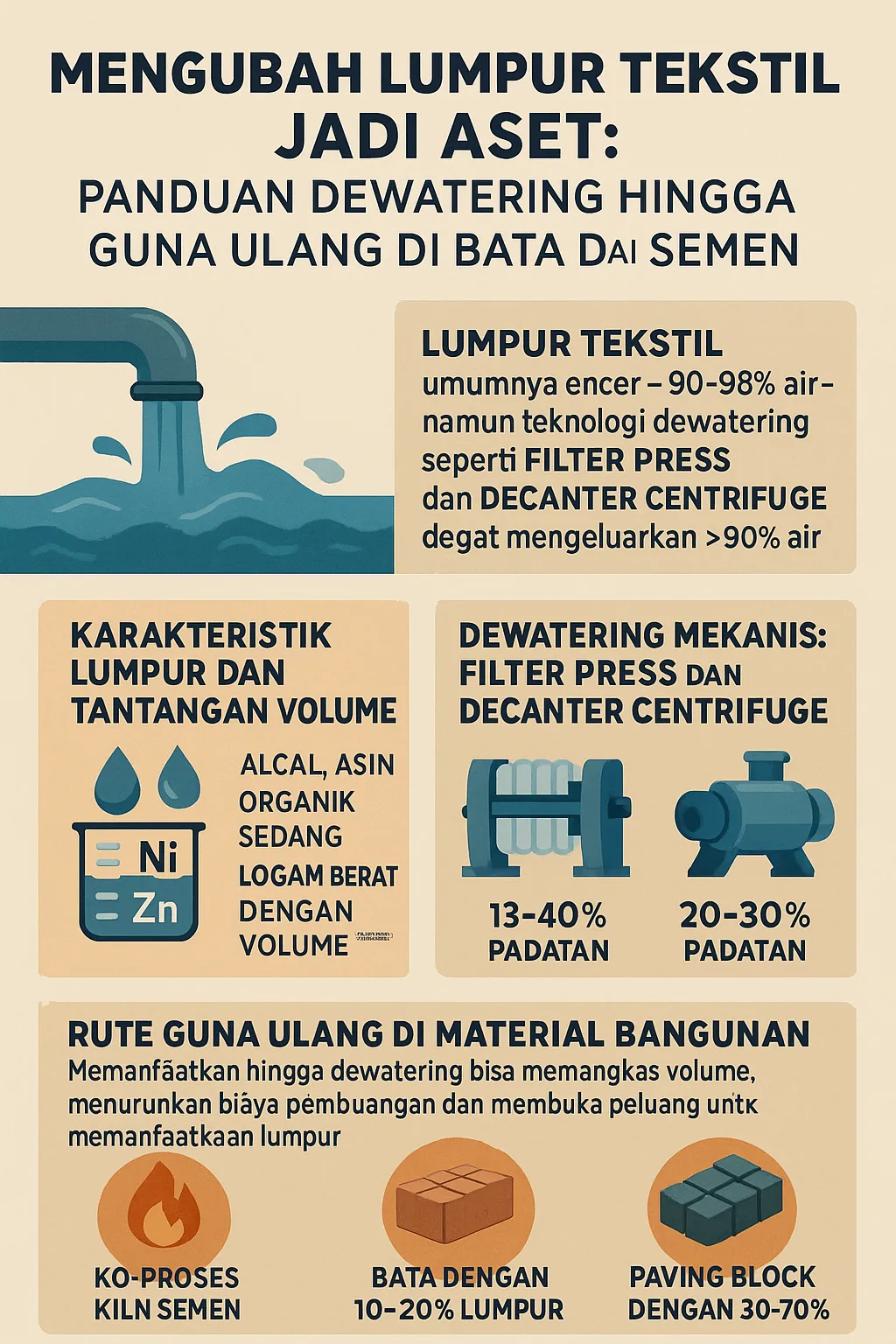
Textile wastewater treatment does not end when the water runs clear. It ends when the sludge is under control. After biological and physicochemical treatment, plants are left with a dilute sludge that is about 90–98% water. Zero-liquid-discharge (ZLD, meaning all wastewater is recovered and none is discharged) facilities can produce “enormous” quantities. Ethiopia’s industrial parks alone generate on the order of 30,000 tonnes per day of partially dried sludge (NCBI).
What is in it? Analyses point to alkaline, saline sludge (high conductivity) with moderate organic content (TOC, total organic carbon, ~1.2–17.8%) and a calorific value ≤~2,066 kcal/kg (ResearchGate). Expect residual dyes and heavy metals such as Cr, Ni, Cu, Pb, and Zn. However, studies usually find these metals below regulatory limits. Therefore the sludge may not be inherently hazardous (ResearchGate).
Before any pressing, typical textile sludge runs 1–5% solids by weight. Gravity thickening to ~3–6% solids can halve the volume. This simple move sets up the big mechanical gains that follow (EPA).
Mechanical dewatering benchmarks
Pressing or centrifuging the sludge can remove more than 90% of its water, delivering cakes in the 13–40% dry solids range (Climate Policy Watcher; STEP Interreg). A plate‑and‑frame filter press — operating in batch cycles of ~1–4 hours — first drains free water for ~20–30 minutes, then squeezes under roughly 200–300 psi (about 5–15 bar; pressure units) to produce 25–38 mm cakes at 35–50% solids (Climate Policy Watcher; Lenntech).
Decanter centrifuges run continuously at high G (gravitational force during rotation). They need less maintenance and floor space, and they can run 24/7. However, they use more power and usually give wetter cakes, around 20–30% solids with good polymer conditioning (STEP Interreg). They are also sensitive to polymer dosing. They are usually chosen for municipal work, but high‑pressure presses are chosen for batch chemical sludges with higher solids (Lushun). Belt or screw presses sit in between, usually around ~20% solids (STEP Interreg).
Chemical conditioning is important. Flocculants (long‑chain polymers that help particles clump and drain) are added before pressing or centrifugation to improve cake formation (STEP Interreg). Plants usually use flocculants for this step. Centrifuges are sensitive to polymer dosing, so the feed needs control. When conditioning is important, operators usually rely on an accurate chemical dosing pump. Centrifuges also work well when the solids are fine, for example with activated sludge, and when processing must be fast and continuous (Lushun).
Volume reduction and selection
From a mass balance perspective, getting from 3% to 6% solids via gravity thickening halves the volume (EPA). Pressing that to 35–50% solids then removes the vast majority of water, and properly designed thickening and dewatering routinely achieve more than 90% volume reduction (Climate Policy Watcher; STEP Interreg). Because outcomes hinge on sludge composition and equipment characteristics, pilot tests are typically used to select the optimal system (STEP Interreg).
Disposal rules and reuse pathways
Final disposal depends on the composition. If hazardous metals or organics are above the regulatory thresholds (for example, under Indonesia’s B3 rules), the sludge is handled as hazardous waste. It is incinerated in a licensed facility or sent to a B3 landfill. If not, it is usually classed as non‑hazardous. The traditional routes are landfilling or incineration. However, landfills are costly (transport plus space) and can leach dyes and metals. Incineration needs a lot of energy and still leaves ash that needs disposal.
Reuse, or “beneficial use”, is gaining ground. In cement and brick manufacture, textile sludge can be co‑processed into building materials. Stabilization with cement or clay immobilizes the contaminants. One study replaced 30–70% of cement with sludge (after solidification). The concrete blocks met Indian standards and reached up to 24.9 N/mm² compressive strength after 28 days (ResearchGate). Fired bricks with 10–20% sludge by weight have also performed strongly. Ethiopian researchers reported ~30 MPa compressive strength (Class “A” bricks) at 1200 °C (NCBI). With 20% sludge, firing energy dropped by ~26–50% (NCBI). Indian trials show that up to 15% sludge in burnt‑clay bricks can give >3.5 N/mm² strength with acceptable water absorption (ResearchGate).
There are concrete data points too. In Indonesia, one study replaced sand with 20–60% sludge in concrete. At 60% replacement the cubes reached ~18.99 MPa against a 25 MPa design target (UNJ Journal). The sludge’s Al, Ca, and Fe oxides help the mix bind. However, its silica content is low, so it usually needs blending with fly ash or cement. Across studies, heavy metals in stabilized bricks stayed well below leaching limits (ResearchGate, NCBI).
Another route is cement kiln co‑processing. Dewatered sludge can serve as a supplemental fuel or raw feed (if chlorides/salts are low). It has a calorific value around 0–2,066 kcal/kg (ResearchGate). Therefore it displaces part of the kiln fuel. It also vitrifies toxic components into clinker. However, strict quality control is needed (in practice, many textile sludge projects target cement co‑processing, and the data are plant‑specific). Composting or use as landfill cover is sometimes possible when the sludge is sufficiently clean. However, most textile sludges are low in biodegradable organics, and dye/metal residues work against direct land application.
Shift to value recovery
Textile producers increasingly sell sludge instead of paying tip fees. Industrial parks in Ethiopia make thousands of tonnes and now work with brick factories. Both sides gain from the reuse (NCBI). Across the literature, up to 20–30% substitution of sludge in bricks or cement is usually feasible without losing strength (NCBI, ResearchGate). Done right, that strategy can remove landfill disposal, turn a waste problem into income and reduce the carbon footprint.