

Article
Shrimp ponds are drowning in sludge. Two fixes are vying for the job — and one keeps the crop running.
Industry: Aquaculture | Process: Grow
Intensive pond aquaculture has a math problem. Only about 30% of feed nutrients end up in shrimp or fish. The other 70% settles as sludge made of organic matter (OM), nitrogen (N) and phosphorus (P) (mdpi.com). Field surveys put that loading at up to 84 kg N/ha·yr, 21 kg P/ha·yr and 2,400 kg OM/ha·yr (mdpi.com).
Left alone, this sludge drags down dissolved oxygen (DO). It raises biochemical and chemical oxygen demand (BOD/COD) and total suspended solids (TSS), and it cuts yields (mdpi.com). In Indonesia, rules such as Permen‑KP 75/2016 need reuse or treatment of pond discharge (maintenance exchange ≈20% daily, harvest drainage ≈16.7% of pond volume). Therefore in‑pond sludge control is a compliance and productivity issue (jala.tech) (jala.tech).
Physical removal methods and performance
The traditional playbook is drain and dry, then physically remove or dredge the dried sludge. In‑situ suction (vacuum pumps or siphons) or scrapers can work with water in place. These options trade immediacy for interruption. Draining and drying halts production and adds labor/equipment and disposal steps. Siphons and vacuums tend to remove only surface sludge.
Engineering upgrades are changing that calculus. A rotating nozzle “sludge‑removing” platform in shrimp ponds removed 82–99.7% of sludge in 8 minutes (3.2 ton water), leaving <0.33 cm behind; a conventional center‑drain with the same water pulled only ~5% (leaving ~21.1 cm) (agris.fao.org) (agris.fao.org). One estimate suggests advanced equipment can save ~90% of labor cost in one season versus manual removal (agris.fao.org).
Copper sludge-collector outlets in super-intensive ponds gave better water quality than standard central drains. Total ammonia nitrogen (TAN), nitrate and TSS were all lower. Shrimp growth also went up. Harvest from the “sludge-collector” pond averaged 3.833 kg shrimp against 3.731 kg in the control (about 8.25% larger average size). Survival-adjusted yields were higher too (researchgate.net) (researchgate.net) (researchgate.net).
Net: removal by physics works at once and takes out nearly all of the sludge. The water after cleaning is cleaner too (see the very low TAN/TSS in [14]). However, it needs capital, maintenance, downtime and logistics for sludge disposal.
Bioremediation with probiotics and enzymes
A second path keeps ponds “self-cleaning.” Farms dose specialty biological products to digest sludge in place. These are probiotic microbes (for example Bacillus spp., Pediococcus) and enzyme cocktails (proteases, cellulases). The mechanism is bioremediation. Beneficial microbes drive heterotrophic decomposition (organic-carbon-driven breakdown of wastes) and nitrification (microbial oxidation of ammonia to nitrite/nitrate).
In practice, farmers dose ponds or feed with such probiotics, usually alongside molasses or another carbon source. These can align with categories such as starter bacteria cultures and nutrients and targeted biological boosters. Dosing can be integrated with standard chemical-metering equipment like a dosing pump when managers opt for automated applications.
Evidence is mounting. In 5-hectare vannamei ponds, a Bacillus-based probiotic (Sanolife PRO-W®) and a multi-species blend (Biomin Aquastar®) gave significant NH₃ degradation against controls, especially when organic matter was present (pmc.ncbi.nlm.nih.gov). Over 8 weeks, both treatments showed much lower un-ionized ammonia and total Vibrio counts than untreated ponds, and higher DO and pH (pmc.ncbi.nlm.nih.gov).
The biological toolkit works like wastewater treatment in principle. Think of biological digestion systems built to speed up aerobic or anaerobic breakdown. Here it is used directly in the pond to keep turning wastes into CO₂ and microbial biomass.
Yield gains and water quality effects
The production impact can be measured. A synbiotic (probiotic + prebiotic) formulation in a commercial shrimp pond gave an extra 625 kg of shrimp biomass at harvest compared with a standard probiotic. At even ~$5/kg shrimp, that is worth ~$3,000 (link.springer.com). The study put the gain down to stronger reduction of ammonia‑N, phosphates and Vibrio/Aeromonas, plus better pH stability (link.springer.com).
In field practice, Makmur et al. paired probiotics and molasses with their sludge collector; they observed that better microbial management kept TAN/nitrate lower during culture (researchgate.net). Reviews add that probiotics often “improve growth rates and reproduction” in aquaculture, leading to higher yields and thus significantly higher profitability, while boosting immune resilience and cutting disease losses and treatment costs (pmc.ncbi.nlm.nih.gov) (pmc.ncbi.nlm.nih.gov).
Key takeaway: biological additives cannot instantly vacuum out sludge, but routine dosing can lower ammonia/N levels and pathogen loads across the crop, with one trial reporting a roughly 8% gain in harvest size/yield with a better outlet plus bio‑additives and others noting markedly higher yields with optimized microbial mixes (pmc.ncbi.nlm.nih.gov) (researchgate.net) (link.springer.com).
Effectiveness tradeoffs and hybrid practice
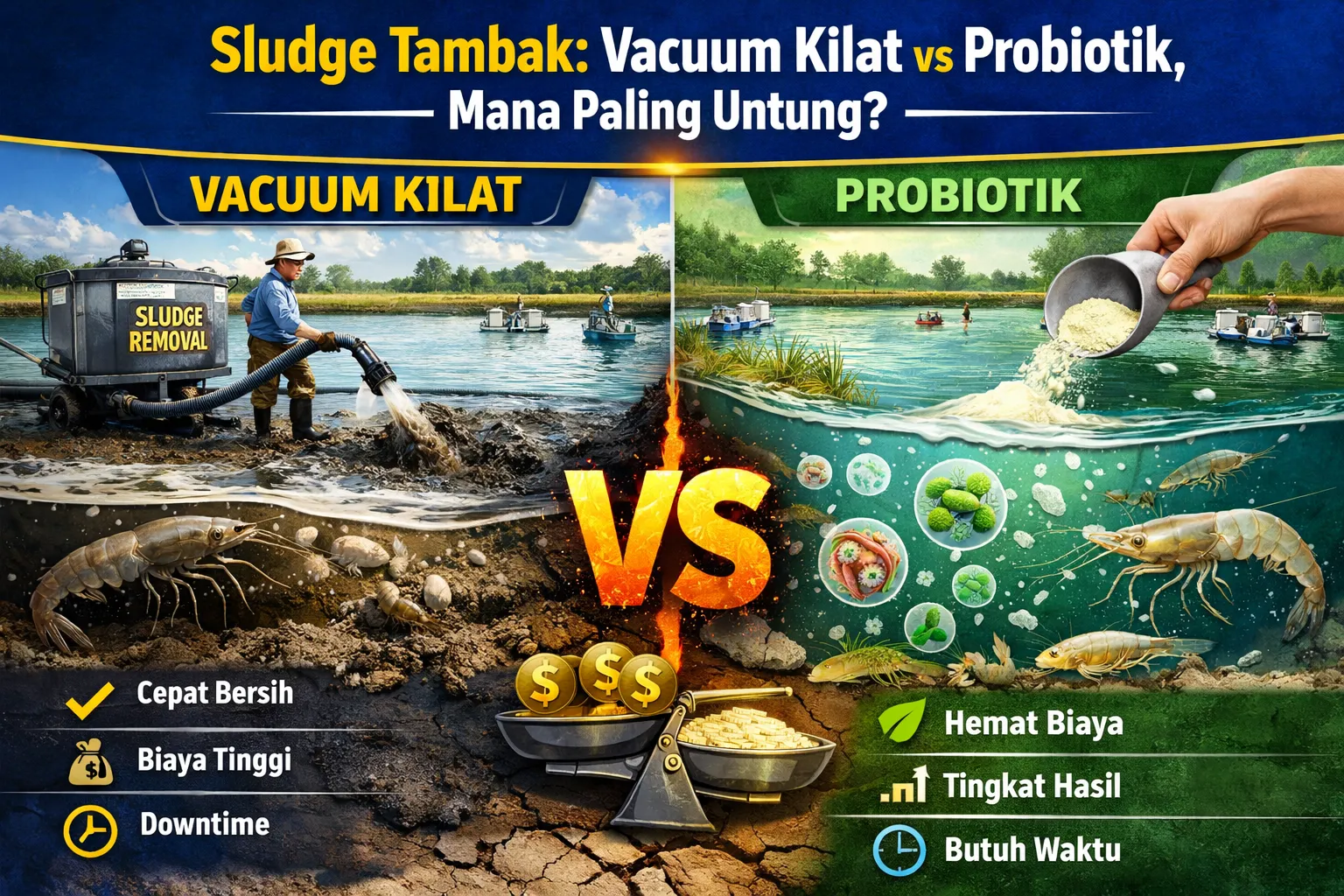
Removal efficiency differs. Physical methods can remove more than 90% of settled solids in one operation. The jet-equipped system reached up to 99.7%. Probiotic dosing reduces organic buildup over weeks (agris.fao.org). Biologicals work on chemistry and stress. After probiotic treatment, NH₃, nitrite and Vibrio drop a lot, and pH/DO rise (pmc.ncbi.nlm.nih.gov).
On production, the sludge‑collector ponds showed slightly higher survival‑adjusted yield (~3.833 kg vs 3.731 kg) (researchgate.net). Biological treatment has logged multi‑hundred‑kg harvest margins in controlled settings (link.springer.com). Even smaller percentage bumps in survival or daily growth multiply over time and acreage.
Water quality improves in different ways. Physical removal leaves the water close to clean after cleaning (see the very low TAN/TSS in [14]). Probiotics give better averages (lower TSS, TAN, nitrite, nitrate) across the crop. However, they usually need strong aeration and some waste substrate (for example molasses) to work well (researchgate.net). In practice, many farms use a hybrid approach. They dose probiotics during culture to keep sludge and nitrogen in check, and they drain or dredge less often (for example at end of crop or when sludge is visible).
Cost–benefit analysis of proactive dosing
Costs for bioremediation products vary by formulation and application rate. They usually run from the low tens to hundreds of USD per hectare per application cycle. Add any carbon source (for example molasses) and a little labor for dosing. These are extra costs while ponds remain productive.
Physical removal costs add up in a different way. Manual draining, drying and dredging of a 1 ha pond can cost a few hundred to over a thousand USD per pond, once electricity, pumping and sludge disposal are counted. The cleaning days also stop production. Automation can cut labor and pay back quickly (agris.fao.org), but the equipment costs a lot to buy.
Benefits from bioremediation often dominate. The 625 kg extra shrimp reported above equates to thousands of USD at market prices, and reviews point to 5–10% improvements in survival or feed conversion delivering similar advantages on multi‑ton crops, alongside fewer disease losses and lower treatment spend (link.springer.com) (pmc.ncbi.nlm.nih.gov). Cleaner ponds also make meeting effluent standards easier, potentially avoiding fines (jala.tech).
One case found that the revenue from a higher harvest was far more than the cost of the probiotic regimen (link.springer.com). A rule-of-thumb summary from field data: treating a 1 ha shrimp pond with compliant probiotics could cost about $100–200, but give an extra 300–600 kg shrimp. At $5–10/kg, that is $1,500–$6,000 more revenue, a 10–50× return on investment (link.springer.com) (pmc.ncbi.nlm.nih.gov). If sludge is left unmanaged, productivity drops and sooner or later urgent, disruptive dredging is needed.
Program design and compliance context
The evidence points to an integrated program: use bioremediation chemicals (probiotics/enzymes) continuously or periodically during the crop to suppress sludge formation, and supplement with targeted physical cleaning when thresholds are reached. For Indonesian pond managers, a modest budget allocation for quality probiotic products can reduce the frequency or intensity of costly dredging and help meet the country’s effluent standards (link.springer.com) (pmc.ncbi.nlm.nih.gov) (jala.tech).
For managers who standardise supplies, the options usually include nutrient supplements that are made to grow bacteria. These are in categories such as bacterial nutrients, and they are used with probiotics to keep performance steady across cycles. Each operation needs to set its own dosing schedule and choose its own manufacturers for local conditions. However, field studies report real gains from this approach.
Sources: peer‑reviewed studies, reviews and industry reports cited above on pond sludge, probiotics and bioremediation — including agris.fao.org, link.springer.com, pmc.ncbi.nlm.nih.gov, pmc.ncbi.nlm.nih.gov, mdpi.com and jala.tech. All figures and conclusions are drawn from those sources.