

Article
Textile Plants Are Driving Iron and Manganese to “Near‑Zero.” Here’s How They Get There
Industry: Textile | Process: Water_Softening_&_Treatment
Textile production runs on water, but iron (Fe) and manganese (Mn) turn that lifeblood into a liability fast. Even trace Fe/Mn catalyze unwanted dye oxidation or precipitate onto fabrics, leaving brown or black specks and stains on cloth and machinery (pmc.ncbi.nlm.nih.gov) (www.apparelsearch.com). The same metals foul equipment and filters—iron deposits accumulate in pipelines and boilers, reducing flow and pressure (pmc.ncbi.nlm.nih.gov) (www.orionwater.com).
That is why mills target far lower Fe/Mn than drinking-water aesthetics need. The U.S. EPA’s secondary maximum contaminant levels (non-enforceable aesthetic guidelines) are 0.3 mg/L for iron and 0.05 mg/L for manganese (www.orionwater.com). However, textile operations usually push for <0.1 mg/L, or even <0.01 mg/L, to avoid any discoloration or build-up. Batik mills in Indonesia use about 200 m³ of water per tonne of fabric, and about 90% of it becomes wastewater. Therefore dissolved metals multiply the risk across large recycle volumes (www.researchgate.net). Untreated Fe/Mn can even darken nearby rivers, for example the Jenes River near Surakarta (www.researchgate.net).
Oxidation and media filtration
The conventional playbook oxidizes dissolved Fe²⁺/Mn²⁺ into insoluble oxides and then filters them. Common oxidants include chlorine (Cl₂ or hypochlorite), potassium permanganate (KMnO₄), ozone, or simple aeration. Degremont’s SUEZ handbook cites aeration-filtration for groundwater up to ~7 mg/L Fe (www.suezwaterhandbook.com). “Oxidizing media” filters, such as manganese-oxide-coated greensand or catalytic zeolites, are applied at ~15–25 mg/L combined Fe+Mn (www.orionwater.com). On the media side, textile plants usually specify manganese greensand. A representative option is manganese greensand media.
Real performance backs this approach. An Iranian waterworks used aeration, chlorination and rapid sand filtration. It reported raw Fe up to about 6.7 mg/L reduced to about 1.0 mg/L. Mean iron fell from 0.93 to 0.18 mg/L (about 80% removal). Manganese fell from 0.24 to 0.105 mg/L (about 55% removal), with raw up to about 0.74→0.67 mg/L (pmc.ncbi.nlm.nih.gov). The highest Fe/Mn drop in that study came from pre‑chlorination plus aeration (“Module 1”) (pmc.ncbi.nlm.nih.gov).
The operating ranges and limits are well defined. With enough oxidant and contact time, oxidation plus filtration usually brings Fe below about 0.1–0.5 mg/L and Mn below about 0.01–0.1 mg/L. Chlorination is cheap (about $350–400/ton Cl₂/NaOCl) and also disinfects. However, it needs careful dosing, and you need to watch trihalomethanes where organics are present (nepis.epa.gov). KMnO₄ is very strong and avoids disinfection by‑products. However, it costs about 7–8× more (about $2,700/ton vs $350–400/ton for Cl₂) (nepis.epa.gov). Aeration adds no chemicals. However, it is slower for Mn, and rapid Mn oxidation usually needs pH about 9.5 (water.mecc.edu). Ozone is powerful, but it uses a lot of energy and does not last long. Chemical control is usually automated. Textile plants pair oxidant feed with an accurate dosing pump.
Filtration hardware matters. Dual‑media filters (anthracite over sand) hold more load (2100+ g Fe per m² filter area) than monochamber beds. They still need periodic backwash (www.suezwaterhandbook.com). Plants usually specify anthracite media over silica sand to build those dual beds. If designed properly, oxidation + filtration handles tens of mg/L combined Fe/Mn (www.orionwater.com) and usually gives 0.01–0.1 mg/L in the effluent.
Ion exchange softening and polishing (IX)
Ion exchange (IX, resin that swaps ions in water) can polish to very low metals, but only under favourable feeds. Standard salt-regenerated softening resins (strong-acid cation) swap Na⁺ for Fe²⁺/Mn²⁺ along with Ca/Mg hardness. In practice, softeners remove only a few mg/L Fe/Mn. Above about 2–5 mg/L combined, precipitates foul the resin (www.orionwater.com) (www.apparelsearch.com). One laundry-extension fact sheet is blunt. Soluble Fe below 3 mg/L can go to a softener. 3–10 mg/L needs a greensand/oxidizing filter. Above 10 mg/L needs a chlorination/filter system (www.apparelsearch.com). Where softening is viable, IX can drive residuals to “near zero” (usually parts per billion) until breakthrough.
Some plants integrate water softening into dye and boiler make‑up. The equipment stack is familiar: a softener built around a strong‑acid cation resin, or complete ion exchange systems when polishing is mandatory.
Chelating and fibrous resins
To push capacity, chelating resins (functional groups such as iminodiacetate or phosphonate) bind Fe and heavy metals strongly. Costs go up accordingly. Chelating cation resins run roughly $330–600 per ft³ (≈$10–20/L). Ordinary cation resin runs about $70–120/ft³ (www.climate-policy-watcher.org). Manufacturers have also promoted fibrous IX (for example PANION®) for faster kinetics and easier regeneration. Literature advertises removal of Fe, Mn, and other heavy metals while leaving alkalinity intact (imt-filter.com). These remain emerging technologies with limited commercial data.
Constraints, regeneration, and pH effects
IX systems need very clean feed. Silica, organics or biological iron (slime-forming bacteria) foul the resin. Regeneration with brine or acid produces waste brine that carries the metals. Also, the throughput of the resin is limited. 1 ft³ of softening resin can treat about 5–10 kg of hardness plus a few kg of iron before regeneration (estimates vary). The chemistry matters too. If Fe²⁺ oxidizes to Fe³⁺ or complexes with organics, it can precipitate or pass through the resin. In practice, softening IX is only used if Fe+Mn < ~3–5 mg/L (www.orionwater.com) (www.apparelsearch.com).
Method metrics and cost notes
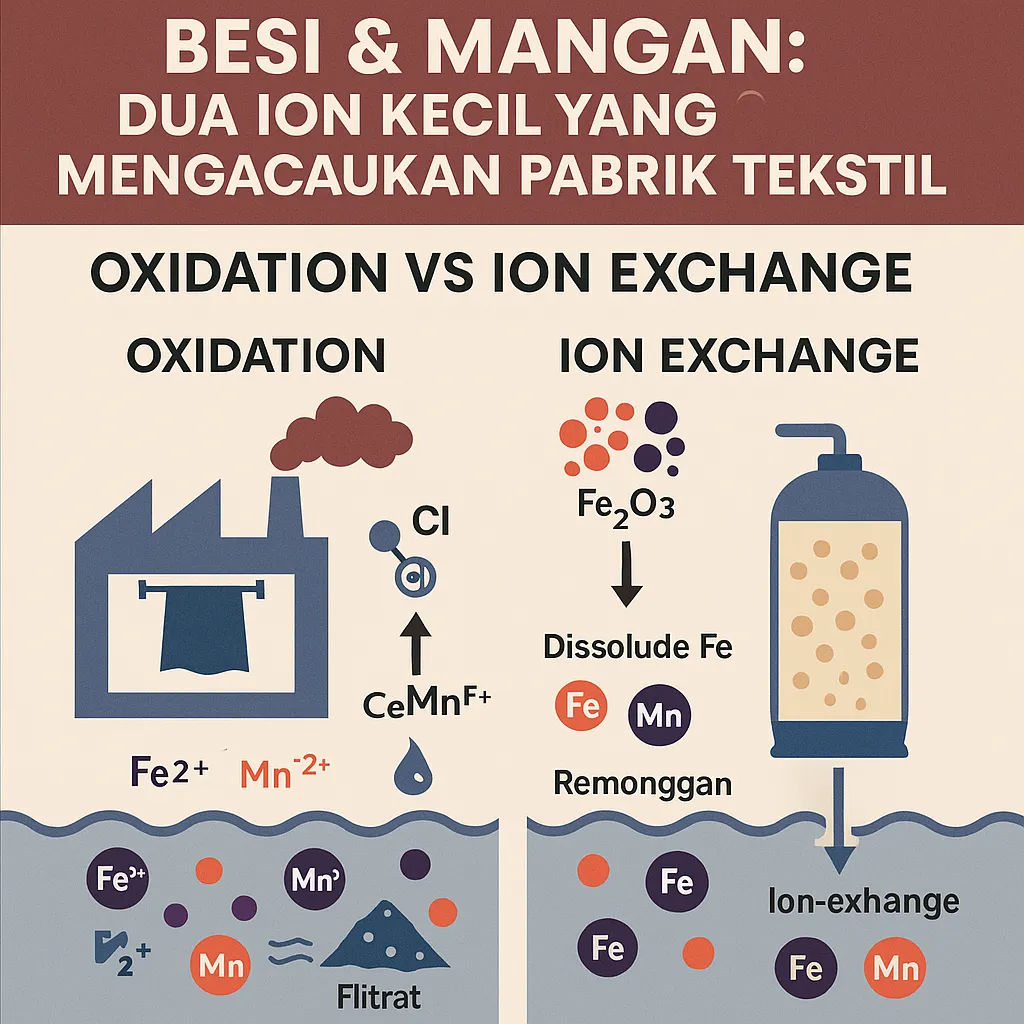
- Oxidation + filtration: Works for high loads (up to about 20+ mg/L combined Fe+Mn) (www.orionwater.com). Typical effluent quality: Fe about 0.01–0.2 mg/L, Mn about 0.01–0.1 mg/L. Key costs: chemicals at Cl₂ about $0.40/kg and KMnO₄ about $2.70/kg, media about $10–$30/m³, and labor for backwash (nepis.epa.gov). Notes: very effective for gross load. It produces sludge and backwash residuals. Careful dosing is needed.
- Water softener (Na⁺ IX): Best when Fe+Mn is 2–5 mg/L or less in soluble form (www.orionwater.com) (www.apparelsearch.com). Effluent can be near‑zero. Designs target <0.1 mg/L. Costs: resin about $70–120/ft³ (www.climate-policy-watcher.org), and NaCl brine about 10 g NaCl/gal regeneration. Notes: limited capacity. Precipitates foul it. It is usually chosen where hardness control is also needed.
- Chelating/fibrous IX: Suited to moderate‑to‑high heavy metals (per resin spec). It delivers trace‑to‑ppm levels, essentially zero for targeted ions. Costs: chelating resin about $10–20/L (≈$330–600/ft³) with regenerant acids and salts (www.climate-policy-watcher.org). Notes: very high capital cost. It is used when needed, for example for precious‑metal recovery.
- Zeolite/greensand filter: Works at medium loads (about 5–15 mg/L). It achieves Fe/Mn about <0.1–0.3 mg/L. Media costs about $300–600/ft³. Notes: manganese greensand acts like catalytic IX and needs periodic KMnO₄ recharge. Representative media include greensand.
Why ultra‑low Fe/Mn matters in textiles
Even “secondary” guideline levels cause problems on fabric. Iron in water, even at ≤0.3 mg/L, gives textiles a brown tint and can redeposit during heating or agitation (pmc.ncbi.nlm.nih.gov) (www.apparelsearch.com). Manganese leaves black specks and affects dye color development. A U.S. laundry-care bulletin warns that water with any appreciable iron “causes ugly discoloration and stains” on laundered items (www.apparelsearch.com). Keeping Fe/Mn <0.05 mg/L prevents these cosmetic and quality problems. Iron also corrodes. It causes pitting and sludge in boilers and heaters, and this drives downtime and maintenance costs.
In Indonesia, effluent regulations (Permen LHK) focus mostly on organics (COD, BOD) and tensioning elements. However, mills are expected to avoid any “brown” process water. Good housekeeping Common Institute (GCI) guidelines for apparel factories, and many Western brand compliance standards, effectively mandate near‑zero metals in cooling/process water. Therefore the design choice is pragmatic: oxidation/filtration first (local supplies usually exceed 1 mg/L Fe/Mn), then IX polish if needed. A typical dyehouse may chlorinate and filter river water to ≤0.1 mg/L Fe (pmc.ncbi.nlm.nih.gov), then run a polishing exchange column to drop trace ions. Each option has trade‑offs: oxidation consumes chemicals but handles bulk load. Ion exchange meets tight specs, but it needs resin and regeneration costs.
Bottom line on the hybrid train
Textile mills must bring Fe and Mn down to very low concentrations, usually ≪0.1 mg/L, to protect product quality and equipment. Oxidation systems remove ≥80–90% of dissolved iron (pmc.ncbi.nlm.nih.gov). Ion exchange can strip the rest to “non‑detect” levels (sub‑ppb) when the feed is low. The cost points to a split. Chlorine and aeration carry low operating cost ($0.3–0.4/kg Cl₂, also framed as $350–400/ton) (nepis.epa.gov). IX needs capital for resin ($3–20/L depending on type) (www.climate-policy-watcher.org) and ongoing regeneration. For most dyehouses, the hybrid step, oxidize and filter, then polish, gives the reliability and ultra‑low metals that modern brands demand.